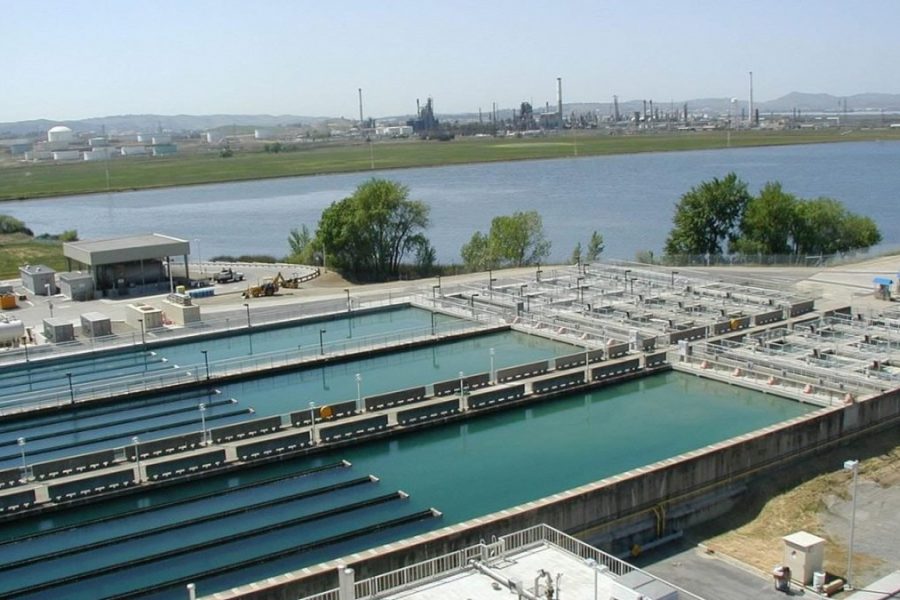
Moroccan Minister of Equipment and Water, Nizar Baraka, expressed the government’s willingness to accelerate the development of non-conventional water resources, including the process related to the desalination of sea water.
During his participation in the second edition of the Business Dialogue organized by the CGEM in partnership with the Moroccan Coalition for Water (COALMA), this Friday, May 13 in Marrakech, Baraka considered that this choice was justified by « the need to secure the needs of people living in coastal cities, but to also provide enough water for inland regions. »
Baraka emphasized the importance of seawater desalination plants, as his ministry considered it a highly promising alternative to conventional water sources.
The Official listed various desalination projects currently underway, namely one in Casablanca with a capacity of 300 million m3 per year, which will release a significant amount of water currently recovered from the Al Massira dam, which will benefit the region of Marrakech and Tensift.
The president of the CGEM, Chakib Alj, highlighted the efforts of Morocco to address the challenges of water, calling for greater involvement of all stakeholders, the private sector in particular.
Alj specified that, due to the geographical location of the Kingdom, many water challenges arise, adding that « to face these challenges, urgent choices and strategic decisions must be taken. »
« This is a shared responsibility, » he said, while advocating for the use of non-conventional waters through significant research and development of new solutions for the mobilization of water resources through sustainable seawater desalination technologies using renewable energy, and reusing treated wastewater.
According to Alj, “all of this can be achieved through water sector governance that ensures the upstream involvement of the private sector and other stakeholders in planning policies, or the use of innovative financing methods through public-private partnerships or purely private investment for certain projects.
In addition, in a country where agriculture occupies a prominent place, solutions for optimized water use are developing significantly through agritech and water-technology.
For his part, Minister of Industry and Trade Ryad Mezzour said that the lower cost of renewable energy could contribute to the competitiveness of water desalination processes.
Morocco currently has a production capacity of renewable energy at a cost among the most competitive in the world, he noted.
According to Mezzour, the current challenge is to devote part of this production to the desalination of water. The Minister also reported a proactive plan for water treatment that targets active industrial areas and polluting and considers moving the polluting activities relating to leather to areas offering the possibility of treating wastewater according to international standards.
This meeting aims to discuss ways to strengthen water security in Morocco by integrating the private sector upstream in the development of strategies and using diversified solutions including the use of non-conventional water resources.
The event was also an opportunity to discuss the role of public-private partnerships and businesses in promoting rational and reasoned uses of this vital resource, its preservation, and its development through research, innovation, and investment.






add your comment
Terms of publication : Not to offend the writer, people, sacred things, or attack religions or the divine self, and refrain from racist incitement and insults.