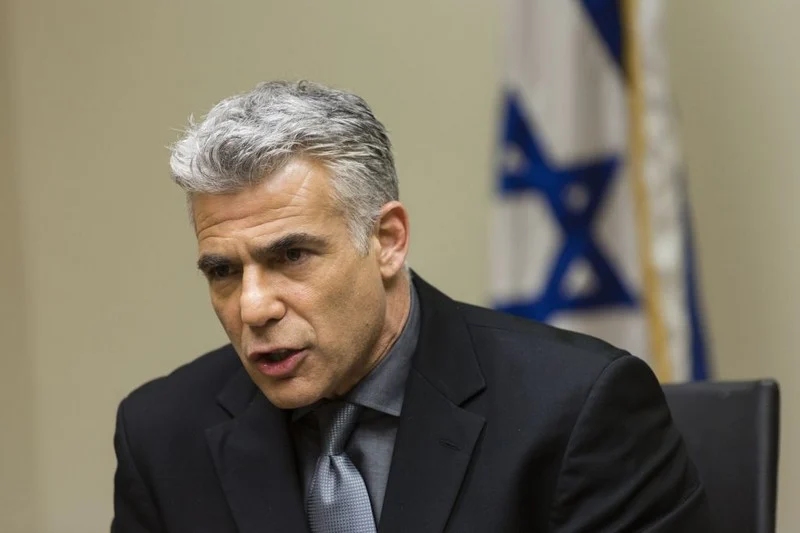
Israeli Foreign Affairs Minister Yair Lapid declared that his country welcomes Spain’s official position to endorse the Moroccan Plan of Autonomy for the Sahara.
“The Spanish position in favor of the autonomy plan in the Sahara represents a positive development in the conflict,” said the Israeli official Monday morning at a press briefing,
Lapid added, “What we are trying to build is a united front committed to peace, prosperity, and stability that will work to confront the attacks against Bahrain and the United Arab Emirates, the terrorist attacks against Israel, and attempts to weaken Moroccan sovereignty and its territorial integrity.”
This is the first public position of Lapid concerning the Moroccan sovereignty that follows Spain’s official support, on March 18, of the Moroccan autonomy initiative.
International actors, including the United Nations and the European Council instances, approved Spain’s position to regard the Moroccan plan as the most “credible” and “realistic” to resolve the conflict in Western Sahara.
The same Israeli official stated to the press in light of the Negev Summit, which kicked off yesterday, that “the Negev summit sends a strong message to the extremist forces led by Iran, which are trying to destabilize the region.”
Head of Israeli diplomacy Yair Lapid welcomed yesterday 27, United States of America’s Secretary of State Antony Blinken, convening also foreign ministers of Egypt, the United Arab Emirates (UAE), Bahrain, and Morocco, represented by Moroccan Foreign Affairs Minister Nasser Bourita.
The summit unveiled a significant realignment of alliances in the Middle East and North Africa (MENA) region, driven by shared interests and mutual concerns.
“We are determined to achieve prosperity and peace in this region and beyond,” stressed Lapid.
“Morocco participated in the Israeli ‘cannabis summit’ and holds the stake of strengthening relations with Tel Aviv and engaging in a U.S. commitment to achieve peace in the region and deal with Iranian threats, despite the fact that there are contradictions in positions regarding the ‘Ukrainian crisis,'” voiced Lapid to highlight the strong ties between Morocco, the U.S., and Israel.
In addition, the officials discussed several other matters, including the nuclear threats of Iran and the challenges of the Israeli-Palestinian conflict.
In this regard, the Israeli foreign minister stated that his country, the United States, and the other Arab participating countries assessed how to coordinate in the face of common security threats, particularly from Iran, considered as the main challenge.
However, Lapid emphasized yesterday in a joint statement with U.S. official Blinken that their countries and Iran “Have a disagreement on the nuclear program and its consequences but are open to an open and honest dialogue.”
The participants also discussed the Israeli-Palestinian conflict while pressing Israel on the need to establish a sovereign Palestinian state.
On this occasion, Moroccan head of diplomacy Bourita reaffirmed Morocco’s “commitment to the two-state solution, within the framework of the 1967 agreement and borders, with East Jerusalem as the capital of the Palestinian state.”
“We are here to build a positive dynamic in the course of the Palestinian cause and defend our common values and interests,” he added, reiterating Morocco’s engagement to seek prosperity and peace between Palestine and Israel.
In the same context, Bourita condemned the terrorist attacks in the city of Hadera in Israel against Israeli police officers on Sunday night, expressing condolences and wishing sound recovery of the victims.
During the press conference this morning, PM Bourita had also hoped that the participants “will meet again in the same spirit in another Sahara,” opening perspectives of a potential meeting in the Moroccan Sahara.
On another note, leaks from Israeli newspapers reported that the officials also discussed the Ukraine-Russia crisis. The two protagonist countries are the leading grain suppliers to Egypt and other parts of the Middle East.
The leaks indicated that “the dinner meeting attended by Bourita yesterday was an opportunity for the U.S. secretary of state to discuss shared concerns about the war in Ukraine and encourage Washington’s Middle East allies to embrace efforts to isolate Russia.”






add your comment
Terms of publication : Not to offend the writer, people, sacred things, or attack religions or the divine self, and refrain from racist incitement and insults.