
In the aftermath of the COVID-19 crisis, growing tensions across the Middle East and North Africa (MENA) due to the Ukrainian crisis are alarming analysts and fueling the debate regarding the prospects of such developments.
Degrading conditions in many countries often indicate a sociopolitical dysfunction that, for so many, is an early sign of a significant potential crisis.
The current international economic crisis, especially given the flagrant increase in prices, is pressuring domestic economies in the MENA region, raising concerns and questions.
Growing tensions suggest a potential regional crisis
Underdevelopment inflation and high prices, far from encouraging the formation of new savings and raising the level of productivity, lead to profound imbalances and generates real economic stagnation.
In many cases, these economic indicators were behind some of the violent social movements that swept several countries throughout history.
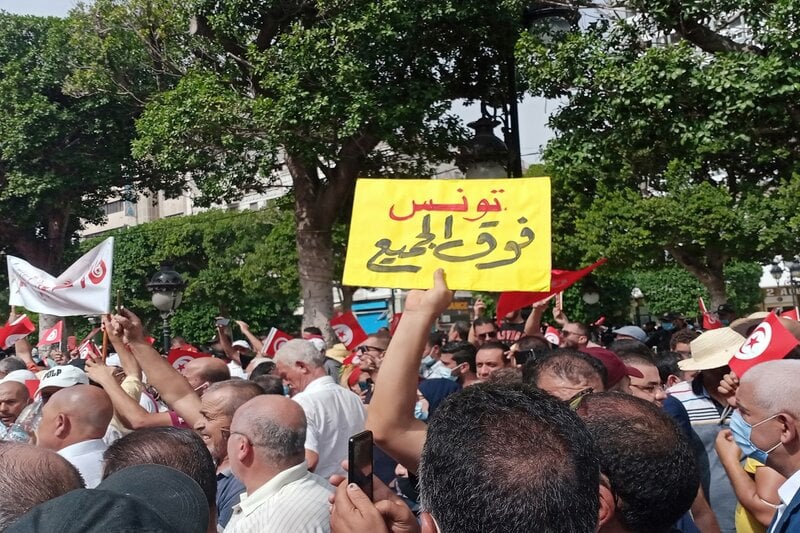
Eleven years ago, Mohamed Bouazizi, a Tunisian citizen, set fire to his body in Sidi Bouzid in Tunisia in protest against local authorities that confiscated his merchandise vehicle, triggering a sudden wave of protests in the country, which rapidly spread to other Arab countries.
Protests against corruption, unemployment, and degrading socioeconomic conditions were the main drivers behind this historic event.
In the wake of the ramifications of the current Ukrainian/Russian crisis suffocating an already ill international economy, especially in the Arab World and the MENA regions, voices tackling an eventual episode of large mass protests do not pass unnoticed.
When asked by Hespress EN about whether it is possible to foresee a scenario of protests at the image of 2008 or 2011 dynamics, Mohammed Masbah, president of the Moroccan Institute for Policy Analysis, noted that the current conditions are not very promising.
“I think problems of 2011 have not been tackled, and there is always a probability that the drivers of 2011 protests can trigger protests,” he stated.
Masbah added, “With the current situation, particularly in the light of the Ukrainian/Russian crisis, there is a high level of challenges.”
Discussing these challenges, Masbah explained, “First of all, there is a structural issue with constantly rising prices, threatening food supplies worldwide. Food supplies in countries like Egypt imports around 70% of their wheat from Russia and Ukraine”.
In this case, it will be too difficult to ensure food supplies in many countries, which may continue to be exacerbated with time. With no wheat, no bread available in the market, it might be very challenging for the populations of many countries,” he illustrated.
Note that bread is an essential element in the MENA region, frequently consumed daily with many meals. An increase in bread prices has been one of the main drivers of sociopolitical unrest, as was the case in Egypt in 1977 or in Morocco in 1981.
One famous slogan chanted during the Arab Spring manifestations was “bread, freedom, and social justice.”
Continuing describing the main issues Masbah estimates on the international market, which threaten sociopolitical instability across the MENA region, he stated, “The second challenge is the increase in prices of energy sources, like oil, impacting hence energy-related sectors such as industries and transportations.”
“This may as well increase the frustration of the citizens. The ground for frustration and protest exists with bad governance and corruption. There is a high probability of instability in the region through the MENA region,” He added.
“Thirdly, there are severe episodes of drought in some countries, especially Morocco. Water scarcity will be a real nightmare for the political regime to secure this water,” Continued Masbah.
In addition to these main structural challenges, Masbah added, “On another level, we can also speak of issues such as remittances sent from European countries that may decrease, another scenario we should take into consideration.”
“I think the right question to ask is whether this time it will be peaceful, as it was in Morocco in 2011, or is it going to be violent,” wondered the researcher.
If the sharp increase of several products on the international market is not the most sensitive aspect of the consequences of this crisis, it is maybe the most prominent.
The crisis and the rising prices
Following the recent developments of the Russian war on Ukraine, soaring prices of essential commodities on the international market immediately began to reach high levels.
Mars 5, 2022, the International Monetary Fund (IMF) warned that the conflict in Ukraine would have “devastating” economic consequences worldwide.
Adding up to production and consumption prices’ inflation experienced in the wake of the COVID-19 crisis, the inflationary tendencies following the Ukrainian crisis threatens economic instability worldwide, including at the level of vital sectors such as agriculture and worldwide food supply.
To measure the extent of the impact of the crisis’s consequences on the international market of agricultural supplies, and specifically, in the MENA region, it is to note that a considerable part of the Russian/economies depends on the export of raw materials.
Russia is the 11th largest country in the gross domestic product (GDP). It is considerable power in producing and exporting energy as it is a leading exporter of oil, natural gas, and metals.
As such, raw materials make up about 60% of Russian exports. It is the largest producer of wheat, a vital commodity for food security worldwide. Ukraine is also a significant exporter of wheat, ranking as the fifth exporter internationally. It is the World’s largest producer of corn, another essential commodity.
With expected cuts of Russian exports, a decrease in the quantities of offered products on the international markets, and the instability of economic value and distribution chains, prices are likely to continue spiking.
The soaring inflation is, in this respect, expected to weigh on the purchasing power of households, in the wake of inflationary dynamics, the ability of households to buy goods and services with their income decreases, leading to social and economic dysfunctionalities.
Rises in prices during the pandemic, in light of global shutdowns, gravely affected households’ purchasing powers. If inflation is higher than the increase in household income, purchasing power eventually declines. The additional inflation resulting from the Ukrainian crisis would predictably aggravate this trend.
Another perspective
While many analysts and researchers suggest that the current socioeconomic conditions are rising concerns, others argue that there are reasons to worry, but nothing is unpredictable.
Talking to Hespress EN, university professor Hicham Attouch stated that “First of all, there is no resemblance between the two facts I would qualify as ‘historical.’ The Arab Spring had its specific context, then the Russian/Ukrainian crisis, of course counting the other events that preceded this crisis, has another.”
Diving into the analysis of this thematic, the professor explained that “In the context of the Arab Spring, the movements were horizontal and transversal. The common denominator belonged to Arab countries because it was not the whole MENA area as we say, it was only the Arab countries of the MENA zone.”
“The second denominator was the socioeconomic frustration that has led to a rather particular situation in these countries. Eventually, the consequences have also been quite different from one country to another,” he continued.
Concerning the current crisis, Attouch argued that “Given it does not have the same context, we cannot tackle the current crisis in a transversal way, since the transmission of this crisis is not the same from one country to another. Although everyone will suffer, everyone will suffer in their way”.
The university professor added in this regard to illustrate how each country will be impacted individually, “The MENA economies are not sufficiently connected to be able to speak of a bloc. Rather, they are individual countries, impacted differently by the current international crisis right after the COVID-19 pandemic”.
Giving example of this divergence, Attouch noted that “Morocco, for instance, will be directly impacted through the international exchanges with the two belligerents in this crisis and Europe.”
“Europe is one of the main partners of Morocco and one that is, in fact, dependent on Russia and Ukraine to some extent. As such, Morocco will suffer a bit of a delayed impact from the gloom that Europe is experiencing, which is not forcibly the case for the Algerian neighbor for instance,” he also noted.
Attouch continued, “One can even say that, in the opposite case, Algeria may benefit from this affair with increasing prices of hydro fuels. While, if we talk about Tunisia, it is almost a similar design as Morocco with some small differences in terms of size and other specificities.”
While the context of the current international socioeconomic constraints is different from past experiences, demonstrations due to increasing prices have already begun in countries such as Sudan, Egypt, or Iraq.
In the light of these dynamics, it is essential to adopt measures that can effectively tackle the growing concerns of populations in the region, preventing sociopolitical outbursts whether on a domestic basis or the region’s level.


add your comment
Terms of publication : Not to offend the writer, people, sacred things, or attack religions or the divine self, and refrain from racist incitement and insults.