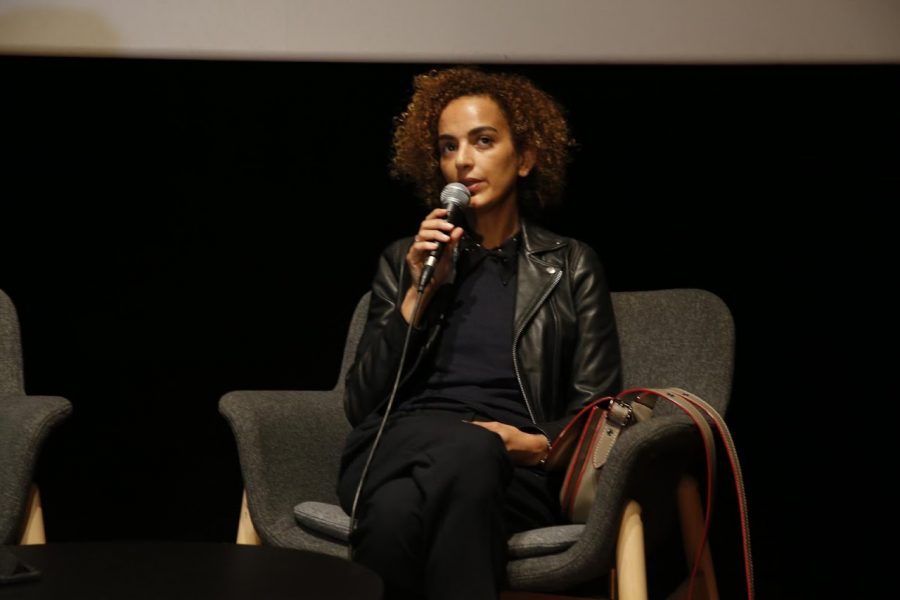
The French-Moroccan author Leila Slimani has embarked on a Moroccan tour, to promote her new book, “Watch Us Dance,” a sequel to her acclaimed novel, “The Land Of Others.”
Slimani is a much-celebrated author both in France and Morocco, conference halls and auditoriums were packed full of fans who came to hear her speak on her new novel in Rabat, Casablanca, and Tangier.
Sara H, an avid reader, and self-described “Slimani minion” says the author’s writings, particularly her “Sex and Lies” anthology, allowed her to “reinforce feminists stances and strengthen militant ideals,” by feeling “seen and heard” and experiencing a deep sense of “sisterhood” with the women who’s stories Slimani reports.
“This is a book that every Moroccan man and woman should read,” Sara tells Hespress EN in an interview, adding that “Leila Slimani exposes a multitude of lived realities Moroccan women experience every day, but that no one dares talk about so freely.”
Slimani’s journalistic background and accessible writing made her a true success in both countries, since she published her first novel back in 2014, “In the Ogre’s Garden.”
The book explored female sexual addiction and peaked the interest of critics and prominent individuals from the francophone writing scene.
Her second novel, “Lullaby” won the prestigious 2016 Goncourt Prize, as well as the Grand Elle Readers’ Prize in 2017.
But to many readers, Slimani’s writings and her status as a public figure are “out of touch.”
In “The Land of Others,” the author explores a bi-racial love story between a Moroccan man and a French woman, Mathilde, in a Morrocco still under the French protectorate.
Mathilde was inspired by Slimani’s own grandmother, and is described as “a feminist, brave and passionate woman unafraid to defy patriarchal norms.”
The character, however, was at the center of significant discourse within the reader community in Morocco, with many describing Mathilde as “racist,” an embodiment of “colonial clichés,” while the book was seen as “displaying a strongly negative perception of Moroccans.”
Among the critical reviewers is Ilham Essalih, a Belgian-Moroccan PhD researcher in Postcolonial Literature at the University of London, based in Brussels, and a book reviewer, who spoke to Hespress EN about the “bad taste” Slimani’s book left her with.
According to Essalih, “the Mathilde character was unable to find humanity in the indigenous population and most particularly in Moroccan men,” adding that the author “disdainfully described them as savage and questioned whether they even ‘have an inner life at all’.”
The landscape to Mathilde was “dark and hostile,” says Ilham, pointing to Slimani’s descriptions of the food as “disgusting,” mentalities “backward” and traditions being “cruel and sickening.”
Mathilde’s monologues were much more forgiving towards her French compatriotes, which stood in stark contrast to her depictions of the Moroccans in her orbit.
When asked about the criticisms towards “the country of others,” Sara H says that “Mathilde’s opinion can’t be held against Slimani,” adding that she is, after all, a fictional character, and that maybe “the contrast and foreign gaze on Moroccan society at the time is what the writer wanted to explore and highlight.”
Only Mathilde’s reflections have left many readers “unable to enjoy the story.” Such was the case for Imane A, who told Hespress EN that “all the book does is project Mathilde’s hatred of the local culture and religion.”
“It felt like this book was written for a French audience, presenting it with a piece of work that described an ‘exotic culture’ and promoted fear and criticism of the ‘other’,” adds Imane.
While taking into account Leila Slimani’s significant platform, audience and credibility as a prominent French-Moroccan activist and literary figure, such literary endeavors with little supporting factual context can be detrimental to Moroccans.
Ian Borim, a history academic of literary production in the Greater Maghreb in Columbia University says that “Slimani is largely out of touch with Moroccan society, and what gets in the way is her orientation towards France and French speakers.”
Borim told Hespress EN that “Slimani is very different from someone like Fatima Mernissi or Aicha Chenna, for whom feminist activism is engrained in a more natural and holistic understanding of Moroccan society, and who work within that context.”
Slimani’s approach is “limited,” says the scholar, mainly due to her deeply rooted French orientation, which makes her work often seem as “trying to impose imported French mores on Moroccan society,” with little to no consideration to the cultural identity and realities of the country.
The award-winning author’s talent is never in question, as most of the interviewees acknowledge, in addition to her ability to evoke important questions pertaining to Moroccan society and the new wave feminism in the kingdom, “but the conversation needs to raise measured and appropriate critiques of her messaging and activism,” says Borim.
“I would like to see her present a more balanced and fair view of our culture and society,” says Imane, adding that so far, “her work barely resonates with Moroccans.”
Leila Slimani herself acknowledged such criticisms, as she told The Guardian back in July 2021, “when people in Morocco tell me I’m just Francophone bourgeois, I want to tell them to read my book and they’ll understand it’s more complicated than that.”
Hailed as one of the most prominent feminist activists in Morocco for her writing about women’s sexuality and her stances in regards to Moroccan individual freedom struggles, Slimani seems to alienate a large portion of the Moroccan audience that is becoming increasingly more aware of non-inclusive, euro-centric feminist struggles.
Her writings “sound a lot like the pervasive kind of feminism that I would describe as a white, specifically French, colonialist, Islamophobic and racist feminism, often co-opted by Moroccan (and more broadly, postcolonial) elites,” Essalih tells Hespress EN.
To the PhD candidate, Slimani’s writing “doesn’t represent Maghrebi/Muslim feminism, instead, it represents a very bourgeois feminism that mostly doesn’t resonate with the realities of Moroccan women and can instead be very harmful.”
“It is unable to take into consideration the trials and difficulties of Moroccan and Maghrebi women because it cannot transcend the notion of a very secular and one-dimensional view of the world in which Western ‘reason’ is superior and any other philosophical consideration is ridiculed,” explains the academic.
Leila Slimani’s nonfiction work, in addition to her activism in Morocco within the “Moroccan Outlaws” movement, has undeniably helped further the discourse on women’s rights in the country, while her firm stance for the respect of Muslim veiled women in France also helped shed light on the necessary respect of women’s choices despite being opposed to the Hijab.
But in a world where discriminations are ripe and on full display against people of color as a whole, and Muslim women, in particular, the brand of “ready-to-go” white feminism is largely being questioned by citizens of the global South, who despite recognizing the efforts of many intellectuals, are continuing to ask for more from their compatriots who have been given a platform.





add your comment
Terms of publication : Not to offend the writer, people, sacred things, or attack religions or the divine self, and refrain from racist incitement and insults.