
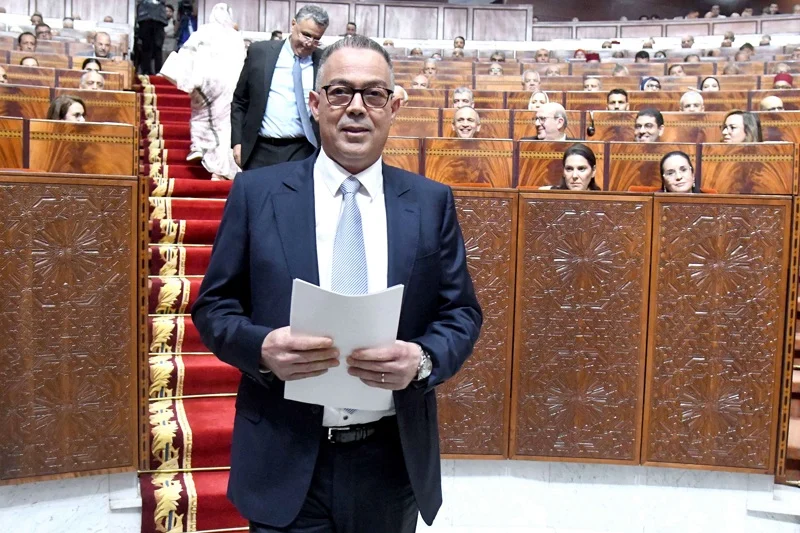
The Minister of Equipment and Water, Nizar Baraka, said Tuesday in Rabat, that the dams in the Kingdom have reached, at the end of February, about 5.3 billion cubic meters (m3), a filling rate of about 32.7% against 49.1% at the same period last year.
In a presentation before the Committee on Infrastructure, Energy, Mining and Environment at the House of Representatives on “water stress and emergency measures for water supply”, he assured that the current dams will supply in normal conditions all major cities, with the exception of urban areas under the water basins of Moulouya, Oum Er Rbia, Tensifet and Guir-Ziz-Rheris, which cities could, according to him, experience some difficulties in their supply because of the low reserves of dams based on the said basins at present.
Faced with this situation, the Minister reported the development of several agreements with all stakeholders to implement a battery of emergency measures to ensure without any disruption the supply of drinking water in all areas of these basins, and this, at a cost of 2.42 billion dirhams including MAD 1.318 bln for the Moulouya basin, MAD 202 mln for Oum Er Rbia and 522 million dirhams for Tensifet.
Regarding the evolution of the situation in the water basins, Baraka said that the rate of rainfall recorded at the end of February is down compared to the same period last year, being between 30 and 50% in the basins Guir-Ziz-Rheris and Draa Oued Noun and between 60 to 70% in the basins of Loukous, Bouregrag and Sakia El Hamra-Oued Eddaheb and between 71 to 80% in the basins Sub-Massa, Tensifet, Oum Er Rbia and Moulouya.
He added that the total volume of mobilization of water resources recorded in all dams in the Kingdom amounted to 732 million m3 during the period from September 1, 2021 to February 28, a deficit of about 89% compared to the annual average.
He noted that the current rate is less than 33% compared to the periods of drought in the 80s and 90s, noting that Morocco is experiencing recurring periods of acute drought as it had been the case during those years when the rural world and agricultural activities had been severely impacted.
To address the difficult water in some regions of Morocco, the Minister stressed that his department, in coordination with all stakeholders, has taken a battery of urgent measures to ensure the supply of drinking water.
He cited, in this sense, the establishment of monitoring cells in all provinces and prefectures affected by water shortages, the acceleration of work to supply rural centers and douars through a sustainable water system under the national program of drinking water supply and irrigation 2020-2027, as well as the strengthening of the exploration of groundwater, in addition to saving water and the fight against losses, especially in the drainage and distribution networks.
Baraka also mentioned the organization of awareness campaigns for rational management of water resources, the water supply of rural centers and remote villages affected by water stress through tours of tankers and this, as part of the national program to reduce territorial and social disparities, in addition to the use of treated wastewater in the irrigation of green spaces instead of drinking water.






add your comment
Terms of publication : Not to offend the writer, people, sacred things, or attack religions or the divine self, and refrain from racist incitement and insults.