
The Alternative Movement for Defense of Individual Freedoms (MALI), an organization dedicated to defending individuals’ freedom in Morocco, launched a new e-book/dictionary to address obsolete language on virginity that has been a source of societal and patriarchal pressure for women around the world.
In honor of “Arab Women’s Day” on February 1, the MALI movement released a campaign aimed at redefining terms used for women today that were designed centuries ago to refer to abuse directed toward women.
Virginity: A patriarchal myth
For centuries, the cultural understanding around “the hymen” has been used to determine a woman’s virginity, thus contributing to her social status as a woman. In many cultures today, a woman’s virginity is considered a sign of purity which usually determines a woman’s eligibility for marriage.
Testing for virginity using the hymen relies on the idea that seeing whether or not a woman’s hymen is visible can indicate whether she is a virgin or not.
Some virginity tests work on the premise that the physical presence, shape, or appearance of a hymen can indicate vaginal penetration.
Researchers Felicity Goodyear-Smith and Tannis Laidlaw examined medical findings that support or refute allegations of sexual penetration. The study, entitled “What is an ‘Intact’ Hymen? A Critique of the Literature,” concludes that it is impossible to determine if the hymen remains intact or not with respect to past sexual relations.
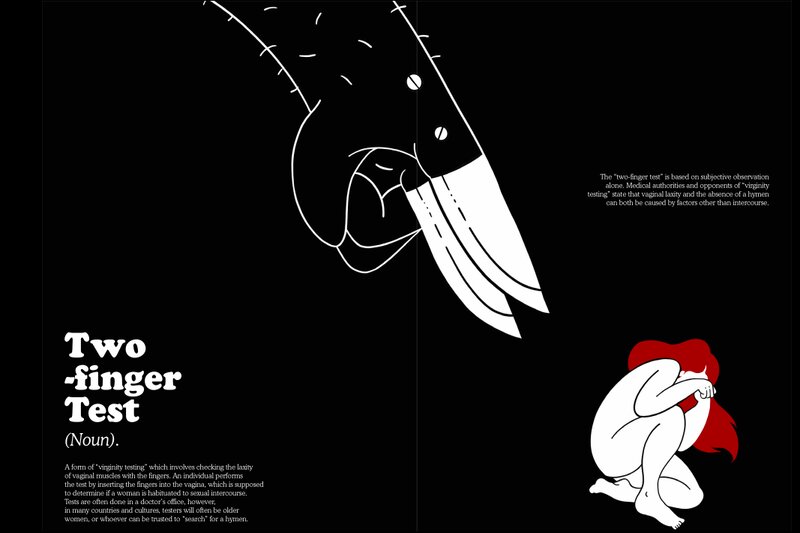
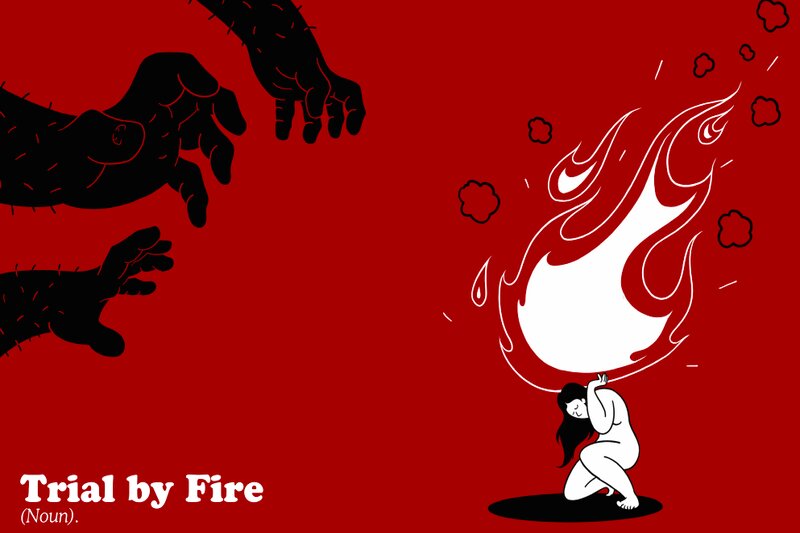
This campaign introduces a new lexicon to convey the horrors of virginity testing, a fight against sexual violence, and rape culture.
The book has beautiful illustrations and is presented as a children’s book, yet it challenges deeply controversial issues that society, especially women, still faces today.
“For centuries, many methods (some more dangerous than others) have been used as a means of testing a woman’s ‘virginity’ on and before her wedding night,” the introductory text of the book says.
“Some are still practiced today in Morocco and in other societies around the world. The mythical and fabricated idea of ’virginity’ has become a concept to measure a woman’s value based on a thin film, testimony, or bloodstain on a bedsheet. For the first time in history, we are striving to change these antiquated notions,” the text continues.
Like many countries around the world, virginity tests in Morocco are widely practiced. The concept of virginity, however, is a patriarchal myth. An examination of the female genitalia to determine whether a woman has had vaginal intercourse is not conclusive because there is no scientific evidence of a woman’s “virginity,” making it impossible to test.
The concept of virginity permeates almost every aspect of Moroccan society, regardless of region or social class. In many cases, virginity tests are part of the process. Doctors examine a woman and issue her a virginity certificate, proving that her hymen is still intact.
Traditions deeply rooted within a culture
In 2007, Reuters interviewed a 19-year old Moroccan student in France who, at the time, was planning to have her hymen resewn before returning back to Morocco to marry a man who, according to local custom, expects her to be a virgin.
“If I told my parents that I wasn’t a virgin, they would call me a liar, and as a result, everything I have ever done would be a lie (to them). I have to do this before I go home. If my mother ever found out about this, she would have a mental breakdown. I don’t want to have this surgery, but I don’t have any choice,” the Moroccan girl, who asked to remain anonymous, revealed to the news outlet.
Women around the world go through similar experiences in cultures that heavily rely on the concept of virginity to fulfill marriage eligibility requirements or to avoid shame and disapproval from their families.
Most of the time, traditions can be embedded so deeply within a culture that questioning them has never been considered.
“Patriarchal systems continue to control women’s bodies and sexuality, so we insist on continuing the fight for female sexual rights. However, when we shed light on such topics, raise awareness, and ignite an open conversation, even when it is an uncomfortable one, we can limit and prevent harmful practices,” the book highlights.
A virginity test to prove that a woman’s hymen is still intact is not conclusive as some women are born without it, or it may get torn during certain activities such as riding a horse or participating in certain sports.
According to the Moroccan Criminal Code, perpetrators who rape a virgin are punished more severely than those who rape non-virgins.
This implies that the worth of a woman lies between her thighs, on the basis of whether or not her hymen is intact. Moreover, rape is classified as a crime against the honor of a woman’s family, rather than against the integrity of the victim.
Several organizations such as the United Nations, UN Women, and the World Health Organization (WHO) have issued statements warning that no test – including those that include an examination of the hymen – can prove whether or not a woman has ever been sexually active.
“Virginity testing is a violation of the victim’s human rights and is associated with both immediate and long-term consequences that are detrimental to her physical, psychological and social well-being,” the WHO says in a book entitled, “Eliminating virginity testing: An interagency statement,” released in 2018.
Deconstructing the virginity myth for good
Although so-called “virginity tests” are generally rejected in Morocco, they still persist among all social classes. It is common to have a woman examined by a doctor before her marriage, usually at the request of her family.
“Virginity is a myth, it is male violence against girls and women because it does not exist and has no scientific or medical meaning,” said Ibtisam Betty Al-Ashqar, a spokeswoman for the MALI movement.
“On the occasion of ‘Arab Women’s Day,’ a new dictionary is released in order to demonstrate our fight against the patriarchal system that believes it has succeeded in controlling women’s sexual lives and suppressing their bodies,” Al-Ashqar said.
She added, “What we need is an educational campaign because if we want to abolish virginity tests, we must first educate and raise awareness.”
TBWE/Raad, a Dubai-based disruption company, collaborated with Mali on the campaign. “We are pleased to continue our collaboration with Mali on this new campaign, which reflects our belief in the great role of creativity in highlighting important issues and contributing to the well-being and health of millions of women who continue to be oppressed in many countries. from communities around the world,” Walid Kanaan, Creative Director of TBWE, said.





We only need to return to our beautiful religion
It’s already forbidden in islam so do such thing.
Islam forbid the husband or the family to test women’s virginity before mariage.
but of course they would not mention it.