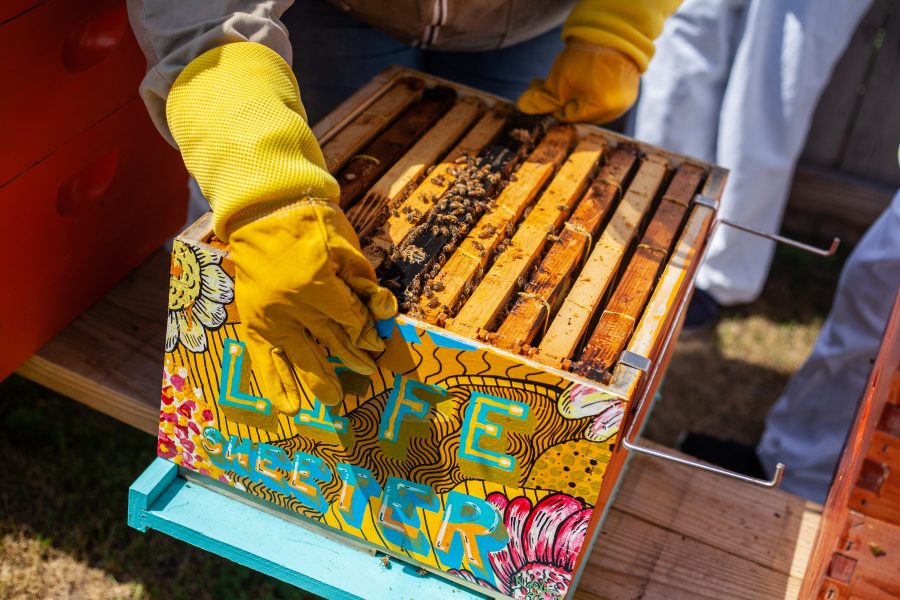
Moroccan beekeepers are struggling with an “unprecedented” mass collapse and death of bee colonies, from Azilal to Kenitra and Settat.
The phenomenon, called “cell collapse,” began last October, according to Mohamed Zaher, President of the Future Beehive Cooperative in Settat.
Zaher told Hespress EN that the number of dead cells in his apiary, where beehives are kept, that month “exceeded 200 cells.” The reasons for the massive cell collapses happening nationwide is “not clear,” as cooperatives struggle to maintain a steady production and healthy bee cells.
The same source added that because bee pollen plays an important role in the agricultural sector and the pollination of agricultural products, “this phenomenon has also affected the economic and agricultural sectors directly.”
The beekeeper stated that this unprecedented occurrence is affecting both strong and weak bee cells alike, with many cells losing all their working bees with the exception of the queen.
Almost 90% of plant species rely on pollinators to reproduce. This means bees are responsible for one out of every three bites of food eaten in the world, according to the College of Agriculture & Natural Resources at Michigan State University.
As excellent pollinators, bees play a vital part in every aspect of the ecosystem and are crucial to the ecological balance They support the growth of trees, flowers, and other plants, which serve as food and shelter.
Bees contribute to complex, interconnected ecosystems that allow a diverse number of different species to coexist.
Amin El Habib, head of the Morocco Apiaries Cooperative, echoed Zaher’s concerns, telling Hespress AR that “the scale of the disaster is beyond description.”
The mass call deaths are happening all across Morocco, and its sudden occurrence had a profound impact on sector professionals, with some apiaries being fully damaged, while others saw 50% and 90% damage to their collective apiaries.
The professionals are utterly perplexed by this strange phenomenon, as the factors usually leading to such mass deaths are caused by a deficiency in pollen and honey, which has not been the case in Morocco in years.
According to Zaher, this may likely be due to a “disease,” considering all other possible factors have been eliminated by his cooperative’s team.
Many cooperative managers and workers have alerted local authorities, such as the regional directorate of agriculture, and the health safety office for food products in the region.
A mixed committee examined the situation and carried a sample of the dead bees, but has yet to offer the professionals an explanation of what happened to the bee cells.
The National Syndicate of Professional Beekeeping in Morocco had previously launched a national campaign aimed at confronting the effects of the “viral disease” that was affecting bee colonies in Morocco, as many colonies were later diagnosed with the Sacbrood virus, which affects the honey bee larvae.
Since the virus is treatable, Moroccan bee farms have managed to overcome the challenge, but today the difficulty comes in the absolute mystery surrounding these deaths.
The union is calling for strict preventative measures for beekeepers in order to avoid the transmission of a possible infection and the exacerbation of the disease.
Measures include the sterilization of tools and examining cells before and after their use, in addition to getting rid of the tires carrying the infected brood in a way that guarantees the elimination of the virus, and the removal of empty cells infected with the disease so that other bees do not graze on them.







add your comment
Terms of publication : Not to offend the writer, people, sacred things, or attack religions or the divine self, and refrain from racist incitement and insults.