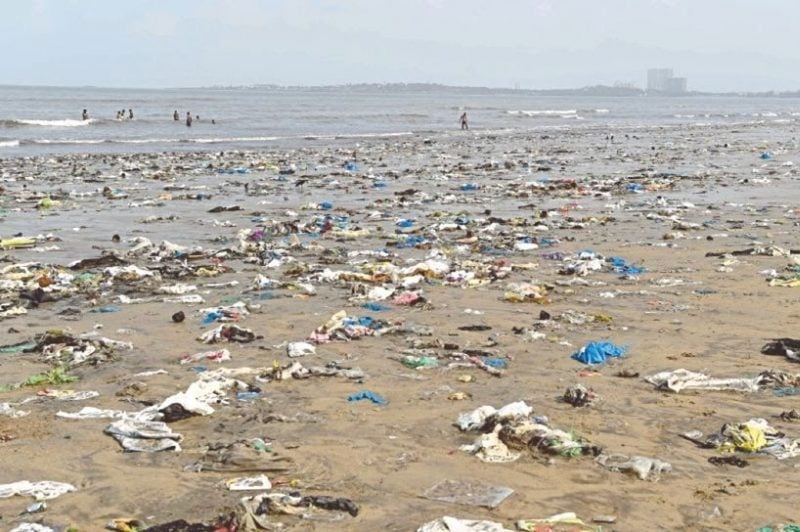
Microbes in oceans and soils all over the world are evolving to eat plastic, a Swedish study finds.
Researchers from the Chalmers University of Technology in Sweden published a study in the Journal of Microbial Ecology that found 30,000 different enzymes capable of degrading 10 types of plastics.
The study is the first large-scale evaluation of the plastic-degrading potential of bacteria at a global scale, showing that one out of four organisms analyzed possessed a specific enzyme that can eat plastic.
Study findings indicate that microbes have evolved in response to the global plastic pollution crisis. In the last few decades, plastic production has accelerated rapidly, increasing from 2 million tons in 1950 to 368 million tons in 2019.
“We found multiple lines of evidence supporting the fact that the global microbiome’s plastic-degrading potential correlates strongly with measurements of environmental plastic pollution – a significant demonstration of how the environment is responding to the pressures we are placing on it,” said Aleksej Zelezniak, one of the study’s researchers, in a statement to The Guardian.
There are millions of tonnes of plastic dumped in the environment each year, and pollution now afflicts every corner of the world, from the top of Mount Everest to the bottom of the oceans. The proper collection and treatment of waste are as important as reducing plastic use.
Most plastics are currently not degradable or recyclable. Through the breakdown of plastics using enzymes, new products could be produced from old ones, and virgin plastic production would be reduced. Many enzymes have been discovered in the new research that can be investigated and adapted for industrial use.
Approximately 12,000 of the new enzymes were found in ocean samples collected from 67 locations at three different depths. The study findings reveal that higher concentrations of degrading enzymes were consistently found in areas with greater plastic pollution.
Researchers also collected soil samples from 169 locations in 38 countries, yielding 18,000 plastic-degrading enzymes.
Scientists concluded the enzyme count was higher in the soil samples than in the ocean samples because soils contain more plastics with phthalate additives, which the new enzymes attack.
Zelezniak explained that the next step would be to test the most promising enzyme candidates in the lab to closely examine how they degrade plastic and how quickly they can do so.
“From there you could engineer microbial communities with targeted degrading functions for specific polymer types,” the scientist said.
The new enzymes could enhance the biodegradation of industrial plastic waste, which would reduce the need to synthesize new plastics.
In 2016, a bug that ate plastic was discovered in a Japanese dump. After tweaking it in 2018, scientists were able to learn more about how it evolved but did so inadvertently by creating an enzyme that was even more effective at breaking down plastic bottles.
This enzyme has been refined by scientists in 2020 so that it can degrade plastic six times faster.
Another mutant enzyme was created by Carbios, a French company specialized in biochemistry, in 2020 that was capable of breaking down plastic bottles for recycling within hours. German scientists have also discovered a bacterium that consumes polyurethane, a toxic plastic material usually disposed of in landfills.
The same year, German researchers have developed an enzyme that could break down a ton of plastic bottles in just 10 hours.
The global plastic waste crisis has been in the spotlight for years, with campaigners and environmental advocates urging world governments to take immediate action to resolve the pollution crisis.
A waste mass in the Pacific Ocean, dubbed ‘The Great Pacific Garbage Patch,’ is currently estimated to be twice as large as the state of Texas.
“We did not expect to find such a large number of enzymes across so many different microbes and environmental habitats. This is a surprising discovery that really illustrates the scale of the issue,” said Jan Zrimec, a scientist at the Chalmers University of Technology.





add your comment
Terms of publication : Not to offend the writer, people, sacred things, or attack religions or the divine self, and refrain from racist incitement and insults.