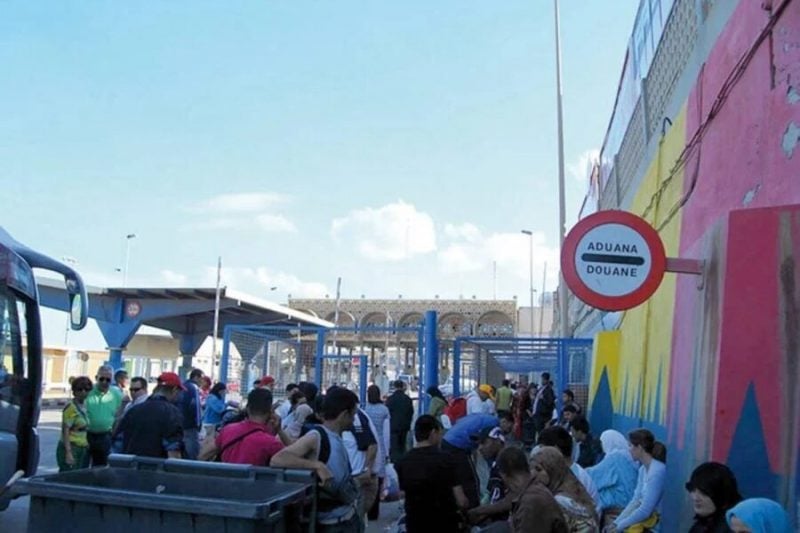
Close to 300 cross-border workers gathered this Sunday, November 14, in the Spanish enclave Ceuta, protesting the prolonged border closure with Morocco.
Moroccan cross-border workers have been stranded in the enclave for close to two years since the borders closed due to the COVID-19 pandemic.
The Andalusian Association for Human Rights (Apdha) co-organized the sit-in, alongside the Feminist Assembly of Seville and the General Confederation of Labor (CGT), which took place in front of the Government Delegation of Sebta headquarters.
The sit-in was punctuated by claims of “ lost basic human rights,” as protestors repeatedly explain their current status is “a sentence they see no end to.”
Both NGOs denounced the dire situation of cross-border Moroccan workers, announcing their plans to bring the case before the EU Court of Justice.
According to a statement by Apdha, this sit-in is intended to pressure authorities and shed light on the absolutely intolerable situation of border workers trapped in Ceuta for a year and a half now.”
According to the same statement, members of the NGO “are studying the cases of over a hundred people, some of whom have been working daily in Ceuta for over 20 years, without any documentation.”
Amin Souissi, spokesman for the Apdha told reporters on-site that the movement will keep protesting weekly, claiming “Ceuta has become a waiting room of irregular immigration.”
The activist said that “many cross-border people have not hesitated to pay the mafias to travel by boat to the peninsula or swim back to their country, risking their lives in both cases.”
Ahmed, a 27-year-old Moroccan national from the small northern Moroccan town Martil, has remained stranded in Ceuta since March 2020.
Homeless and jobless for over 7 months, he told Hespress EN he “would do anything to get back home.”
Ahmed has been staying with a host family, and resumed work back in July 2020, following the end of state-mandated quarantine. He has been unable to return home, “despite there being different ways” he could do so, such as resorting to irregular migration.
“I know I can probably get back to Morocco through clandestine boats, but I’m not willing to risk it,” he told Hespress EN.
Morocco had briefly reopened borders back in May 2020, to allow Moroccans to travel back home. The reopening was temporary and did not suffice all stranded Moroccan workers to go home.
Since then, several border opening date extensions were announced.
In addition to the rough social dilemma, administrative norms are threatening to worsen the workers’ situation, as many stranded Moroccans’ cross-border cards and health cards have expired.






add your comment
Terms of publication : Not to offend the writer, people, sacred things, or attack religions or the divine self, and refrain from racist incitement and insults.