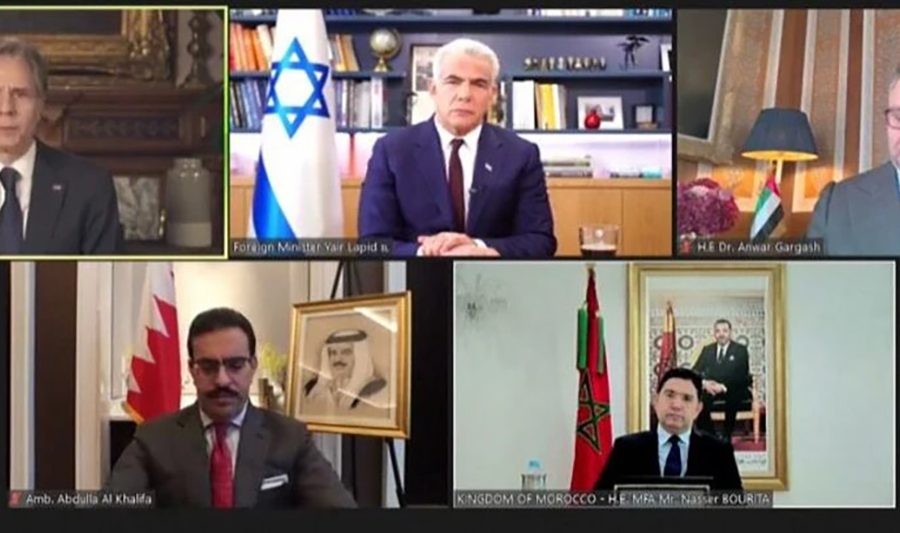
The U.S Secretary of State Antony Blinken hosted a meeting with Israel, Morocco, Bahrain and the United Arab Emirates envoys to commemorate the first anniversary of signing the Abraham accords and normalizing ties with Israel.
The virtual meeting witnessed the presence of the Israeli foreign minister Yaer Lapid, the Moroccan foreign minister Nasser Bourita, the Emirati Minister of State for Foreign Affairs Anwar Gargash, and Ambassador of Bahrain to the United States Sheikh Abdullah bin Rashid bin Abdullah Al Khalifa.
The United Arab Emirates last year became the first Arab state to normalize relations with Israel since Egypt and Jordan decades earlier, with Bahrain and Morocco following suit soon afterward.
Bourita started his statement by recalling the history of Morocco’s relationship with Israel that preceded the Abraham Accords by a few decades before signing the Abraham accords.
After that, the Moroccan foreign minister, stated the “bilateral actions” that followed the normalization of ties with Israel as the channels have been opened between the business communities through the establishment of the Morocco-Israel business Council and the Morocco-Israel Chamber of Industry and Commerce, the exchanges between the two countries grew 50% just in the first six months of 2021.
20 flights operating under two airline companies already established their rotations and 1 million Israeli tourists are expected per year in Morocco after the start of direct flights between Israel and Morocco earlier this year, according to Bourita’s statement.
Partnerships in sensitive sectors have also been launched between Morocco and Israel including cyber-security and inter-operability of forces through joint military Special Forces exercises like the HD-Annual 21.
Bourita, also, highlighted the diplomatic missions between Israel and Morocco, which have started after Abraham accords, “Our government officials talk, meet and work together: a dozen Ministers initiated direct contacts laying the ground for the signing of more than 20 agreements,” he continued, “I myself welcomed my friend Yair Lapid, last month and we look forward to other important visits including the Ministers of Economy and Defense.”
Israeli Foreign Minister Yair Lapid inaugurated, during his visit to Rabat in August, the headquarters of the Israeli liaison office in Morocco.
Liaison offices between Morocco and Israel existed but were closed during the second Palestinian Intifada in the 2000s.
In the second part of Bourita’s speech, he counted the challenges of “preserving, improving and giving sense to the giving sense are still ahead of us.”
Bourita stressed the normalization was no substitute for an accord with the Palestinians.
“Morocco believes there is no other alternative to a two-state-solution with an independent Palestinian state within the borders of June 67.” Bourita said.
Bourita called for an updated joint assessment to maintain the new regional order, where to generate opportunities that favor stability and development for all.
“This new regional order should not be perceived as “against someone”, but rather “to benefit us all.” Bourita stated in the end.
Israeli Foreign Minister Yair Lapid voiced hope to expand recognition as he mentioned his new plan of the development of Gaza, a plan that will upgrade the infrastructure of the Palestinian strip in exchange of Hamas, the controlling party of the strip, long-term quit.
“This Abraham Accords club is open for new members,” Lapid said.
Anwar Gargash, a top Emirati foreign policy adviser, stated during the meeting, “We feel that the Abrahamic Accords will allow us to help and assist further in the peace process, leading to what we all see as the ultimate goal of a two-state solution.”
The United Arab Emirates last year became the first Arab state to normalize relations with Israel since Egypt and Jordan decades earlier, with Bahrain and Morocco following suit soon afterward.
Notably absent from Friday’s commemoration was Sudan, whose new civilian-backed government — desperate for US support — promised Trump to move forward with Israel but has since been hesitant in the face of public opposition. Blinken said that the United States would encourage Sudan to foster ties with Israel.
The U.S secretary promised, Friday, to encourage more Arab countries to recognize Israel as he congratulated the countries, which signed the accords, on their daring and brave step to ask the question “why not”, recalling the story of Abraham in the holy book, where he was asking the hard questions that everyone avoided.



add your comment
Terms of publication : Not to offend the writer, people, sacred things, or attack religions or the divine self, and refrain from racist incitement and insults.