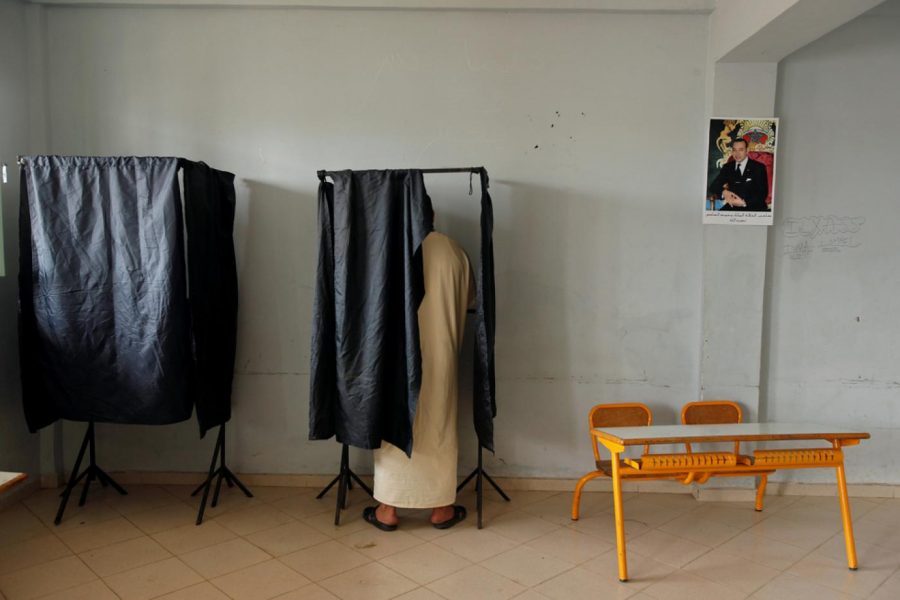
The Moroccan Northern Observatory for Human Rights (ONDH) recorded 185 violations of electoral laws and health measures out of 210 observation tours carried out by the ONDH’s observers.
In terms of the violations’ categories, the ONDH’s report recorded a lack of respect, by 36 percent, for the health measures adopted by the government, as organizing mass rallies and violating the state of emergency by continuing campaigns after the 9 p.m curfew, as well as putting the election posters in undesignated places.
Following a meeting with the ministry of interior before the start of the electoral campaign, political parties agreed to give up rallies, banquets and distribution of pamphlets, during the September 8 election, to avoid further spreading the Coronavirus.
The parties promised, also, to digitize their communication strategies in order to limit conventional meetings to a minimum since the ministry sets a limit of 25 people in public gatherings, during the campaign, in both closed and open spaces. However, not all parties respected these conditions and measures, according to the ONDH’s report.
In 19 percent of the observation tours conducted by the ONDH, the Observatory’s members noticed the use of children in electoral campaigns.
Verbal skirmishes between different candidates’ supporters, using money to convince voters, and cases of violence were less than 5 percent during the observations’ tours carried out by the ONDH.
The little use of Amazigh language in the electoral campaign was highlighted in the same statement.
The observatory also recorded some parties’ use of personal data, by “sending propaganda text messages to citizens without their permission, according to ONDH’s press statement published on their Facebook page.
Mohammed Ben Aissa, responsible for communication in ONDH explained the legal consequence of these violations, “I do not think that the political parties, which committed these violations, will be held accountable, but at least, by this report, we drew attention to such practices as the violation of citizens’ privacy and we urge the relevant institutions, such as the National Committee for the Protection of Personal Data, to protect the privacy of individuals.”
Ben Aissa added, in his statement to Hespress English, “the aim behind such reports is not invoking penal sanctions as much as they are aimed at fortifying the democratic practice in the nation. He stressed that the discussed ONDH’s report is an evaluation of democratic practice during the September 8 election.”
Most of the parties, their representatives and supporters, committed violations, albeit unevenly, as a result of the lack of professional training, « since during the election period, electoral campaigns are joined by people who lack awareness about the political role of the parties or the purpose of the electoral process, and due to their fragile financial situation, they take advantage of the electoral “wedding” to obtain a daily wage,” according to Ben Aissa’s statement to Hespress English.
The ONDH’s report didn’t point out the political parties’ names whose campaigns they witnessed the most violations of electoral campaign rules.
The reason behind this anonymity is that “the ONDH’s report doesn’t aim to accuse or attack a particular political party or parties,” according to Ben Aissa.
During the Election Day, the local authorities in Martil prevented two election observers from attending the vote counting at the polling center at Mohamed 6 High School in the city, according to the ONDH’s report.
Ben Aissa said, in his statement, that the prevention act was the result of an individual act by the city’s pasha, and not a systematic policy executed by the Ministry of Interior since the ONDH’s observers and other associations and organizations exercised their electoral observation’s right freely during the September 8 election.
The ONDH’s report mentioned, also, the lack of female presence in the election committees as well as the “total absence” of access facilities devoted to people with disabilities during the elections.
The lack of access facilities devoted to people with disabilities during the elections was discussed in detail by the Collective for the Promotion of the Rights of People with Disabilities (CPH), during a press conference Tuesday, as the collective stated that almost half of voting offices were unreachable or inaccessible to disabled citizens during the September 8 elections.
The ONDH announced, on their Facebook page, that they will issue, soon, a detailed report on the electoral observations that concerned the local, regional and legislative elections.



add your comment
Terms of publication : Not to offend the writer, people, sacred things, or attack religions or the divine self, and refrain from racist incitement and insults.