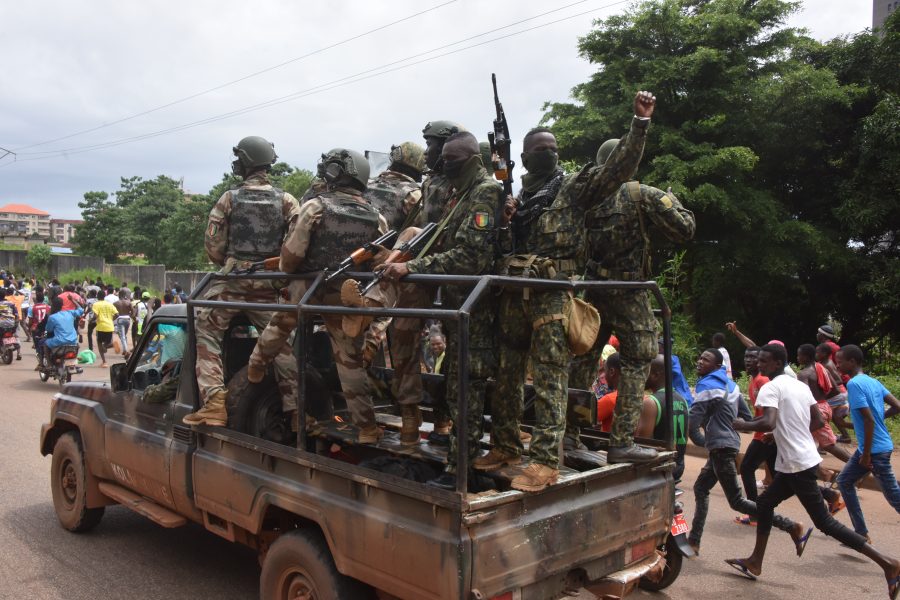
Heavy gunfire echoed around Conakry, the capital of Guinea, early on Sunday morning. Pictures then surfaced on social media of the West African country’s president, Alpha Condé, slouched on a sofa with his floral shirt in slight disarray, being held in custody by men in military fatigues.
Finally, the head of Guinea’s Special Forces, Doumbouya, announced on state television he had staged a coup on the country. The constitution, government and all institutions were dissolved as borders, both land and air, were closed.
The soldiers also said in a statement read out over national television they would convene President Conde’s cabinet ministers and other top officials at 11:00 GMT on Monday in Conakry.
Doumbouya said he was acting in the best interests of the nation of more than 12.7 million people. Not enough economic progress has been made since independence from France in 1958, the colonel said.
“Guinea is beautiful,” he said near the end of his televised announcement, offering a brutal explanation: “We no longer need to rape her. We need to make love to her, that’s all.”
Videos on social media showed Guineans taking to the streets in celebration and military vehicles moving through Conakry, accompanied by dozens of motorcycles, their riders raising fists in the air.
Guinea is no stranger to coups. Before Condé, a former opposition activist himself, became the country’s first democratically elected leader in 2010, there were two military takeovers, in 1984 and 2008.
Conde won a third presidential term in a violently disputed election last October, after pushing through a new constitution in March 2020 which allowed him to sidestep the country’s two-term limit.
He accused the opposition leader, Cellou Dalein Diallo, of trying to recruit mercenaries to attack Guinea and closed the border, preventing many people living abroad from returning to cast their vote. Cello and other opposition figures accused Conde of electoral fraud.
The tense political atmosphere provoked mass protests after the election. Dozens of people died while hundreds were arrested in clashes between supporters of the government and those of the opposition.
Guinea has witnessed sustained economic growth during Conde’s decade in power thanks to its bauxite, iron ore, gold and diamond wealth, but it came at a cost to some Guineans.
Human rights groups say that mining companies have upended the lives and livelihoods of rural communities.
International reactions
The events drew concern and condemnation from regional and international observers.
United Nations Secretary-General Antonio Guterres, said on Twitter, he strongly condemned “any takeover of the government by force” and called for Conde’s immediate release.
The Economic Community of West African States (ECOWAS) threatened to impose sanctions after what its chairman, Ghana’s President Nana Akuffo-Addo, called an attempted coup, while the African Union said it would meet urgently and take “appropriate measures”.
The United States condemns “Sunday events in Conakry, saying that violence and any extra-constitutional measures would only erode Guinea’s prospects for peace, stability and prosperity.
“These actions could limit the ability of the United States and Guinea’s other international partners to support the country as it navigates a path toward national unity and a brighter future for the Guinean people.” the Department of State said in a statement.
If the takeover proves successful, Guinea will become the third West African country to experience a violent transfer of power in the past five months.
In April, the president who had ruled Chad for three decades was killed on the battlefield and replaced by his son in what academics called a “covert coup.” In May, Mali’s vice president arrested the president, prime minister and defense minister in the country’s second coup within nine months.




add your comment
Terms of publication : Not to offend the writer, people, sacred things, or attack religions or the divine self, and refrain from racist incitement and insults.