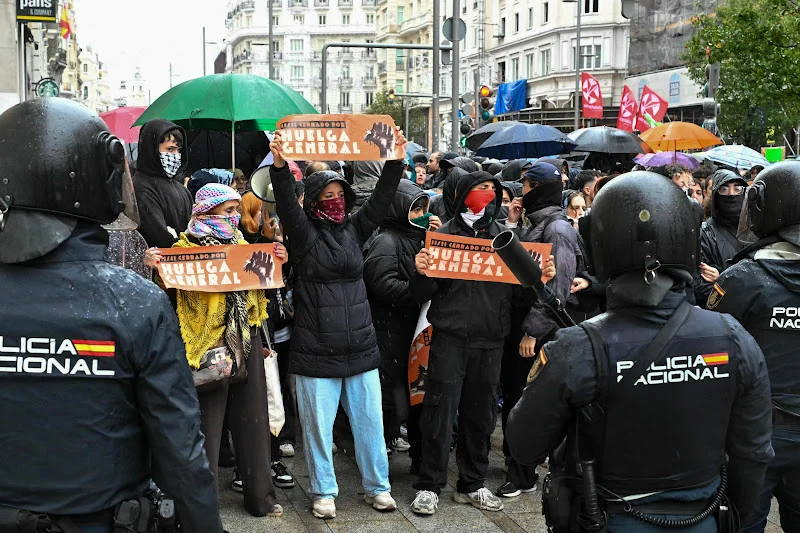
Hugo was outside the hospital where his mother was being treated when he was mugged at gunpoint. For the 22-year-old, immigration is to blame — and Spain’s far right offers the answer.
The assailants, he said, were four Latin Americans whom he believed to be “in an irregular situation”. The student, who declined to give his surname, backs far-right party Vox’s call for “mass remigration” ahead of Spain’s November 29 general election.
He is far from alone.
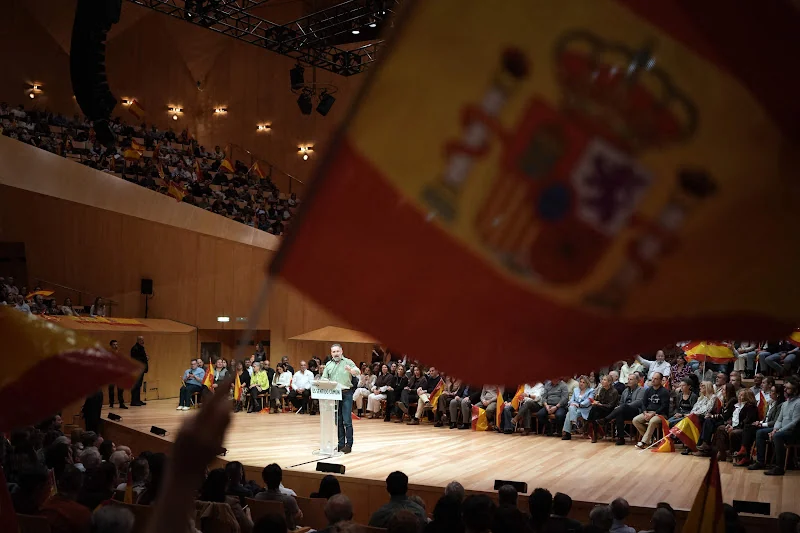
Vox is gaining ground among young Spaniards, tapping into mounting frustration over housing, living costs and immigration — and potentially putting the far right within reach of national power for the first time.
“In working-class or middle-class neighbourhoods, we are the ones who suffer these consequences,” Hugo told AFP, recalling the attack in the Madrid suburb of Leganes.
According to survey data analysed by El Pais daily in October, shortly after Socialist Prime Minister Pedro Sanchez called the snap election, Vox led among 25- to 34-year-olds, with support approaching 30 percent.
Among voters between the ages of 18 and 24, Vox was joint-first at 26 percent with the mainstream conservative Popular Party (PP), which leads most overall polls.
The surge in youth support could hand Spain’s third-largest party its best-ever general election result and a decisive role in forming the next government, with polls pointing to another hung parliament.
– ‘Radical change’ –
Isabel Ariela Mahmoud, a political science professor at Madrid’s Carlos III University, said the far-right surge witnessed elsewhere in Europe was bound to reach Spain.
“There were no solutions to all the problems that led to the rise of the far right,” notably on housing and living standards, despite positive macroeconomic data, she told AFP.
Vox has capitalised by linking immigration to the housing crisis, crime, deteriorating public services and economic insecurity, creating a “common enemy” around grievances that cut across gender and ideological lines, the researcher said.
Immigration dominated Spanish politics after tens of thousands of migrants streamed into Spain’s north African territory of Ceuta from Morocco in July.
Housing then took centre stage following a wave of protests sparked by the eviction of an 87-year-old Madrid pensioner in September.
Sanchez gambled on a snap vote after his minority government’s urgent housing decrees failed to pass parliament — but any electoral benefit appears unclear.
Housing prices have soared during his eight-year premiership, often swallowing half of people’s wages and particularly affecting the young.
At a pro-Ceuta march in Madrid in October, Vox voter Enrique Pereira, 23, dismissed the Socialists’ last-ditch efforts, saying they had “promised a lot and lied a lot”.
“Ultimately, we have little idea of decrees and laws. We feel it in our own flesh, in not being able to pay a rent of 800 euros ($880),” he said.
Draped in Spain’s red-and-yellow flag, Pereira praised Vox leader Santiago Abascal.
“Spain needs a radical change.”
– ‘Betrayed’ youth –
“Young people have realised that a generation of politicians who have governed in Spain in recent years have betrayed them,” Vox’s secretary general Ignacio Garriga told AFP.
Vox offers “an alternative path”, said Garriga, 39, who entered the party’s national executive committee in his 20s.
Analysts have also observed a backlash against a leftist government which has prided itself on liberal social reform centred on feminism and equality.
“Generation Z males skew more towards this extremist right,” explained Ariela Mahmoud, speaking of youngsters who were “convinced that feminism has gone too far”.
Vox cultivated “extremely intelligent” messaging on TikTok and Instagram before other parties, connecting with youth “who hadn’t even reached voting age but who were at an early age in which opinions are formed”, she added.
For Pablo Gonzalez Gasca, national spokesman for Revuelta, a youth organisation founded by Vox members, “young people are rebellious by nature”.
“Ten years ago, being progressive, Marxist, communist or anti-fascist was fashionable… I think that has changed,” said the 32-year-old.
A far-right presence in a national government would mark a seismic shift for a country once ruled by General Francisco Franco’s fascist-backed dictatorship (1939-1975).
Experts say insufficient education about Franco and disinformation on social media are responsible for many young people’s rejection of Spain’s liberal democracy in favour of the far right.
At the October Ceuta protest, a freckled young man wearing a green Vox wristband offered a stark illustration of that rejection.
Refusing to give his name, he dismissed Spain’s constitutional system, established in 1978 after Franco’s death, as a “regime”.







add your comment
Terms of publication : Not to offend the writer, people, sacred things, or attack religions or the divine self, and refrain from racist incitement and insults.