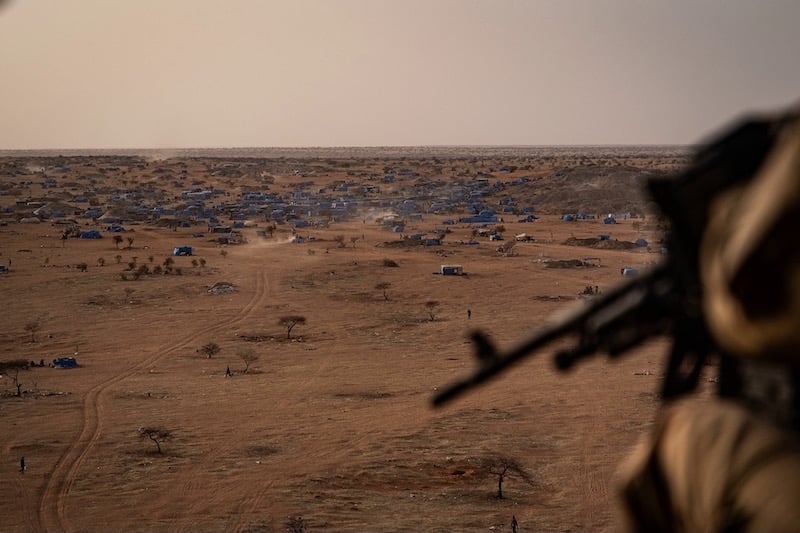
Artisanal gold miners in Mauritania are continuing protests against government measures requiring them to leave mining sites and move at least 10 kilometers away from the country’s border, arguing that the restrictions threaten their livelihoods and limit access to areas they helped discover.
The measures have also raised concerns over overlapping mining permits, the boundaries of areas designated for traditional mining and the allocation of sites to other operators.
Several days ago, a delegation led by Mohamed Ould Ahmed Ghadhi, director general of the Mauritanian Mining Agency, and Idrissa Demba Corera, governor of Tiris Zemmour region, visited artisanal mining sites near the border. The delegation reaffirmed the government’s decision and urged miners to respect Mauritania’s territorial integrity and avoid crossing into neighboring countries, citing the need to protect their safety.
Mauritanian Minister of Mines and Industry Adi Ould Zein said the decision was taken in response to security circumstances and to protect Mauritanian citizens. He added that it applied to all activities.
In a statement presented at a news conference Friday, representatives of traditional gold miners in Tiris Zemmour said miners were facing increasingly limited access to areas available for artisanal extraction because these sites overlapped with exploration and prospecting permits granted to other parties.
They questioned the criteria used to determine which mining sites must be evacuated, the differences in distances imposed on miners and whether the security justifications for removing them were consistent with the subsequent allocation of the same areas to other operators.
The representatives also stressed that artisanal gold mining supports a much broader economic and social network, including owners of crushing equipment, ore and passenger transporters, traders selling machinery and food, drilling-equipment suppliers, mineral-processing plants and other businesses operating around mining sites.
Restrictions on access to these areas therefore affect not only miners but also the wider economic network dependent on the activity, they said.
The miners called on authorities to review the corridors and areas designated for artisanal mining and update their maps, resolve overlaps with exploration permits, reconsider the removal of miners from sites they had discovered and invested in, and clarify the legal and security grounds for the restrictions imposed along the border.
Miners raise concerns over permits and alternative sites
Mohamed Mahmoud Ould El Hassan, president of the General Union of Mauritanian Gold Miners, told Hespress that the protests stemmed from a series of decisions issued by the authorities overseeing the sector, particularly the Mauritanian Mining Agency and the Ministry of Mines, which they had sought to implement simultaneously.
One of the main measures requires miners to remain at least 10 kilometers inside Mauritanian territory from the border running alongside the buffer zone. Authorities had attempted to enforce the restriction earlier this year but were unsuccessful, before reviving it amid regional security concerns and what they described as the need to strengthen border protection.
Ould El Hassan said the protests were not limited to the border restrictions. Other decisions had also generated widespread discontent and prompted demonstrations at mining sites in different parts of the country.
These include a requirement that miners operate only within designated artisanal mining corridors, whose boundaries are not clearly established. Identifying their locations also requires an internet connection, which is unavailable in some of the areas concerned, making implementation difficult in practice.
Miners have also raised concerns about overlaps between large- and small-scale mining permits and their own investments in the same areas, a situation that has led to disputes on the ground.
Despite the anger generated by the measures, Ould El Hassan said he believed the border restrictions could be understood and accepted given the current regional security situation.
He said the union had previously been among the first to oppose the measure, considering it unfair, but added that security developments in neighboring countries had become difficult to ignore.
He also noted that the restrictions were not directed exclusively at gold miners. Administrative authorities in the border localities of Boulenouar, Chami and Tamichett had previously asked livestock herders to move away from the buffer zone for similar security reasons.
According to Ould El Hassan, Mauritanian authorities have pledged to provide alternative areas inside the country and incorporate them into the Mining Agency’s designated corridors to compensate miners for the sites they will have to leave.
Authorities have also given miners 14 days to take note of the decision and implement it.
Acknowledging the initial shock among miners who must abandon sites in which they have invested years of work and resources, Ould El Hassan said sector representatives remained committed to defending their rights and investments.
He added, however, that security should take precedence over all other considerations, describing it as the country’s most important asset. He called on miners to support the authorities and comply with their decisions during what he described as an exceptional period.








add your comment
Terms of publication : Not to offend the writer, people, sacred things, or attack religions or the divine self, and refrain from racist incitement and insults.