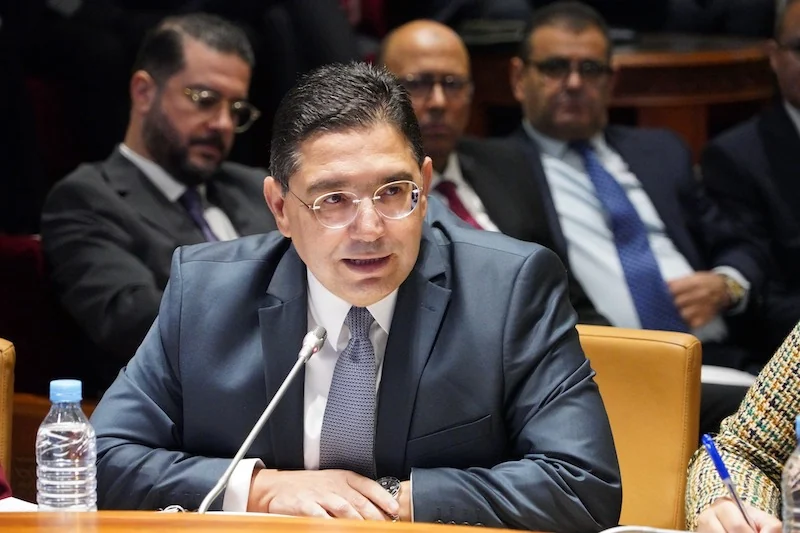
Morocco’s Foreign Minister Nasser Bourita has outlined the international challenges shaping the country’s diplomatic agenda, describing a global environment in which crises have become a structural and persistent feature, while stressing that Morocco remains “strong through its legitimacy, diplomacy and credibility.”
Speaking during a review of his ministry’s proposed 2027 budget before the House of Representatives’ Foreign Affairs, Defense, Islamic Affairs and Moroccan Expatriates Committee, Bourita pointed to rising tensions and armed conflicts, as well as the growing role of non-state armed actors, including separatist and terrorist groups, organized crime networks and mercenaries, particularly in Africa.
He also highlighted intensifying competition over energy resources and critical minerals, alongside growing concerns over food security and fertilizers, according to the committee’s report.
These developments require Moroccan diplomacy to move beyond assumptions of a stable international environment and incorporate conflict dynamics and successive crises into its analysis and forward-looking strategic planning, the report quoted Bourita as saying.
The minister said Morocco would continue strengthening its diplomatic presence and pursuing a multidimensional foreign policy focused on firmly defending the country’s national interests rather than reacting to events.
Western Sahara and Africa at the center of diplomatic agenda
Bourita said the continuation of the Western Sahara dispute and the resulting regional deadlock and lack of Maghreb integration impose a significant economic cost on North African countries, depriving their populations of investment and development opportunities that could help transform the region into an integrated economic hub.
He also pointed to what he described as a new turning point in the dispute, referring to the non-renewal of the United Nations Mission for the Referendum in Western Sahara (MINURSO). He characterized the development as a decisive moment marking the end of one phase and the beginning of a new path toward a final settlement.
The minister reaffirmed the African dimension of Morocco’s diplomatic policy, describing it as rooted in the country’s historical and institutional ties with the continent.
He cited several strategic initiatives aimed at strengthening African integration, including the Atlantic Initiative to facilitate landlocked Sahel countries’ access to the Atlantic Ocean, and the Africa-Atlantic Gas Pipeline project. He also highlighted Morocco’s efforts to develop balanced partnerships with countries around the world.
Morocco reiterates support for Palestinian statehood
Bourita also reaffirmed Morocco’s support for the Palestinian cause, saying the country’s position is based on the establishment of an independent Palestinian state within the framework of a two-state solution, with East Jerusalem as its capital.
He said the position draws on historical and diplomatic principles under the leadership of King Mohammed VI, who chairs the Al-Quds Committee.
The minister strongly condemned what he described as serious violations in the Gaza Strip and highlighted Morocco’s continued humanitarian efforts to support Palestinians through the Bayt Mal Al-Quds Asharif Agency.
Ministry outlines priorities and 2027 budget
Looking ahead, Bourita identified several priorities for the ministry, including consolidating Morocco’s diplomatic gains by continuing to mobilize international support for its autonomy initiative under Moroccan sovereignty.
He also stressed the importance of implementing royal strategic initiatives in Africa to strengthen Morocco’s position as a trusted actor and strategic partner.
The minister called for closer cooperation between the legislative and executive branches to advocate for Morocco’s national interests, while emphasizing the need to improve budget governance and strengthen the efficiency of diplomatic and consular services.
The Foreign Ministry’s proposed budget for 2027 stands at approximately MAD 4.85 billion.
Of that amount, around MAD 3.30 billion is allocated to personnel costs, while MAD 1.262 billion is earmarked for operating expenses, including equipment and other expenditures. Investment spending accounts for the remaining MAD 290 million.





add your comment
Terms of publication : Not to offend the writer, people, sacred things, or attack religions or the divine self, and refrain from racist incitement and insults.