
The Moroccan Sahara file is heading back to the U.N. Security Council in October, almost a year after the Council adopted a resolution that changed the tone of the political process and put Morocco’s autonomy proposal at the center of the talks.
Since then, Morocco, the Polisario Front, Algeria and Mauritania have returned to discussions, the United States has taken a more direct role, and the U.N. has reviewed the future of its mission.
Here is what has changed since the last Security Council.
Oct. 31, 2025: A new resolution changes the language
The starting point is Resolution 2797, adopted by the Security Council on Oct. 31, 2025.
The Council renewed the mandate of the U.N. Mission for the Referendum in Moroccan Sahara, or MINURSO, until Oct. 31, 2026. The vote was 11-0-3, with China, Pakistan and Russia abstaining. Algeria did not participate in the vote.
The resolution also gave new weight to Morocco’s 2007 autonomy proposal. It said genuine autonomy under Moroccan sovereignty could constitute “a most feasible solution” and called on the parties to negotiate on that basis.
At the same time, the resolution continued to call for a “mutually acceptable political solution” that provides for the self-determination of the people of Moroccan Sahara.
That combination became the starting point for the diplomacy that followed.
December 2025: The General Assembly keeps the self-determination language
In December 2025, the General Assembly adopted Resolution 80/89 without a vote.
The resolution reaffirmed the “inalienable right” of peoples to self-determination and independence and said available options for self-determination are valid when they reflect the freely expressed wishes of the people concerned and comply with U.N. principles.
This is different from the October 2025 Security Council resolution, which put Morocco’s autonomy proposal more prominently into the negotiating framework. The General Assembly resolution continued to use broader language centered on self-determination and decolonization
That language is important because it shows that the broader U.N. framework contains positions that go beyond the wording used by the Security Council in Resolution 2797.
January-February: De Mistura gets a new framework
U.N. envoy Staffan de Mistura then moved to turn the resolution into talks.
In January and February of 2026, senior delegations from the U.N. and the United States held discussions in Madrid with Morocco, the Polisario Front, Algeria and Mauritania on implementing Resolution 2797.
The talks then moved to Washington in February.
De Mistura and the United States co-chaired another round on Feb. 23-24, with the discussions focusing in particular on Morocco’s autonomy proposal.
The U.N. described the discussions as encouraging but said major issues remained unresolved, including the question of self-determination.
That left the four sides talking about the same framework while still disagreeing over what the final political settlement should look like.
The United States moves closer to the process
Washington has also become more directly involved in the negotiations.
The United States backed the 2025 Security Council resolution and offered to host talks as part of de Mistura’s efforts.
That involvement continued through the Madrid and Washington meetings, giving the U.S. a more visible role in the diplomatic process than in previous rounds.
The result is a process that is no longer limited to U.N. consultations in New York or regional meetings. U.S.-backed talks have become part of the current diplomatic track.
April: the U.N. reviews MINURSO’s future
The Security Council did not only renew MINURSO for another year. Resolution 2797 also called for a strategic review of the mission’s future mandate.
On April 23, Council members held closed consultations on MINURSO. De Mistura and Alexander Ivanko, the U.N. secretary-general’s special representative for Moroccan Sahara and head of MINURSO, briefed members.
Asif Khan of the U.N. Department of Political and Peacebuilding Affairs also briefed them on the strategic review.
The review is crucial because MINURSO was created in 1991 to support a settlement plan and ceasefire. Today, it monitors, investigates and reports on developments and works with the parties to reduce tensions.
The mission’s future is therefore tied to the political process that has developed since the 2025 resolution.
June: de Mistura returns to the region
De Mistura traveled to Algeria and the Tindouf camps for consultations as he worked to restart the negotiations under the framework created by Resolution 2797.
At the U.N.’s decolonization committee in June, Algeria continued to emphasize self-determination, while Morocco argued that the committee’s traditional approach did not reflect what Rabat described as the new diplomatic momentum created by Resolution 2797.
The exchanges showed that the new negotiating framework has not erased the basic disagreement between the parties.
The fighting has not disappeared
The diplomatic talks have taken place alongside continued low-intensity hostilities.
The U.N. secretary-general’s 2025 report described the situation as marked by tensions and low-intensity hostilities between Morocco and the Polisario Front.
The report said most firing incidents reported to MINURSO were concentrated in the north of the Sahara, particularly around Mahbas.
U.N. peacekeepers visited several sites after reported attacks and in many cases found traces of exploded artillery ammunition. Most of the verified rounds landed in remote areas and caused no significant damage.
The report warned that the fighting had continued for nearly five years and was creating a growing risk of escalation in the region. It called for an immediate end to hostilities and a return to a full ceasefire.
The report also raised concerns about incidents near civilian areas and MINURSO facilities and urged both sides to avoid actions that could endanger the mission.
August: MINURSO gets a new force commander
The mission also got a new military commander this year.
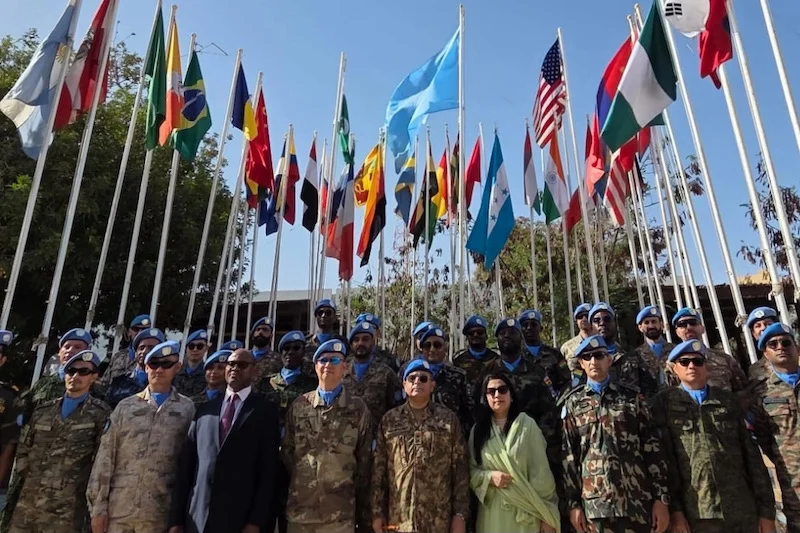
On Aug. 17, U.N. Secretary-General Antonio Guterres appointed Pakistan’s Maj. Gen. Jawwad Ahmed as MINURSO’s new force commander.
Ahmed replaced Bangladesh’s Maj. Gen. Md. Fakhrul Ahsan, whose assignment ended Aug. 2. The U.N. said Ahmed brought more than 35 years of military leadership and U.N. peacekeeping experience to the post.
The change comes as the mission prepares for another mandate decision and as the Council considers how its role fits into the evolving political process.
September: October comes into view
The Council held a Sept. 15 briefing on the mission as the U.N. prepared the strategic review requested under Resolution 2797.
MINURSO also welcomed its new force commander, Pakistan’s Maj. Gen. Jawwad Ahmed, in Laayoune on Sept. 16.
On Sept. 25, U.N. High Commissioner for Refugees Barham Salih warned the Security Council that conditions for Sahrawi refugees were deteriorating and humanitarian needs remained underfunded.
The October deadline is now back
The next deadline is Oct. 31, when MINURSO’s current mandate expires.
The Security Council is therefore approaching another decision with a political process that is more active than it was a year ago, but without a final agreement between the parties.
Resolution 2797 put Morocco’s autonomy proposal at the center of the negotiations while retaining the requirement for a mutually acceptable solution and references to self-determination. The months since have produced three rounds of talks, a stronger U.S. role, a strategic review of MINURSO and a new force commander.
But they have not produced a settlement.



add your comment
Terms of publication : Not to offend the writer, people, sacred things, or attack religions or the divine self, and refrain from racist incitement and insults.