
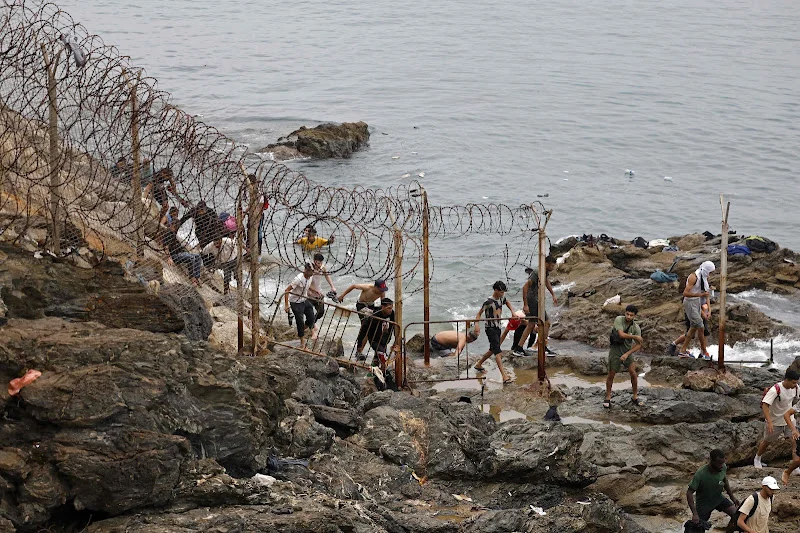
Spain’s release of 40 previously classified documents has offered its clearest account yet of what authorities knew before tens of thousands of people crossed from Morocco into Ceuta on July 30 and 31.
The documents do not show that Spanish intelligence predicted the scale of the crossing. But they do show that warnings had been building for weeks, that Spanish authorities knew irregular entries were increasing and that the country’s intelligence service received specific information one day before the mass crossing about online calls encouraging people to enter Ceuta by sea and over the border fence.
The Spanish government published the documents after declassifying them, saying the files would allow the public to reconstruct what information institutions had at each stage of the crisis and who received it.
The collection includes reports and communications from the National Police, Guardia Civil, the National Intelligence Center (CNI), and military intelligence bodies.
A border already under pressure
In the weeks before the mass crossing, signs of growing pressure around Ceuta had already emerged.
Several of the documents consisted of regular updates by Spanish security bodies tracking attempts to enter the city by swimming and through the border fence.
The Guardia Civil had asked the Interior Ministry for additional personnel and resources about 20 days before the mass crossing, citing the risk of an increase in irregular entries by sea.
A Spanish Supreme Court ruling issued at the end of June became a key concern because it limited Spain’s ability to immediately turn back people intercepted in waters under Spanish sovereignty or after they reached Spanish territory by sea.
The Guardia Civil warned that the decision could encourage a shift away from attempts to cross by land toward swimming into Ceuta from nearby areas.
Spanish police recorded 1,240 irregular entries into Ceuta after the ruling was issued, according to the documents reviewed by El País.
The documents therefore show that Spanish authorities were already dealing with a changing migration pattern before the events of July 30.
The warning that arrived the day before
The most politically significant revelation concerns July 29.
Spain’s CNI sent what the documents describe as an urgent note to Moroccan intelligence services warning that it had detected plans for several attempts to enter Ceuta, both by swimming and by crossing the fence.
Facebook and WhatsApp groups promoted plans urging people to cross during Morocco’s Throne Day celebrations, when security forces could be occupied with ceremonies and deployments elsewhere.
The CNI alerted Spanish authorities in Ceuta and the Guardia Civil to online calls for people to enter by sea and cross the fence, shared by social media groups with a combined audience of about 180,000 people.
This is the strongest evidence yet that Spanish authorities had received a specific warning about coordinated attempts to enter Ceuta the following day.
However, the documents also show that the CNI did not predict that between 70,000 and 80,000 people would attempt to enter the city.
The Spanish government argues that the intelligence service shared information about online calls but did not issue a formal warning predicting a massive and exceptional event.
A warning system scattered across agencies
The 40 documents reveal how fragmented the flow of information was.
The records involved about 30 different institutions, including police, Guardia Civil, intelligence and military bodies. Many of the communications were sent by email or WhatsApp rather than through formal intelligence reports or emergency alerts.
Only seven of the published files are classified as alerts, and only one was issued before the mass entry began, according to El País’ analysis of the documents.
The CNI exchanged messages with the Spanish government’s delegation in Ceuta and the Guardia Civil in the days before the crossing. But the released records show a mix of meetings, messages, calls and intelligence notes rather than a single, clear warning declaring that Ceuta was facing an imminent mass breach.
What the documents say about Morocco
The files shed light on why Moroccan security forces did not prevent the movement of such large numbers of people toward the border.
Spanish intelligence had informed Moroccan services about the online calls before the crossing.
One Guardia Civil assessment said Moroccan authorities had shown a lack of proactive action, allowing people to reach the border area.
Another document listed several possible explanations, ranging from an operational surprise to the possibility of political motivations.
The documents do not establish that Morocco organized or deliberately encouraged the crossing.
They instead show that Spanish security bodies considered several explanations while trying to understand why Moroccan forces failed to stop the movement.






add your comment
Terms of publication : Not to offend the writer, people, sacred things, or attack religions or the divine self, and refrain from racist incitement and insults.