
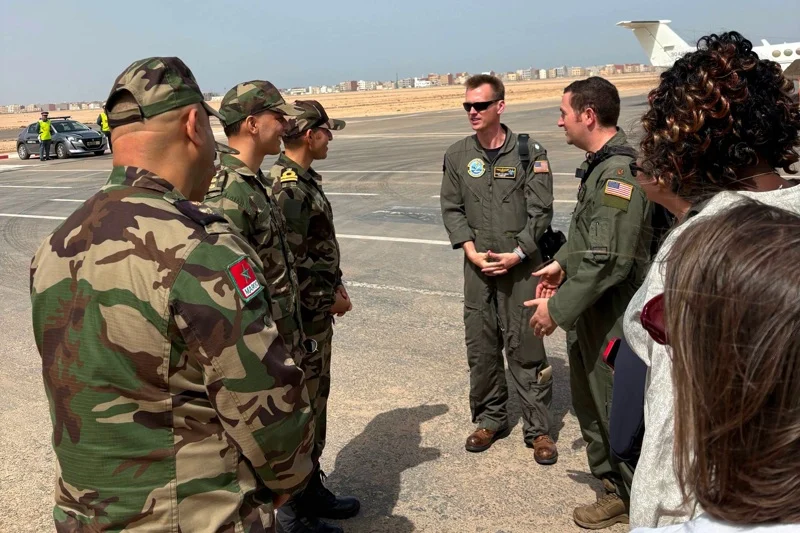
A delegation of senior U.S. military officials from the U.S. Embassy in Rabat visited the Dakhla Atlantic Port, highlighting the strategic importance of the major infrastructure project as Morocco and the United States deepen cooperation on security, economic development and regional connectivity.
During the visit, the delegation reviewed maritime activities in the region and discussed with Moroccan officials issues related to maritime infrastructure, regional connectivity and economic development, as well as shared security priorities.
The visit follows a June trip by a U.S. mission delegation to Guerguerat, the border crossing between Morocco and Mauritania. That visit focused on border security, countering drug trafficking and illicit trade, and coordination among security agencies.
Together, the visits underscore the range of issues involved in Morocco-U.S. engagement in the southern provinces, spanning security and border management to infrastructure and economic development.
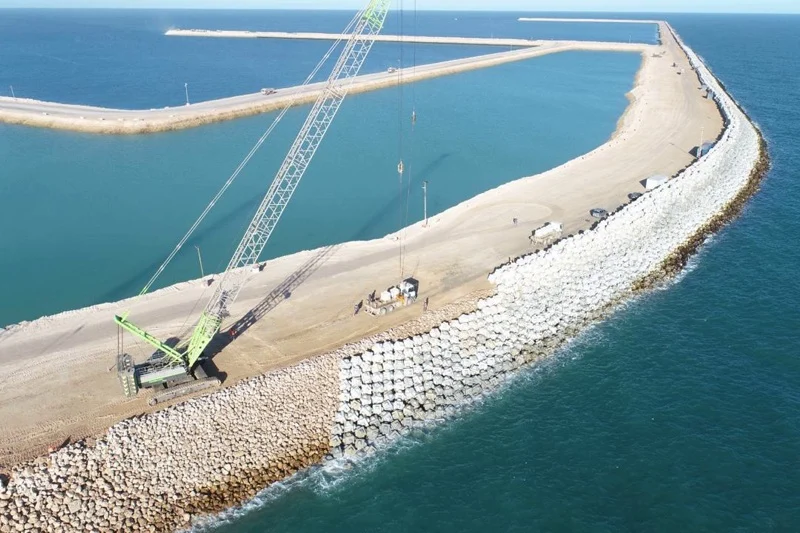
Dakhla port project advances
The Dakhla Atlantic Port is one of Morocco’s major infrastructure projects in the southern provinces and is intended to strengthen the region’s position as a logistics and economic hub connecting Morocco with West Africa, the Sahel and international markets.
The Ministry of Equipment and Water said overall construction progress has exceeded 65%, while work on the maritime bridge has reached 85.4%. Major reclamation works are about 50% complete.
More than 2,800 workers are involved in the project, according to the ministry.
The project forms part of the development program for Morocco’s southern provinces and is designed to create an integrated port, industrial and logistics platform capable of supporting investment and regional trade.
Beyond handling imports and exports, the port is intended to improve Morocco’s connections with its African hinterland, including landlocked Sahel countries, as part of Morocco’s broader initiative to facilitate their access to Atlantic trade routes.
Port linked to green energy ambitions
The planned port complex includes a heavy-load terminal, while the commercial basin is expected to be deepened from 16 to 18 meters to accommodate larger vessels.
The project also includes two terminals dedicated to green ammonia, with a combined capacity of up to 6 million tons annually, linking the port to Morocco’s plans to develop renewable energy and green hydrogen industries.
The port is expected to form part of a wider industrial and logistics hub incorporating activities related to green hydrogen, renewable energy and low-carbon industries.
The project is being developed within a broader national port strategy that includes major facilities such as Tanger Med and the Nador West Med port.
Growing US economic involvement
The U.S. delegation’s visit comes amid growing American economic engagement in Morocco’s southern provinces.
In late July, the U.S. Trade and Development Agency signed an agreement with Moroccan-American joint venture ORNX to finance a preliminary engineering study for an ammonia production project in Laayoune.
The agreement, valued at 57 million Moroccan dirhams, or about $5.7 million, will support studies for a project expected to eventually produce up to 560,000 tons of ammonia annually.
ORNX selected a consortium of U.S. companies to carry out the engineering study. The planned project would rely on about 900 megawatts of electrolyzer capacity and integrate renewable energy generation, hydrogen production and ammonia manufacturing.
The Dakhla visit therefore comes at the intersection of Morocco’s security, infrastructure, energy and economic priorities along its southern Atlantic coast.
As construction of the Dakhla Atlantic Port progresses, the project is increasingly positioned by Moroccan authorities as a potential logistics and industrial hub linking the country with African markets and wider Atlantic trade networks.



add your comment
Terms of publication : Not to offend the writer, people, sacred things, or attack religions or the divine self, and refrain from racist incitement and insults.