
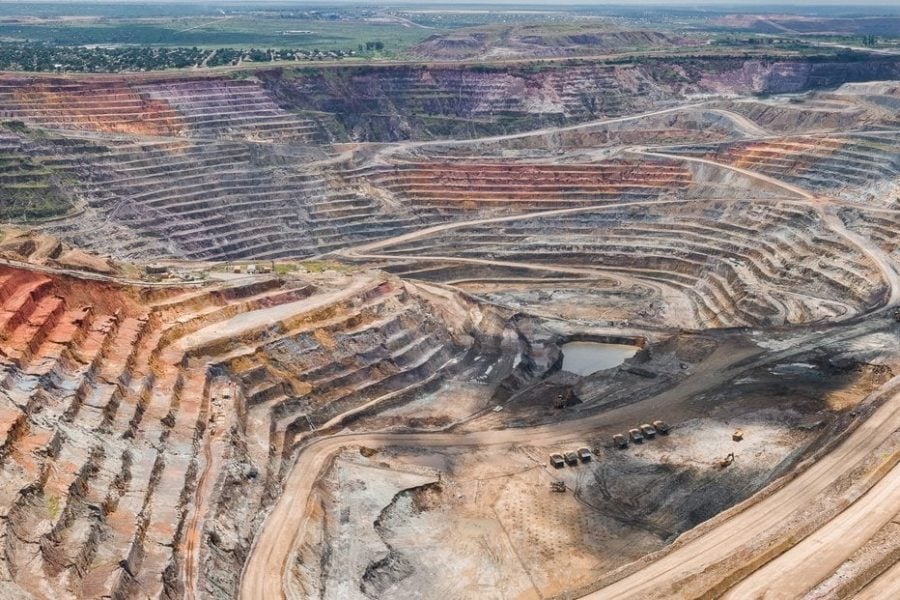
Morocco’s mining sector is seeing increased activity around titanium and antimony projects as the country seeks to strengthen its position in global critical minerals supply chains, according to Australian mining platform Mining.com.au.
The platform reported that a pilot processing plant has been launched for the Titan Beach project, which covers 192 square kilometers and has a titanium oxide content of 14.9%.
The project could help strengthen Morocco’s titanium supply chain for its growing aerospace industry while increasing the country’s access to critical minerals, according to the report.
Titanium oxide has been classified as a critical and strategic mineral by several countries, including the United States, Canada and European countries. Global demand is driven largely by aerospace manufacturing, defense programs and industrial pigments, while supply is concentrated among a limited number of producers.
The global titanium market is expected to reach between $2.9 billion and $3.7 billion by 2030, the report said.
Morocco’s mining industry accounts for about 10% of the country’s gross domestic product and roughly 30% of total exports, according to the platform. The sector employs about 40,000 people and attracts between $1.7 billion and $3.4 billion in annual investment, it said.
The report also highlighted Morocco’s 2021-2030 Mining Plan, a strategy aimed at increasing the sector’s contribution to the national economy by encouraging investment, developing higher-value production and promoting innovation.
The strategy also seeks to address challenges including the discovery of new mineral deposits, increasing the added value of extracted materials and ensuring the sector’s sustainable development, according to Mining.com.au.
Antimony draws attention
The platform also pointed to the Casablanca Antimony Project, a 79-square-kilometer project in central Morocco involving companies including Steadright Critical Minerals, NSM Capital and Zeus Resources.
The project contains evidence of multiple historical and more recent exploration activities, with rock samples showing antimony concentrations of up to 46.52%, according to the report.
Interest in antimony has increased as Western countries seek alternatives to Chinese supplies. China restricted antimony exports to the United States in 2024, contributing to a sharp increase in prices, while China accounts for about 80% of global production and more than half of global reserves, the platform said.
The report said Western countries have since focused on identifying and developing antimony sources outside China, potentially increasing Morocco’s strategic importance as a source of future discoveries and production.
Global antimony production declined from 187,000 tons in 2011 to 110,000 tons in 2023, according to the report, pointing to tighter supplies in international markets.
Antimony is used in a range of industries, including electronics, defense, energy storage and renewable technologies. Its applications include ammunition and armor-piercing projectiles, laser-guided systems, military electronics, batteries, flame retardants and night-vision equipment, the platform said.
The developments come as countries seek to diversify supplies of critical minerals used in strategic industries and reduce their reliance on concentrated global sources.




add your comment
Terms of publication : Not to offend the writer, people, sacred things, or attack religions or the divine self, and refrain from racist incitement and insults.