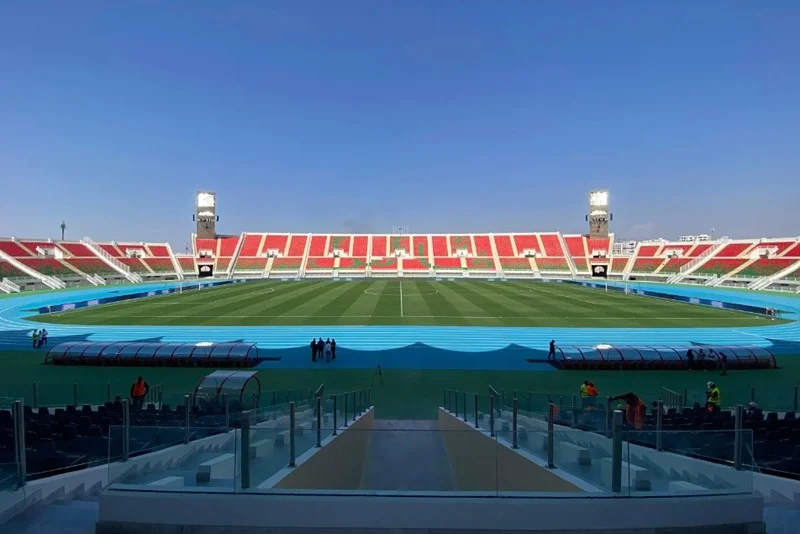
A public call for tenders estimated at 2.816 billion dirhams has just been launched to upgrade the Fez Sports Complex, as part of Morocco’s preparations for the 2030 World Cup, through an open international call for tenders launched by the National Agency for Public Facilities (ANEP).
According to the Special Conditions relating to the call for tenders, the design of the Fez Sports Complex must comply with the rigorous sustainability standards established by FIFA, in order to create an infrastructure that not only meets the needs of a large-scale sporting event but also contributes to environmental conservation and the improvement of the quality of life for local communities.
The stadium project imposes a series of general sustainability criteria that must be respected during the design, construction, and operation of stadiums hosting international events. These criteria aim to ensure that sports infrastructures minimize their environmental impact while maximizing social and economic benefits for local communities.
The project comes with particularly ambitious environmental requirements, as the Fez Sports Complex is expected to align with an approach aimed at obtaining the “High Environmental Quality (HQE) Sustainable Infrastructures” certification.
This environmental approach, integrated into the contract, covers the various phases of the project and relies notably on eco-design, biodiversity preservation, sustainable resource management, and the improvement of comfort and the infrastructure’s quality of use.
The involved contractors will be subject to obligations of means and results regarding environmental performance, mainly appointing a coordinator trained in environmental certifications and deploying the human and technical resources necessary to monitor the environmental specifications and ensure the success of the certification process.
The construction work must be carried out in accordance with a Low-Nuisance Construction Site Charter, which specifically requires the development of an erosion and sedimentation management plan, a construction waste management strategy, and an air quality management plan.
The energy component targets a reduction of at least 30% in energy consumption compared to a standard design, achieved notably through the use of LED lighting, high-performance HVAC systems (Heating, Ventilation, and Air Conditioning), and a reinforced thermal envelope. The project also mandates that 5 to 10% of the energy be generated from renewable sources, alongside the installation of a Centralized Technical Management (CTM / BMS) system to monitor and optimize consumption.
The project also aims to reduce water consumption by at least 40%, particularly through the use of water-efficient fixtures and the recovery and reuse of rainwater and greywater for irrigation and certain non-potable uses, with specific provisions planned to strengthen the resilience of the stormwater drainage system against climate change.
The project prioritizes the use of materials with a low carbon footprint, such as low-carbon concrete, recycled reinforcement (rebar), and bio-based materials, as well as local sourcing to limit transport-related emissions. A Life Cycle Assessment (LCA) is also planned to quantify and reduce the embodied carbon within the materials and construction processes.
The preservation of biodiversity and the proper integration of the complex into its urban environment are also among the project’s guidelines, notably by limiting land artificialization (soil sealing) and enhancing the site’s natural characteristics.
The improvement of accessibility via public transport, pedestrian walkways, and bicycle paths is also taken into account.
Waste management must align with a circular economy approach, through the sorting, reuse, and recovery of materials. Contractors must ensure the traceability of the waste produced, reused, repurposed, recycled, or recovered.
Furthermore, the project integrates requirements relating to thermal and acoustic comfort, indoor air quality (IAQ), and the quality of the spaces intended for spectators, players, and staff. Resilience to natural and climatic risks is also factored in, particularly through the structural sizing against extreme winds and compliance with Moroccan seismic building codes.
Through this operation, the upgrade of the Fez Sports Complex aims to combine infrastructure modernization, environmental performance, resource management, and the improvement of reception conditions, in anticipation of major international sporting events, most notably the 2030 World Cup, which Morocco will co-host with Spain and Portugal.









add your comment
Terms of publication : Not to offend the writer, people, sacred things, or attack religions or the divine self, and refrain from racist incitement and insults.