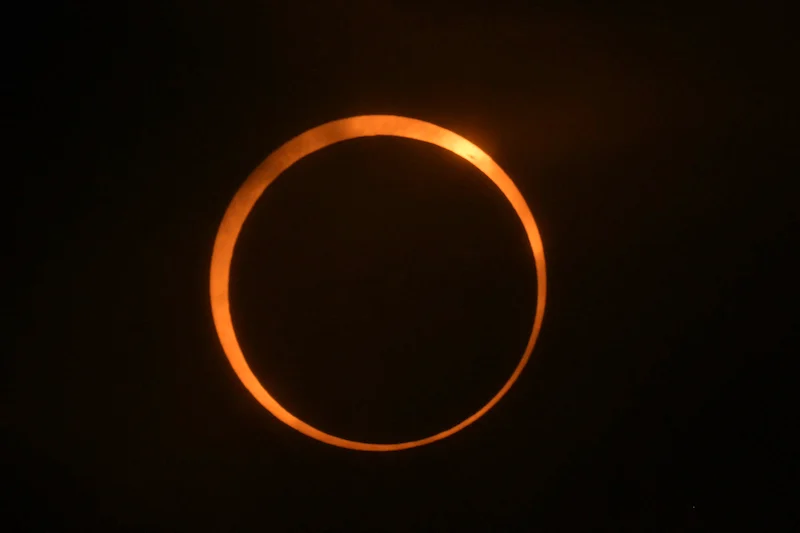
Morocco will witness a partial solar eclipse on Wednesday evening, with the Moon expected to obscure part of the Sun shortly before sunset, offering skywatchers across the country an opportunity to observe the astronomical event.
The extent of the eclipse will vary depending on location, with northern parts of Morocco expected to experience a greater degree of solar obscuration than areas farther south.
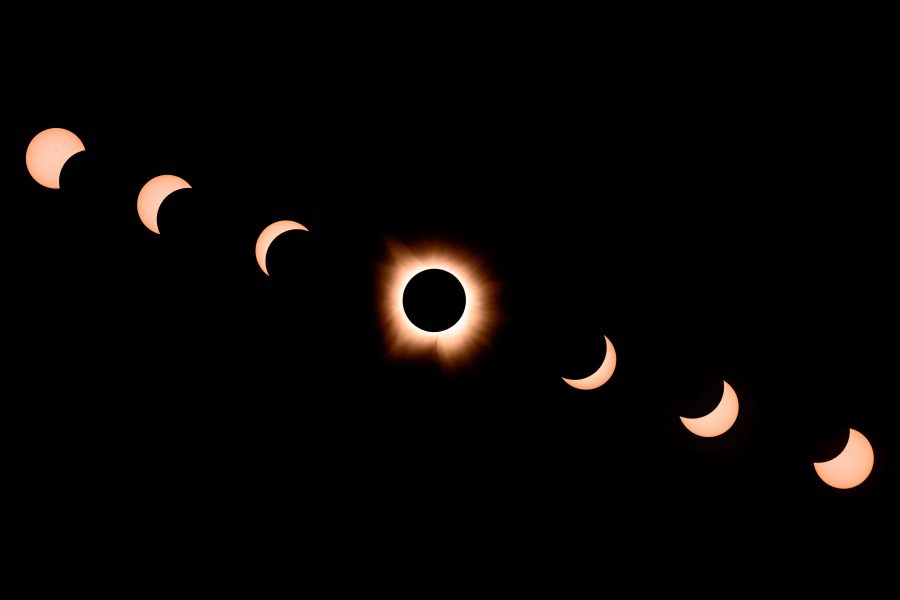
The eclipse will be total along a narrow path stretching from northern Russia across the Arctic Ocean, Greenland and Iceland before crossing the Atlantic Ocean and reaching northern Spain and limited areas of Portugal. In those locations, the Moon will completely cover the Sun for a brief period.
The partial eclipse, meanwhile, will be visible across a much wider area, including large parts of Europe and North Africa, as well as parts of North America and several areas over the oceans, according to NASA.
The event is expected to attract astronomy enthusiasts and researchers interested in observing changes in the Sun’s appearance, particularly in locations where the eclipse will reach its highest level of obscuration.
Mazen Younes, a member of the British Astronomical Association, said the event would be particularly striking across the Iberian Peninsula, where the path of totality will pass through parts of Spain.
“The scene will be more spectacular in the Iberian Peninsula, as the path of the total eclipse will cross parts of Spain, where the Sun will disappear completely for a few minutes in areas within the Moon’s shadow,” Younes told Hespress.
In Morocco, however, the eclipse will remain partial.
“That will not make the scene any less beautiful. Instead, it will give Moroccans a rare opportunity to see the Sun gradually transform into a golden crescent low on the horizon,” Younes said.
Northern Morocco to see highest obscuration
The percentage of the Sun covered by the Moon will differ from one Moroccan region to another, with the highest levels expected in the north of the country.
“Generally, the percentage of obscuration increases as we move toward northern Morocco, reaching its peak approximately in Tangier and Tetouan,” Younes said, citing estimates published by Time and Date.
In Tangier, the partial eclipse is expected to begin at about 6:44 p.m. local time and reach its peak at around 7:40 p.m., when more than 92% of the Sun’s disk will be covered.
In Agadir, the eclipse is expected to begin at about 6:54 p.m. and reach its maximum at around 7:49 p.m., with approximately 80% of the Sun obscured.
Residents of northern Morocco could therefore see the Sun gradually change from a full disk into a thin crescent while remaining close to the western horizon.
One of the most distinctive features of the eclipse in Morocco will be its timing, as it will coincide with sunset.
“The Sun will set before the eclipse has ended,” Younes said, adding that clear weather and an unobstructed western horizon could allow the colors of sunset to blend with the eclipsed Sun, creating a striking visual display.
Experts warn against viewing the Sun directly
Astronomy experts are also warning observers to take precautions when watching the eclipse.
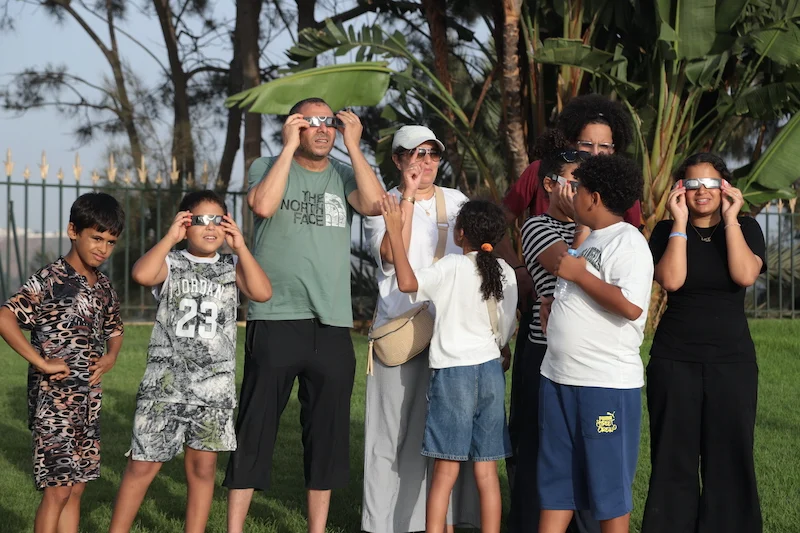
Looking directly at the Sun with the naked eye can cause eye damage, including during a partial eclipse. Younes recommended using certified eclipse glasses or other reliable solar-viewing equipment specifically designed for observing the Sun.
Ordinary sunglasses should not be used to view the eclipse, nor should improvised or uncertified viewing devices.
Scientists prepare to document the eclipse
The eclipse will also be the focus of scientific and educational activities involving Moroccan and international researchers.
The Instituto de Astrofísica de Canarias, in cooperation with Morocco’s Mohammed VI Polytechnic University and the U.S. National Solar Observatory, previously announced the launch of the “NEET” project to train joint scientific teams and establish a network of telescopes.
The project includes scientific and public outreach activities in Valencia, Spain, involving solar physics experts.
On Aug. 12, researchers are expected to observe and document the eclipse, collecting images and scientific data while also providing a live broadcast of the event accompanied by explanations for the public.



add your comment
Terms of publication : Not to offend the writer, people, sacred things, or attack religions or the divine self, and refrain from racist incitement and insults.