
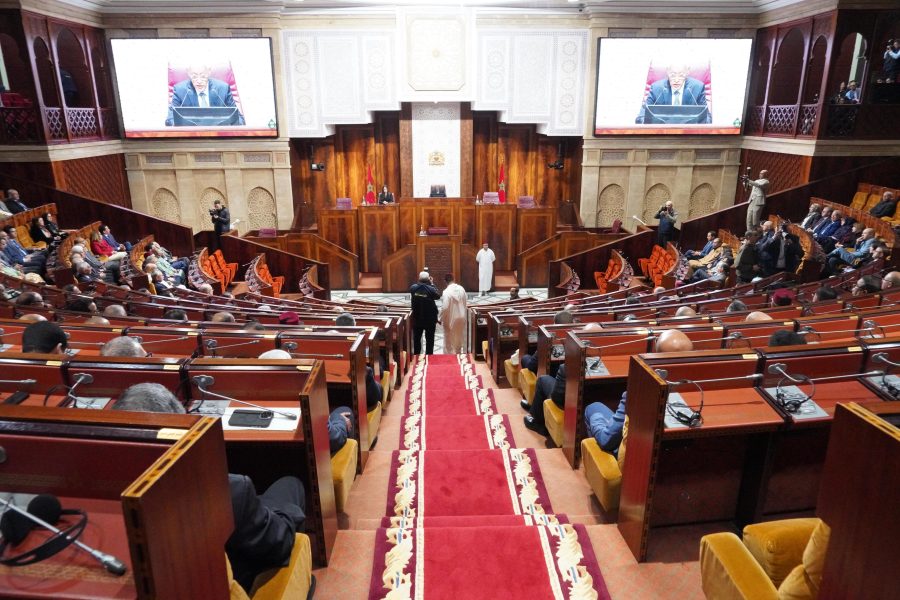
The House of Representatives concluded the second session of the fifth legislative year (2025-2026) of the 11th legislature (2021-2026) on Monday.
In his address at the closing sitting, the Speaker of the House of Representatives, Rachid Talbi Alami, stated that this legislature has been marked by sustained legislative output, robust parliamentary oversight, evaluation activities, fruitful institutional dialogue, and qualitative initiatives. He particularly highlighted the adoption of landmark legislation aimed at establishing a new generation of social services.
Throughout the legislative term, the House of Representatives adopted 237 government bills during 128 sittings, he said, noting that these texts regulate various aspects of institutional, social, economic, and cultural life.
He stressed that this record should not be assessed solely in quantitative terms, given the impactful initiatives that have characterized the legislature.
Talbi Alami noted that more than 60% of the legislative texts were adopted unanimously, reflecting “the consensus among the nation’s components on the country’s major fundamental issues.” He added that over 25% of the laws adopted are foundational legislation.
In the same context, he pointed out that members of the House submitted more than 14,000 amendments to draft legislation, over 2,700 of which were accepted. Furthermore, more than 400 private members’ bills were tabled, including 65 that successfully entered the legislative process.
Regarding parliamentary oversight, the Speaker noted that the legislative institution examined a total of 3,991 oral questions across 125 sittings, while the number of written questions exceeded 32,000. The government responded to 62% of these questions, yielding nearly 20,000 replies.
He added that social issues, including health, social protection, public support for vulnerable groups, and education and training, as well as public finances, infrastructure, water, agriculture, investment, and youth and sports, occupied a prominent place in the exercise of parliamentary control.
Referring to the work of the standing committees, Mr. Talbi Alami stated that they held more than 130 meetings devoted to hearing from government members and heads of public institutions, in addition to authorizing 12 exploratory missions.
Regarding the evaluation of public policies, he indicated that the chamber carried out five evaluation operations over the past five years. He added that this work focused, for the first time, on the evaluation of specific laws, notably through examining the implementation conditions and modalities of Law No. 103-13 on combating violence against women.
This effort culminated in the examination, during a plenary session attended by government members, of four reports prepared by the relevant thematic groups, he noted.
This work also led to a consensus on more than 500 recommendations covering current public policies with a direct impact on the productive, social, and service sectors. He added that these reports constitute “rich institutional capital” that will contribute to improving the governance of public services and the performance of public policies.
Regarding relations with constitutional institutions and governance bodies, the Speaker indicated that during the current legislative term, the House received 45 annual reports and 68 advisory opinions, 17 of which were requested by the House itself. All of these were forwarded to the competent parliamentary committees for review.
Addressing the development of the regulatory framework governing the House’s operations, Talbi Alami recalled that the internal rules of procedure were revised three times, in 2023, 2024, and 2025.
He explained that these revisions notably addressed legislative procedures, the parliamentary code of conduct and ethics, asset declarations, conflicts of interest, mandate forfeiture procedures, relations with constitutional institutions, and the work of standing committees, all while taking into account the rulings of the Constitutional Court and daily parliamentary practice.
On institutional openness, he highlighted that the House continued to implement communication programs targeting the public and civil society organizations, particularly through executing action plans under its membership in the Open Government Partnership (OGP). He also pointed to the achievements made in developing an e-parliament system, which the House has been working to consolidate since 2014 as part of its program to modernize and digitalize parliamentary administration and procedures.
In this regard, Talbi Alami noted that the House has strengthened its engagement with citizens, particularly children, adolescents, and young people, by continuing to organize the Moroccan Children’s Parliament, consolidating traditions of public consultation, and establishing the Parliamentary Studies and Parliamentary Press Awards as institutional traditions.






add your comment
Terms of publication : Not to offend the writer, people, sacred things, or attack religions or the divine self, and refrain from racist incitement and insults.