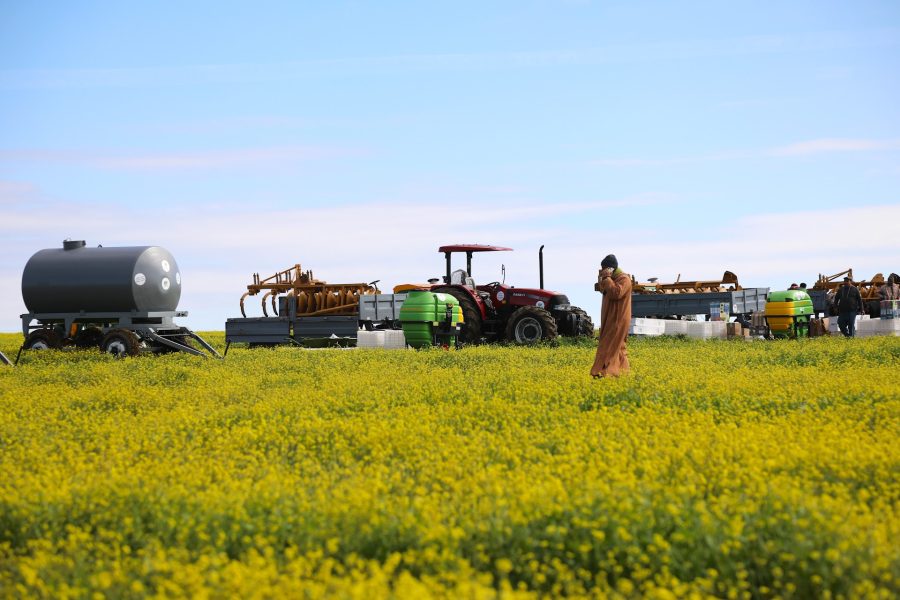
Morocco’s National Federation of the Agricultural Sector, affiliated with the Moroccan Labour Union (UMT), has launched a 12-day protest campaign across more than 20 locations nationwide, accusing the Ministry of Agriculture of failing to implement a series of agreements affecting thousands of workers in the sector.
The demonstrations, running from June 18 to June 30, mark the latest escalation in a labor dispute that has been simmering for months between union representatives and the ministry.
“The level of tension has reached an unprecedented point,” Badr Ourich, secretary-general of the National Federation of the Agricultural Sector, told Hespress English.
The regional protests follow two previous mobilizations organized by the union earlier this year. The first took place during the International Agricultural Fair (SIAM) in Meknes in April, while the second was held in May outside the Ministry of Agriculture and the Ministry of Economy and Finance in Rabat.
According to the union, the dispute centers on the government’s failure to implement approximately 10 agreements and administrative frameworks covering employees across several public agricultural institutions.
These include the National Office for Food Safety (ONSSA), the Agricultural Development Agency, the Hassan II Institute of Agronomy and Veterinary Medicine, the National School of Agriculture in Meknes, the National Office for Agricultural Advice, the National Institute for Agricultural Research, and the National Agency for Water and Forests.
“Some systems were amended, but not implemented,” Ourich said, arguing that reforms approved in principle have yet to be translated into concrete measures benefiting employees.
One of the main grievances concerns public-sector workers who obtained academic diplomas but have not been integrated into the corresponding salary grades and administrative classifications.
According to the union, an agreement had been reached with the Ministry of Agriculture to regularize the situation of diploma holders through a methodology similar to that adopted in other public sectors, particularly education. However, the process has yet to be carried out.
“Our position is that this constitutes discrimination against employees in the agricultural sector, especially since the issue has already been resolved in other sectors,” Ourich said.
The union is also demanding increased funding for social welfare programs serving agricultural-sector employees. According to Ourich, staff members working for the Ministry of Agriculture, ONSSA and other affiliated institutions currently rely on a social welfare fund with an annual budget of approximately MAD 25 million.
He said an agreement had been reached to raise that amount to at least MAD 50 million annually, but the increase has not been implemented.
Another major point of contention is the wage gap between agricultural workers and employees in the industrial sector.
According to the union, industrial workers currently earn roughly 30% more than agricultural workers performing comparable jobs. Union leaders argue that the disparity is unjustified and should be gradually eliminated.
Ourich said the Ministry of Agriculture had previously agreed to coordinate with the Ministry of Labor on a roadmap to achieve wage parity by 2028, but no concrete progress has been made.
“Nothing has been done,” he said.
The federation warned that the current protest campaign could be extended if negotiations fail to produce results. Union leaders have not ruled out additional forms of escalation should authorities continue to delay implementation of previously signed agreements.
The dispute comes at a sensitive time for Morocco’s agricultural sector, which remains a key pillar of the national economy and employs a significant share of the workforce. Union officials say workers are seeking the fulfillment of commitments already agreed upon rather than the negotiation of new demands.
For now, the demonstrations are expected to continue across multiple regions until the end of June, with the union closely monitoring the government’s response.





add your comment
Terms of publication : Not to offend the writer, people, sacred things, or attack religions or the divine self, and refrain from racist incitement and insults.