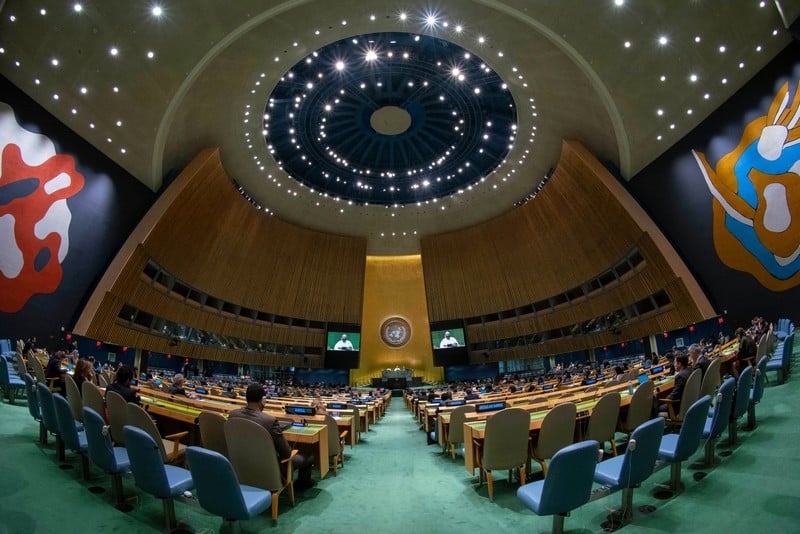
United Nations High Commissioner for Human Rights Volker Türk warned Monday that the world is facing an “unprecedented and shameless assault” on the international order founded on fundamental rights, as he opened the 62nd session of the United Nations Human Rights Council in Geneva.
Addressing member states, Türk said the global human rights landscape has reached a critical moment, marked by mounting conflicts, repression and challenges to international norms. While acknowledging setbacks, he stressed that the broader trajectory of human rights remains one of progress toward greater freedom and urged governments to continue strengthening protections for fundamental rights.
“The struggle for human rights is a story of tremendous progress followed by setbacks,” Türk said, adding that the overall direction remains clear despite current challenges.
The high commissioner welcomed a recently reached agreement between the United States and Iran that includes an immediate and permanent ceasefire and the reopening of the Strait of Hormuz. However, he said the conflict had already produced “devastating effects on human rights throughout the region and around the world.”
Türk condemned the use of force against Iran by Israel and the United States, while also criticizing Iranian attacks targeting several countries in the region and Tehran’s blockade of the Strait of Hormuz. He called on all parties to exercise “maximum restraint” and implement the agreement “swiftly and in good faith.”
The UN official also voiced concern over the situation inside Iran, saying its population remains caught “between war and brutal repression.” He further highlighted ongoing violence in Gaza Strip and the West Bank, condemning attacks against Palestinian civilians and efforts that could undermine the creation of a viable Palestinian state.
“All of this is entirely illegal,” Türk said, warning that repeated international alerts have failed to prompt sufficient action. He urged influential governments and international actors to take steps to end civilian suffering and ensure accountability.
Beyond the Middle East, Türk cited a growing number of human rights concerns worldwide. He pointed to attacks by armed groups in Mali, Burkina Faso and Niger, as well as continuing violence in Cameroon and Nigeria. He also raised concerns about conflicts in Ethiopia, worsening insecurity in Somalia, gang violence in Haiti, the human rights situation in Cuba and ongoing institutional challenges in Peru.
Separately, Deputy High Commissioner for Human Rights Awa Dabo presented an update on the regional consequences of the recent conflict. She said missile and drone attacks launched by Iran against several Gulf states and Jordan killed 19 civilians and injured nearly 850 others.
Dabo stressed that attacks targeting civilians and civilian infrastructure constitute serious violations of international humanitarian law. She also warned that disruptions to shipping through the Strait of Hormuz could have far-reaching consequences for energy supplies, humanitarian assistance and global food security.
She called for an immediate de-escalation of tensions and the restoration of the free movement of goods to prevent a broader humanitarian and economic crisis.





add your comment
Terms of publication : Not to offend the writer, people, sacred things, or attack religions or the divine self, and refrain from racist incitement and insults.