
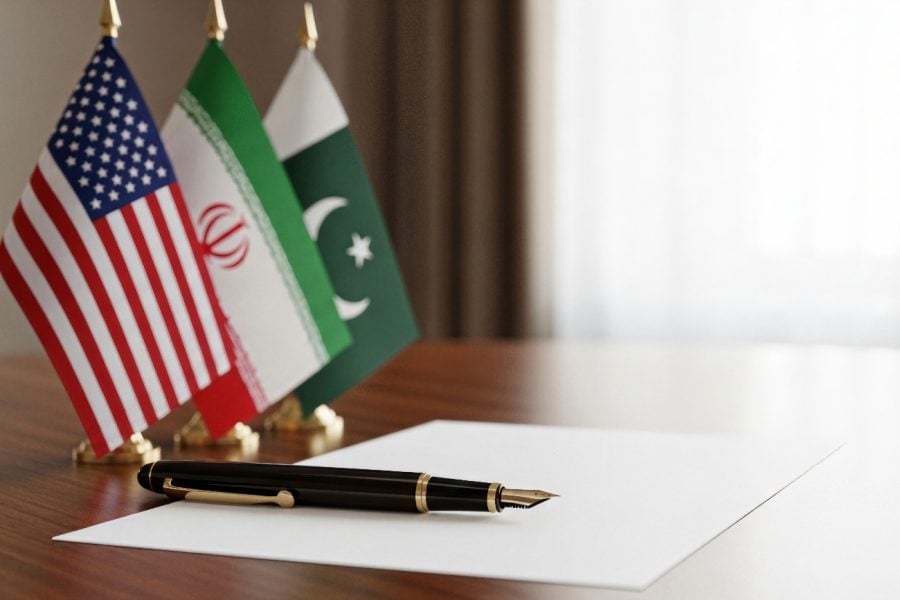
A Moroccan international relations expert says escalating tensions between the United States and Iran reflect a volatile global environment marked by uncertainty, strategic rivalry and fragile international order.
Speaking to Hespress EN, analyst and Professor of International Law, Tajeddine El Husseini said the confrontation between Washington and Tehran resembles a complex “chess game,” in which each side leverages its advantages, technological superiority on the U.S. side and geographic and strategic positioning for Iran.
El Husseini pointed to earlier predictions by a Chinese analyst who forecast that Donald Trump would return to power and that the United States could enter into a conflict with Iran during his presidency. The analyst also suggested such a war could end either in defeat or prolonged attrition.
“These projections were not speculative,” El Husseini said, noting they were based on historical precedents and strategic analysis. Some elements of those forecasts have already materialized, he added, while the outcome of any potential conflict remains uncertain.
The expert also highlighted recent tensions in the Strait of Hormuz, a critical global shipping route. He said a brief period of de-escalation, marked by Iran allowing maritime traffic and a ceasefire between Hezbollah and Israel, had eased pressure on global markets.
However, that relief was short-lived. According to the analyst, Iran later tightened its stance, restricting passage through the strait and confronting foreign vessels, citing continued U.S. pressure and sanctions.
El Husseini said such developments underscore a fundamental imbalance: while the United States holds a technological edge, Iran’s geography gives it leverage over vital maritime routes and regional dynamics.
He added that Iranian diplomacy has demonstrated strategic adaptability rooted in a long historical tradition, while U.S. rhetoric has at times escalated tensions. Statements attributed to Trump about targeting Iran’s infrastructure, he said, have not received broad domestic or international support.
Public opinion in the United States, shaped by past conflicts such as the Vietnam War and the war in Afghanistan, is increasingly reluctant to back overseas wars not directly tied to national security, the analyst noted.
Beyond bilateral tensions, El Husseini warned that the situation reflects a weakening of international governance, with key decisions unfolding outside frameworks such as the United Nations Security Council.
He raised questions about potential alliances if the conflict escalates, including whether it could expand beyond the United States and Israel to involve actors such as NATO, Japan or Gulf countries.
The positions of major powers like China and Russia, as well as emerging actors such as Turkey, India and Pakistan, will also be critical in shaping the trajectory of the conflict, he said.
El Husseini added that Europe’s stance remains uncertain, questioning whether it will maintain its current cautious approach or take a more active role amid rising global tensions.
He concluded that any conflict could evolve into a prolonged war of attrition, given Iran’s geographic scale, complex terrain and large population, making a decisive outcome difficult and prolonging instability in an already fragile international system.





add your comment
Terms of publication : Not to offend the writer, people, sacred things, or attack religions or the divine self, and refrain from racist incitement and insults.