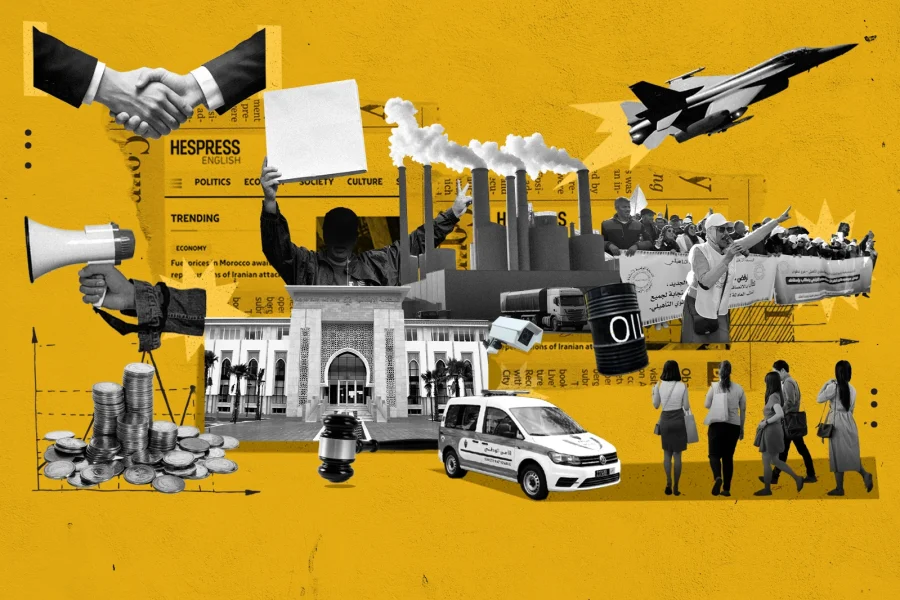
Welcome to this week’s edition of our Weekly Risk Watch, offering insights into the economic, political, and security updates that could have significant implications for your business or daily life.
Economy and market:
- Morocco’s aromatic and medicinal plant sector: Flooding in Ksar Kebir and the Gharb, along with poor weather at ports, has damaged crops, greenhouses, and exports.
Risk factor: These conditions continue to pose risks to production, supply chains, and market recovery.
- Tobacco price rise: From April 1, retail prices for several mass-market cigarette brands, namely Casa, Camel Activate, Marquise Classic, and Marvel, increased under Circular No. 6730/214, while new heated tobacco products entered the market and some older lines were removed.
Risk factor: Higher prices for these cigarette brands could push consumers toward cheaper or unregulated alternatives, affecting public health.
- Fuel price in Morocco: Diesel prices have increased more slowly than global benchmarks, while gasoline prices have risen faster, prompting the Moroccan Competition Council to review the semi-monthly adjustment system.
Risk factor: Differences in how price increases reach consumers could raise costs for drivers and create uncertainty in the fuel market.
- Nonperforming debts in Morocco: Justice Minister Abdel Latif Ouahbi said roughly MAD 100 billion are tied up in nonperforming debts, highlighting systemic issues in the judicial and financial sectors.
Risk factor: Loopholes in the judicial expertise system allow individuals to retain mortgaged properties and continue exploiting them without repaying debts, fueling the accumulation of massive nonperforming loans.
Political stability:
- Child dies from electric shock in Martil: A 6-year-old boy died after coming into contact with exposed electrical wires on the Martil corniche, believed to have been left after lighting equipment was removed from nearby public toilets.
Risk factor: The presence of live or unsecured cables in a public area poses serious safety risks to children and families.
- Debate over outside investors in Moroccan pharmacies: A proposal to allow outside investors to own shares in Moroccan pharmacies is sparking growing debate within the sector, with many pharmacists warning it could undermine professional independence and public health standards.
Risk factor: Allowing non-pharmacist investors could prioritize profits over patient care, undermine professional independence, and reduce equitable access to medicines.
- Ambulance technicians protest unemployment: Ambulance and medical transport technicians staged a sit-in in Rabat over persistent joblessness, with hundreds of trained graduates unable to find work despite urgent staffing needs across Morocco’s health system.
Risk factor: The lack of specialised staff forces reliance on untrained personnel, posing risks to patient care and safety during medical transport missions
Cross-border stability:
- Landmine case against Polisario Front and Algerian authorities: A Moroccan association representing landmine victims is preparing consultations with government bodies and partners to explore legal and diplomatic avenues for filing a case before international courts against the Polisario Front and Algerian authorities.
Risk factor: Recurring landmine explosions in desert areas related to the absence of precise maps continue to pose risks to civilians and military personnel.
-
- Hidden hashish tunnel in Ceuta: Spanish police say they discovered a hidden tunnel under a warehouse in Ceuta, equipped with rails, wagons, and pulley systems, used to smuggle hashish from Morocco to Spain and France.
- Royal Air Maroc cancels Middle East flights: Royal Air Maroc said it has canceled several flights to and from Doha, suspended until June 30, 2026, and Dubai, halted until May 31, 2026, due to ongoing regional developments.
Risk factor: The cancellations could leave passengers stranded, disrupt travel plans, and create difficulties in reaching destinations as scheduled.
- Beaches to avoid this summer: Morocco’s environment ministry classified Quemado and Sabadia in Al Hoceima, Likheira in Dakhla-Oued Eddahab, and Tangier City, Mohammedia, and Oued Merzeg in Casablanca as unfit for bathing, while three others remain partly polluted.
Risk factors: Pollution from wastewater, industrial discharges, inadequate sanitary facilities, proximity to river mouths and bays, and marine litter continue to pose health risks to swimmers at the affected beaches.


add your comment
Terms of publication : Not to offend the writer, people, sacred things, or attack religions or the divine self, and refrain from racist incitement and insults.