
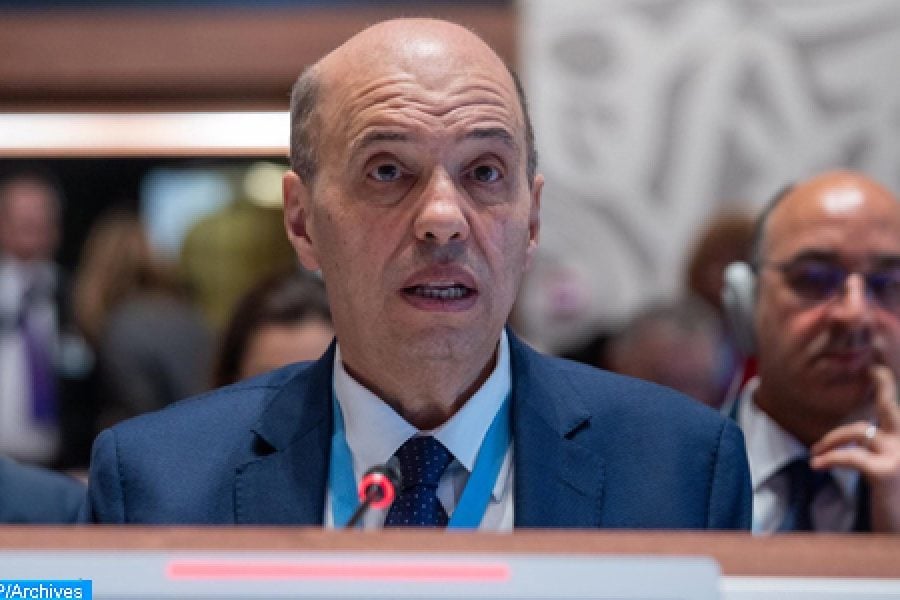
Morocco’s Ambassador and Permanent Representative to the United Nations Office in Geneva, Omar Zniber, highlighted on Thursday the Kingdom’s historic model of religious coexistence and its commitment to promoting interfaith dialogue and combating religious discrimination on the international stage.
“Morocco has always been a strong advocate of tolerance as well as of interreligious and intercultural dialogue and remains committed to strengthening international cooperation to promote a world where diversity is a source of richness and tolerance a shared value,” he said during an event held on the sidelines of the 61st session of the UN Human Rights Council (HRC).
Speaking at a meeting on combating religious discrimination, Zniber stressed that “Morocco is a land of diversity and tolerance” where Muslims, Jews, and Christians “have lived peacefully for centuries.” He noted that “the Kingdom has always been committed to promoting religious tolerance and respect for fundamental freedoms, incorporating a model of coexistence into its political, social, and cultural life.”
According to the ambassador, this tradition is upheld at the highest level of the State by His Majesty King Mohammed VI, who, in his capacity as Commander of the Faithful, serves as the “protector of all believers, regardless of their religion.”
Zniber also recalled the crucial role played by the late King Mohammed V in protecting Jewish citizens when he opposed discriminatory measures and clearly stated that there was no difference among Moroccans, whether Muslim, Jewish, Christian, or otherwise.
The ambassador also highlighted Morocco’s initiatives to promote religious tolerance and dialogue among faiths, notably the Marrakech Declaration on the Rights of Religious Minorities in Muslim-majority countries and the Al-Quds Appeal launched in 2019 by His Majesty King Mohammed VI and Pope Francis in support of enlightened interfaith dialogue during the historic visit of the pontiff to Morocco.
At the multilateral level, he reaffirmed Morocco’s active engagement within the United Nations General Assembly to promote “interreligious dialogue, tolerance, and mutual respect,” particularly through initiatives aimed at combating hate speech and religious intolerance.
He also referred to Morocco’s hosting of major international processes, such as the Rabat Plan of Action, which seeks to prevent advocacy of national, racial, or religious hatred that constitutes incitement to hostility, discrimination, or violence, and the Fez Process (2017) on preventing incitement to violence that could lead to atrocity crimes.
Zniber stressed that “interfaith dialogue is the most effective tool for resolving tensions linked to identity and religion,” adding that it “helps overcome misunderstandings, dismantle prejudice, and strengthen relations among peoples and nations.”
He further suggested that the Human Rights Council should complement existing mechanisms working on this fundamental issue by creating, through an appropriate instrument, a mechanism tasked with collecting international data on discrimination, xenophobia, racism, and hate speech to promote a pragmatic and consensus-based approach to combating these drivers of discord.
The diplomat concluded by inviting participants to a side event organized by Morocco on March 12 under the theme “Protecting human rights by combating hate speech,” which will bring together representatives from different faiths and aims to “translate commitments into concrete actions.”
Organized by the European Union, the side event marked the 40th anniversary of the mandate of the United Nations Special Rapporteur on freedom of religion or belief, created in 1986 by the Commission on Human Rights to promote and protect this fundamental right enshrined in the Universal Declaration of Human Rights and the International Covenant on Civil and Political Rights.


add your comment
Terms of publication : Not to offend the writer, people, sacred things, or attack religions or the divine self, and refrain from racist incitement and insults.