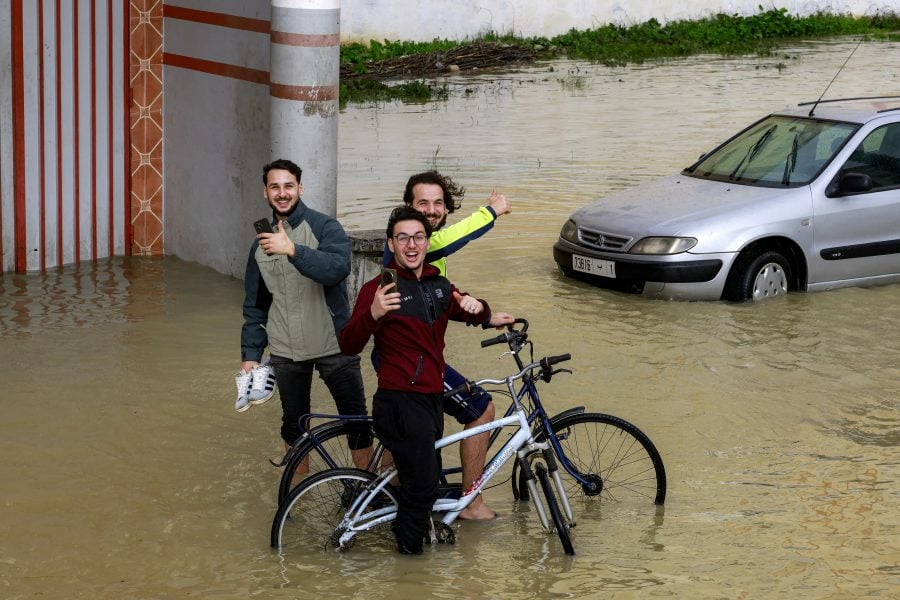
When floodwaters rose around Ksar El Kebir, forcing families to leave their homes with little warning, help did not come from one place alone. It came from neighbors opening doors, teachers reopening classrooms and strangers offering rides, meals and shelter to people they had never met.
“I won’t even try to describe what’s happening in my city right now,” said Otmane Baaj. “Just search Ksar El Kebir on social media and you’ll be shocked by the scale,” he as as local officials said about 50,000 people were evacuated from threatened areas of the city, many moving with only what they could carry as families tried to decide, minute by minute, what to save and where to go.
“No one imagined that within just a few hours, people would be forced to flee their homes,” Baaj said. “I witnessed human moments I had never experienced before. I’m still in shock.”
For many residents, the emotional toll was immediate. “What broke my heart the most was the look of helplessness in my parents’ eyes as they left their home,” Baaj said, adding that he was with them when the floods hit. “Thank God I was with them when the disaster struck.”
That sense of emotional strain quickly became part of the community response. Volunteers announced plans to organize a psychological support caravan once the emergency phase passes, aiming to provide mental health care to residents affected by the floods.
As the water advanced, residents described an emergency landscape that was changing by the hour. Authorities opened temporary shelters and began controlling access to some flooded zones, while families reported that power cuts hit parts of the city.
Housing was among the most urgent needs. Social media users helped arrange free hotel rooms in Larache for displaced families, while residents in nearby coastal towns stepped in as well.
Three apartments were offered free of charge in M’diq, and volunteers helped connect evacuees with available homes in Martil and Tetouan, sharing contact details widely on social media.
For many families, the help came from complete strangers. Apartment owners opened empty flats, while others hosted evacuees in spare rooms, including disabled father of three children, said Baaj, and local authorities alongside the army coordinated placements by prioritizing families with children, elderly members and people with disabilities.
Volunteers delivered meals and basic supplies to families staying in shelters and temporary housing. Community groups also provided accompaniment and assistance to evacuees relocated to shelter camps, checking on their needs beyond food and bedding.
Taxi drivers and private vehicle owners offered free transport to shelters, schools and hospitals. Others volunteered trucks to help families move belongings from flooded homes, offering one or two medium sized vehicles to assist with evacuation and clean up efforts.
Teachers and volunteers organized free lessons for displaced students, often using community spaces or private homes. Stationery and school materials were distributed through donations.
A private school in Larache province announced it would open its doors to students from Ksar El Kebir affected by displacement, and offered transportation from evacuation areas and supplies.
Individual initiatives stood out as well. A retired mathematics teacher originally from Ksar El Kebir, now living in Asilah, offered free math classes to displaced students. He said it was his way of standing by children whose education had been interrupted.
Youth volunteers were visible across affected neighborhoods, helping elderly residents. Others helped evacuees access medication and basic services during the first days of displacement.
As neighbors organized rides and meals, the official response formed another layer of the same story.
Emergency services and local authorities deployed teams to support evacuations, monitor river levels and assess damage to roads and basic infrastructure, working across affected pockets as water levels shifted and new streets became impassable.
For residents, the overlap between civic solidarity and institutional response became part of how the city held together, even as many tried to understand why some areas flooded faster than others and whether earlier warnings could have reduced the chaos.
At the same time, Moroccan civil society and human rights groups warned that not all responses reflected the same spirit of solidarity.
Several organizations condemned what they described as cases of extortion and exploitation of flood victims in Ksar El Kebir, calling them a violation of basic human values and a distortion of community solidarity.
They said some individuals took advantage of the situation by charging inflated prices for essential services, including selling candles for MAD 15, demanding excessive fees to transport people to safe areas, and raising rental prices in neighborhoods less affected by flooding.
Such practices, the groups said, worsen the suffering of families who have already lost homes and belongings.
Authorities continued to assess damage to roads and infrastructure, but local officials said the community response eased pressure on public resources and reflected deep social bonds in the region, at a moment when the flood was not only a local emergency but also a strain on the wider north.






add your comment
Terms of publication : Not to offend the writer, people, sacred things, or attack religions or the divine self, and refrain from racist incitement and insults.