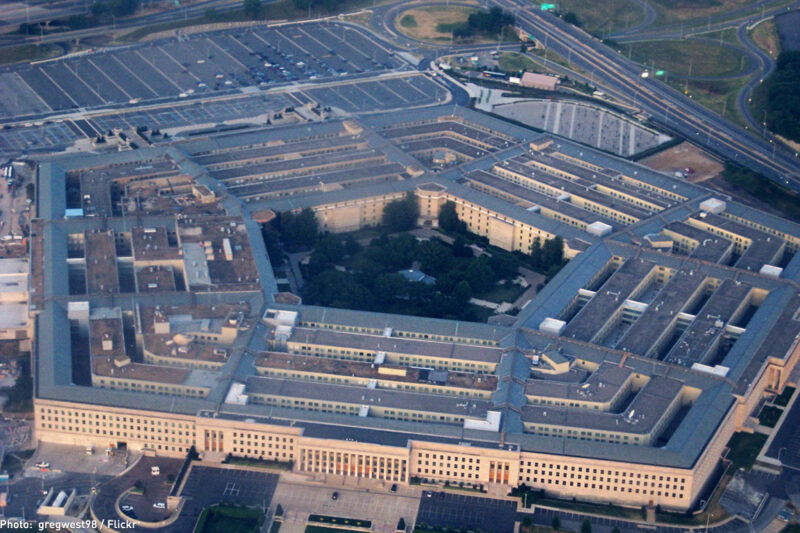
The United States has approved a potential military sale to Morocco involving advanced air-to-air missiles, underscoring the growing depth of the strategic defense partnership between Rabat and Washington, the Pentagon said.
According to a notice published in the U.S. Federal Register on Monday, the proposed deal is valued at an estimated $88.37 million and includes the sale of 30 AIM-120C-8 Advanced Medium-Range Air-to-Air Missiles, known as AMRAAMs. The missiles are among the most advanced in service worldwide and are designed for beyond-visual-range aerial interception.
The missiles would be supplied to Morocco’s Royal Air Force as part of a broader effort to modernize its air defense capabilities.
Security and military analyst Mohamed Chakir said the deal fits within Morocco’s comprehensive defense strategy, which goes beyond air force modernization to include a range of missile systems, both surface-to-air and air-to-air.
Chakir tells Hespress AR that the approach aims to reinforce Morocco’s ability to defend its borders and deter potential threats, particularly amid regional tensions and the presence of a neighboring military system. He added that strengthening defenses along the eastern border and the defensive wall remains a strategic priority.
Morocco, he said, is preparing for multiple scenarios, including military movements and security threats, through an integrated defense vision encompassing air, land and naval forces. The acquisition, Chakir added, aligns with Morocco’s long-standing military partnership with the United States, which runs from 2020 to 2030 and focuses on access to cutting-edge defense technology.
Military expert Abdelrahmane Mekkaoui described the acquisition of AMRAAM missiles as a qualitative leap for Morocco’s air defense system, particularly as they are intended for use on F-16 Block 72 fighter jets.
Mekkaoui said the missiles would enhance Morocco’s ability to protect its land and maritime borders as well as its national airspace, noting that the kingdom is steadily building an integrated air, naval, space and cyber defense arsenal.
He added that sustained modernization has helped curb the regional arms race seen in recent years. The AMRAAM missiles, he said, are equipped with highly advanced and classified targeting algorithms, and Morocco has assured U.S. authorities it has the capacity to safeguard the technology to the same standards applied by Washington.
Mekkaoui said the missiles are not only intended to counter conventional military threats but also to address emerging risks posed by extremist groups that have acquired aerial capabilities, including drones and portable surface-to-air missiles. He added that the system could also support efforts to disrupt transnational organized crime networks, including drug trafficking groups, a priority shared by both Morocco and the United States.
The proposed sale also includes related equipment and systems needed to integrate the missiles with Morocco’s F-16 fleet, further enhancing the Royal Air Force’s operational readiness, he said.
Geostrategic analyst Cherkaoui Roudani said the missile deal reflects the deepening operational maturity of U.S.-Morocco defense ties and cannot be separated from recent high-level military visits between the two countries.
Roudani said the sale fits within the broader 2020–2030 military roadmap signed during a visit by former U.S. Defense Secretary Mark Esper, which laid the foundation for long-term cooperation focused on capability-building, interoperability and integrated military planning. He added that subsequent visits by senior U.S. military officials further demonstrated Washington’s confidence in Morocco’s role as a key regional security partner.
The partnership, he said, is also reflected in preparations for upcoming editions of the annual African Lion military exercises, which have become a central platform for joint operational testing and multinational cooperation across Africa.
Roudani said Morocco is viewed as a pillar of regional stability amid worsening security conditions in the Sahel and sub-Saharan Africa, particularly in efforts to counter terrorism and transnational crime.
He added that the acquisition marks a shift in Morocco’s air defense doctrine toward proactive, beyond-visual-range engagement capabilities, enhancing deterrence and increasing the cost of any potential violation of Moroccan airspace.




add your comment
Terms of publication : Not to offend the writer, people, sacred things, or attack religions or the divine self, and refrain from racist incitement and insults.