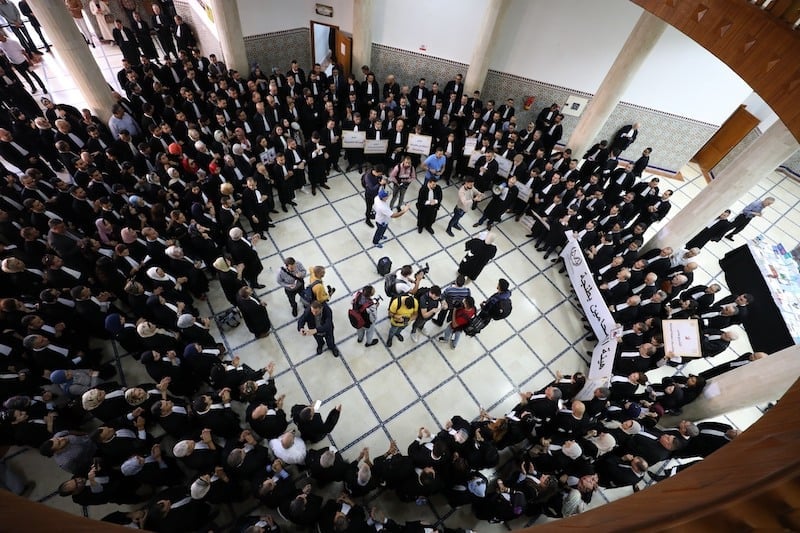
Lawyers across Morocco are staging a nationwide strike and work stoppage today. The strike was declared by the Association of Bar Associations of Morocco (ABAM) after an extraordinary meeting in Marrakech.
The lawyers’ main demand is to withdraw a new draft law governing the legal profession that they say was written without proper consultation and violates previous agreements made with the Justice Ministry.
On the morning of January 6, courts across Morocco were almost totally paralyzed as lawyers stopped work in protest. Civil, criminal, and administrative hearings were not held because lawyers refused to provide legal services.
Lawyers and their associations have warned of further mobilization if their demands are not met.
The strike is the latest phase in a long and growing conflict between lawyers and the Ministry of Justice over judicial reforms and how the legal profession should be regulated.
A central complaint is that the draft law weakens the autonomy of lawyers by giving the state more control over training, oversight and discipline.
Lawyers say this reverses decades of self-regulation and would let the Ministry of Justice influence who becomes a lawyer and how lawyers are disciplined.
Lawyers say that the profession has traditionally controlled its own training and ethical standards, and handing those powers to the executive branch undermines their ability to defend people without fear or pressure.
The draft law proposes new disciplinary mechanisms. Lawyers say these could be used to punish them for defending unpopular clients or challenging government decisions.
Previously, disputes between lawyers and clients were handled by bar councils first, with courts later if needed. The draft would transfer some of this authority to state institutions, reducing the profession’s self-governance.
Senior lawyers have publicly warned that the draft law violates the Constitution and tramples on the rights of defense.
They say that any restriction on lawyers’ freedom directly affects citizens, because if lawyers can’t act freely, citizens lose rights in court.
Lawyers say that promised guarantees of independence were not kept in the final text, and the law now contains measures that hinder lawyers’ ability to defend clients effectively.
One of the biggest grievances, according to lawyers, is that there was no real consultation with bar associations even though earlier agreements promised a participatory process.
ABAM says comments and proposals from lawyers were ignored or dismissed, which they see as a breakdown of trust and dialogue between the profession and the Ministry.
Beyond the professional law itself, lawyers are also alarmed by related changes to civil and criminal procedure codes that could limit how they represent clients.
For example, some reforms would limit appeals for civil cases under fixed amounts, meaning people might not be able to challenge lower court decisions.
There were proposals to allow prosecutors to retry cases already judged, something lawyers say weakens the rule of law.
These procedural reforms, part of a broader justice reform package, are seen as part of the same trend to weaken defense roles.
Lawyers argue that a society cannot have fair trials or access to justice if those who defend accused or civil parties lack independence.
They see the draft law as part of a larger shift that could make the justice system more controlled by the executive branch and less by independent professionals.
Lawyers say they have been raising concerns for months or even years, calling for meaningful dialogue on draft reforms that would affect how courts, appeals, defence rights, and professional independence work in Morocco.
Some of these earlier protests have included sit-ins in front of Parliament and heated meetings involving thousands of lawyers.
In response, the Justice Ministry has so far not withdrawn the draft law, saying it aims to organize the profession and update the legal framework. This refusal is a core reason why the strike was called.
The strike’s effects are already visible: many cases are delayed, people who need legal help cannot get it, and courts risk gridlock if the standoff continues.
The dispute has also drawn attention from rights groups and public actors who say that interfering with lawyers’ independence could weaken justice and citizens’ rights.
Moroccan lawyers have not only protested at home, they have also written an open letter to international legal bodies to raise alarm about the draft law’s implications.
On December 26, 2025, the President of the National Association of Lawyers of Morocco, Maître Mohamed Lahbib Benchikh, sent an open letter to the President of the International Union of Lawyers (UIA), based in Paris.
In that letter, Benchikh said that the draft law poses a setback to the independence of the legal profession and called on the UIA to push Moroccan authorities to revise the draft in line with international standards and to include lawyers in a genuine, participatory legislative process.








add your comment
Terms of publication : Not to offend the writer, people, sacred things, or attack religions or the divine self, and refrain from racist incitement and insults.