
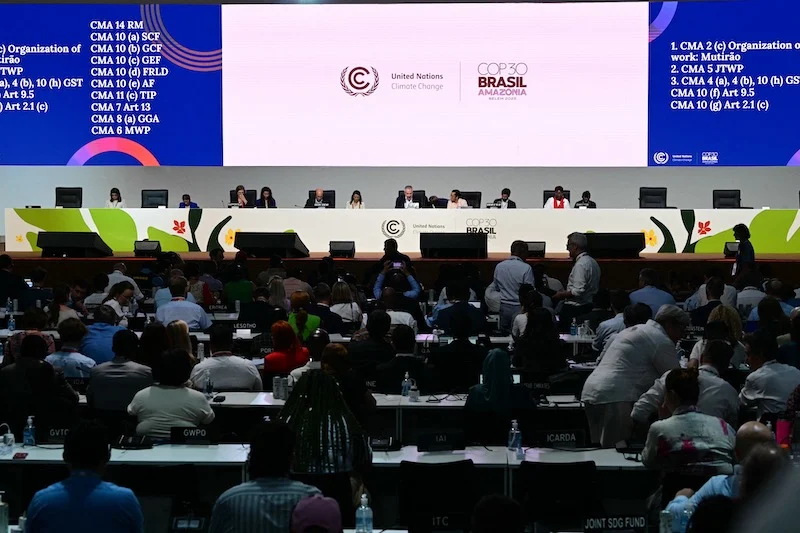
Morocco’s experience in water resource management, through local authorities projects’ for reusing treated wastewater, was spotlighted Tuesday at COP30 in Belém, in the Brazilian Amazon.
A side event organized on the second day of the UN Climate Conference by the Moroccan Association of Municipal Council Presidents (AMPCC) and the Directorate General of Local Authorities (DGCT) under the theme “Wastewater reuse: an innovative alternative for the circular economy in urban areas,” provided an opportunity to discuss challenges associated with this practice, a sustainable response to water stress, in line with the High Royal Guidelines.
Officials and experts emphasized that pressure on freshwater resources is intensifying under the combined effects of urban growth, agricultural and industrial demand, and continued rainfall deficits. The reuse of treated wastewater is deemed a “win-win” solution: it reduces drinking water consumption while preventing pollution of ecosystems.
Faced with seven consecutive seasons of drought and a persistent rainfall deficit, Morocco has embarked on a proactive strategy to secure its water resources, according to Jaouad Elkharraz, founder of the Water-Energy-Climate Experts Network. According to him, the overexploitation of aquifers, saline intrusion, and the increasing scarcity of surface water require resorting to “unconventional” sources, including desalination and wastewater reuse.
Referring to the potential of desalination, Elkharraz pointed out that an ambitious national program aims to produce 1.7 billion m 3 of fresh water per year by 2030, using reverse osmosis technology and increasing use of renewable energy to power the country’s large plants.
El Hassan Zoubir Idrissi, head of the environment at the DGCT’s Local Public Networks Directorate, detailed the national strategy for the reuse of treated wastewater, part of the National Program for Shared Sanitation and Wastewater Reuse (PNAM). This program, he explained, aims to mobilize 100 million m³ of treated water from 2027 and 573 million m³ by 2040 for watering golf courses and green spaces, agricultural irrigation, and some industrial activities.
Idrissi added that the 2025-2034 program plans to expand to 90 municipalities and 14 new agricultural projects, noting that the private sector is also contributing, with the OCP Group having recovered over 20 million m³ for phosphate washing in 2024.
For his part, Karim Bouamrane, mayor of Saint-Ouen-sur-Seine and vice-president of Plaine Commune (France), praised Morocco’s leadership in Africa in terms of sustainable development and called for cooperation based on sharing expertise and training younger generations.






add your comment
Terms of publication : Not to offend the writer, people, sacred things, or attack religions or the divine self, and refrain from racist incitement and insults.