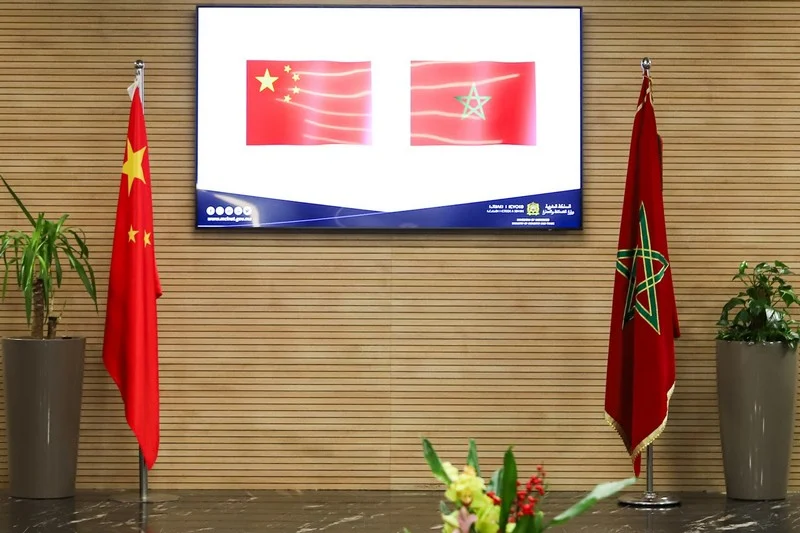
China’s approach to the Moroccan Sahara issue has become increasingly pragmatic as Beijing seeks to deepen its strategic partnership with Morocco, according to a new report by the Chinese Policy Observatory, a research center specializing in the country’s foreign policy.
The report notes that Beijing has strengthened ties with Rabat through several strategic agreements, reflecting growing diplomatic convergence on territorial integrity and opposition to separatism, principles shared by both countries in their ongoing strategic dialogue.
According to the Observatory, China has adopted a cautious and balanced stance in multilateral forums. While it has avoided using its veto power against key resolutions on the Sahara, it has also refrained from issuing statements in support of the separatist Polisario Front.
The report highlights Beijing’s abstention from the latest UN Security Council vote on October 31, 2025, a resolution that rejected a referendum and reaffirmed Morocco’s autonomy plan as the most realistic and sustainable solution.
Official Chinese statements, the report says, continue to emphasize peaceful conflict resolution and non-interference in domestic affairs, a position also applied to the Sahara dispute. This strategy, according to the authors, allows Beijing to maintain positive relations with both Morocco and Algeria while preserving diplomatic flexibility in North Africa.
The report suggests that China increasingly favors an autonomy-based solution under Moroccan sovereignty, rather than full independence, for economic and geopolitical reasons. Morocco’s stability, geographic position, and access to resources such as phosphates and rare minerals make it a key partner for Beijing’s long-term investments in Africa and the Mediterranean.
The Observatory also traced the evolution of China’s voting record at the UN. In 2023, Beijing voted in favor of renewing MINURSO’s mandate, while in 2018 it abstained from voting on Resolution 2414.
“China’s votes have not followed a fixed pattern,” the report said, “shifting between support and abstention depending on the wording of the resolutions.”
By abstaining from the latest vote, the report adds, China “did not oppose the Moroccan-backed initiative and effectively allowed it to pass, signaling quiet approval without overt endorsement.”
Beyond the Sahara issue, Morocco-China relations have grown into a multidimensional strategic partnership since the signing of their comprehensive cooperation agreement in 2016. Beijing now views Morocco as a major gateway to Africa and Europe, a manufacturing and logistics hub, and a reliable partner.
China is Morocco’s largest Asian trading partner, with bilateral trade exceeding $9 billion in 2024, according to the report. Beijing also values Morocco’s consistent support for the “One China” policy and its refusal to recognize Taiwan, a stance seen as fundamental to Chinese diplomacy.
In conclusion, the Chinese Policy Observatory said Beijing’s current position on the Sahara “leans toward a solution ensuring autonomy under Moroccan sovereignty, stability without full independence in the near term.”
The report described the October 2025 UN resolution as a “turning point” that subtly shifted China’s long-maintained strategic balance, reflecting its expanding economic and diplomatic interests in Morocco and the broader Maghreb region.





add your comment
Terms of publication : Not to offend the writer, people, sacred things, or attack religions or the divine self, and refrain from racist incitement and insults.