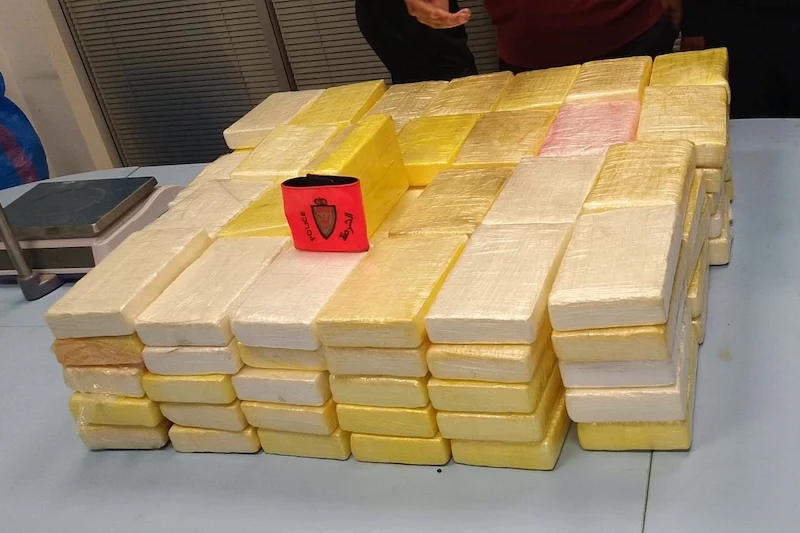
Moroccan authorities have once again uncovered an international drug trafficking attempt through a freight truck operating under a Moroccan transport company. Security services at the Tanger Med Port seized 33 kilograms of raw cocaine hidden inside a shipping container last weekend, reviving concerns about the use of international transport routes to smuggle narcotics to Europe.
Although the seized amount barely exceeded 30 kilograms, the incident reignited debate over the murky relationship between drug smuggling operations and international transport companies. While company owners consistently deny any involvement, they often blame their drivers when illicit substances are found in their vehicles.
Sources inside the Tanger Med Port told Hespress AR that investigations typically rely on driver statements, which remain the most decisive evidence in court. The source added that transport companies are sometimes prosecuted following investigations that focus on where and how the drugs were hidden.
According to the same source, the placement of the drugs often determines who bears responsibility. When narcotics are concealed in tire compartments or hidden panels requiring vehicle modifications, the operation is deemed deliberate and time-consuming — pointing to possible company involvement. However, if drugs are found among a driver’s personal belongings, the driver is usually held solely accountable.
Commenting on the matter, Amer Zghino, president of the Moroccan Association for Intercontinental Road Transport (AMTRI), questioned why authorities continue to seize company trucks even when drivers admit full responsibility. “If a driver is caught transporting a significant quantity of drugs and confesses that the company and its owner had no involvement, why should the truck be confiscated?” Zghino told Hespress AR.
He said such cases have created serious problems for transport company owners, many of whom face prosecution despite having no connection to trafficking attempts.
Zghino noted that in some cases, small drug shipments, less than five kilograms, can be loaded into a truck within minutes, often without the owner’s knowledge. However, he said owners must be held responsible when drugs are found in hidden compartments created through modifications to the vehicle, such as near the fuel tank or inside wheel cavities.
“The greed for quick profits is what drives people to take such risks,” he said, adding that some smuggling operations hide drugs inside export goods, such as frozen fish. In such cases, Zghino argued, “the truck owner cannot be held responsible, as they have neither the tools nor the authority to inspect sealed export cargo.”


add your comment
Terms of publication : Not to offend the writer, people, sacred things, or attack religions or the divine self, and refrain from racist incitement and insults.