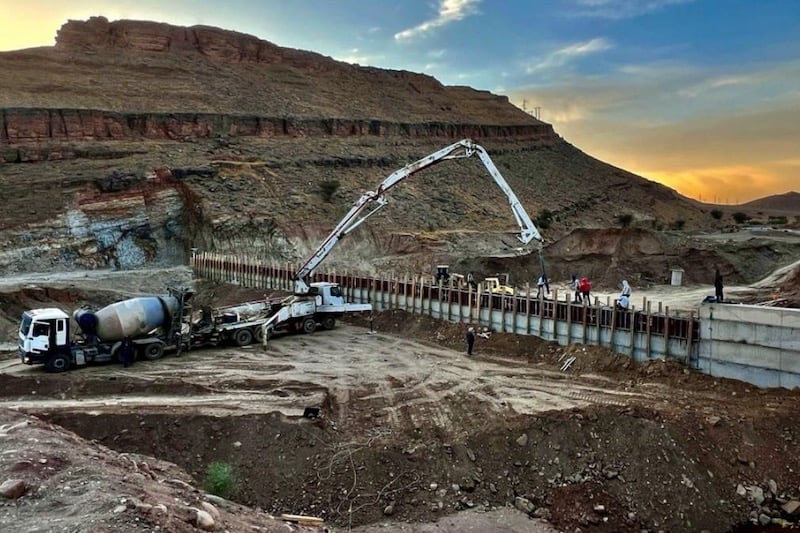
Morocco must invest about $38 billion in non-energy infrastructure by 2035 to keep pace with urban growth and bolster its role as a regional logistics hub, according to a new study by Allianz Research.
The report said more than 60% of Moroccans now live in cities, making infrastructure expansion critical.
It estimated Morocco’s needs at $19.3 billion for roads, $8.2 billion for ports, $6.3 billion for telecommunications and digitalization, $3 billion for railways, $1.1 billion for sanitation and $100 million for aviation.
The country is also pushing ahead with renewable energy and green hydrogen projects, aiming to become a key supplier of clean fuel to Europe and Asia.
Allianz said energy and non-energy infrastructure must advance together to strengthen Morocco’s position as an industrial and logistics hub.
Globally, the study projected $11.5 trillion in non-energy infrastructure spending over the next decade, with two-thirds in emerging markets.
Including energy, total global infrastructure investment could surpass $26 trillion by 2035.
The report said emerging markets face wider investment gaps, while advanced economies mostly struggle to modernize aging systems.
It added that the pandemic and geopolitical tensions exposed supply chain weaknesses, underscoring the need for stronger local transport networks, ports and warehouses.
On the energy side, Allianz said the global shift to electrification and lower carbon emissions is driving demand.
But delays in grid and storage projects have created bottlenecks, raising costs. Europe alone will need $110 billion to $150 billion annually for electricity networks, storage and cross-border links, while the global shortfall in energy investment is estimated at $1.5 trillion each year.






add your comment
Terms of publication : Not to offend the writer, people, sacred things, or attack religions or the divine self, and refrain from racist incitement and insults.