
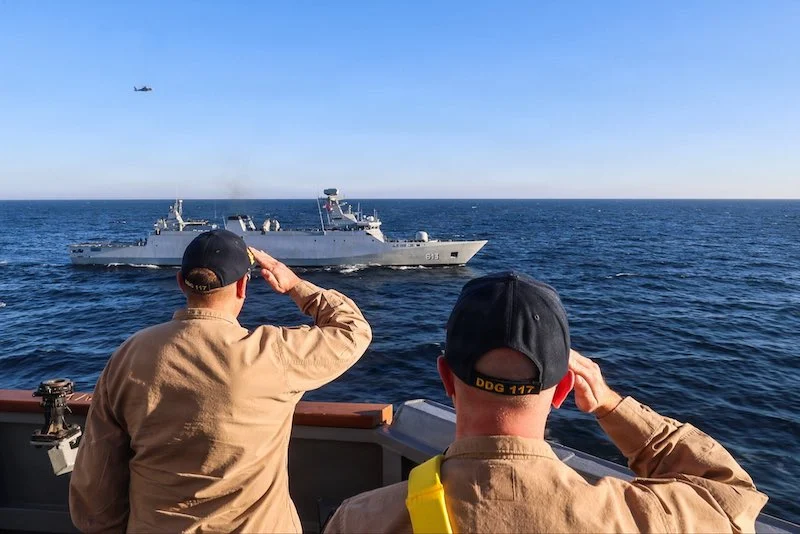
Morocco will participate in “UNITAS 2025,” the world’s longest-running annual multinational maritime exercise, scheduled to begin mid-September along the eastern seaboard of the United States and run through October 6, according to the U.S. Navy.
The large-scale naval drills will bring together around 8,000 personnel from 25 U.S. allied nations, including Brazil, Italy, Japan, and Morocco, the only country from the Arab and African regions to take part.
The exercises will be held across several U.S. military bases: Naval Station Mayport in Florida, Marine Corps Base Camp Lejeune in North Carolina, and Naval Station Norfolk in Virginia.
The operations will feature an array of U.S. naval assets, including aircraft carriers, destroyers, submarines, support vessels, aircraft, and fast boats.
Vice Adm. Carlos Sardiello of the U.S. Southern Command and leader of the U.S. 4th Fleet and Task Force 138, emphasized the strategic value of the operation.
“UNITAS 2025 is a vital opportunity to showcase how our regional partners collaborate to counter regional threats,” Sardiello said.
“By bringing together 25 nations, we not only enhance tactical proficiency and interoperability but also exemplify regional burden-sharing, fostering trust and unity essential to confronting shared security challenges.”
Strategic and Military Significance
Morocco’s participation in UNITAS 2025 carries strategic importance, according to military analyst Abdelrahman Mekkaoui. Speaking to Hespress AR, he highlighted the drills as an opportunity for the Royal Moroccan Navy to enhance its operational capabilities in various maritime environments.
“This participation underscores Morocco’s strategic military partnership with the United States and reinforces the Royal Armed Forces’ defensive maritime abilities,” Mekkaoui said.
He noted that Morocco’s involvement in exercises featuring advanced naval technologies, such as nuclear submarines, frigates, and unmanned aerial maritime systems, facilitates knowledge exchange and strengthens multilateral military cooperation.
The North African nation, which lies between the Atlantic and Mediterranean and borders key maritime corridors like the Strait of Gibraltar, plays a crucial role in ensuring international maritime security.
Mekkaoui emphasized that Morocco’s dual coastlines and growing challenges like illegal fishing, smuggling, and maritime piracy necessitate greater surveillance and technological investment in its navy.
“These exercises allow Morocco to test its naval fleet’s readiness in scenarios like anti-piracy missions, port defense, and countering non-conventional threats,” he added.
Geopolitical Presence and Defense Diplomacy
Strategic affairs analyst Hicham Moutadid also weighed in on Morocco’s role, describing the invitation to UNITAS as a recognition of the kingdom’s rising geopolitical relevance.
“This is not just about military cooperation,” Moutadid told Hespress AR. “Morocco is increasingly being seen as a geopolitical anchor connecting Africa, Europe, and Latin America. Its participation reflects trust in its capacity to contribute to multidimensional maritime security frameworks.”
He said the drills also signal a shift in Morocco’s global defense posture, from recipient of support to proactive contributor to regional and global security. Morocco’s participation, he argued, indicates its maturity in operating alongside top-tier naval powers in complex environments.
“These exercises are part of a broader strategy in which Morocco uses its defense tools to bolster political and economic diplomacy,” Moutadid said. “Its presence in UNITAS reinforces its image as a stable, reliable actor committed to collective security.”
He concluded that Morocco’s integration into operations involving live ammunition, amphibious landings, and unmanned systems offers a real-time opportunity to refine its naval doctrine. The participation also helps broaden its defense partnerships beyond traditional Atlantic alliances to include nations like Japan, Singapore, and Latin American states.
“This multidirectional cooperation strategy provides Morocco with strategic flexibility and positions it as a key maritime actor in a rapidly shifting geopolitical landscape,” he said.






add your comment
Terms of publication : Not to offend the writer, people, sacred things, or attack religions or the divine self, and refrain from racist incitement and insults.