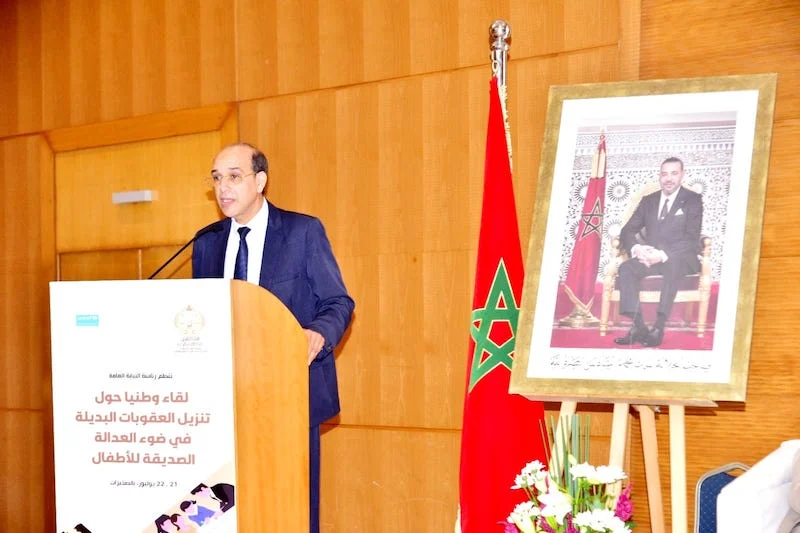
Morocco’s new law on alternative sentencing represents a major step toward child-friendly justice and rehabilitation, said Hicham Balaoui, Prosecutor General at the Court of Cassation and President of the Public Prosecution Office, during a national meeting held Monday in Skhirat.
Balaoui highlighted Law 43.22 as a modern legal tool designed to address cases involving children in conflict with the law. The legislation grants judges the discretion to replace custodial sentences with alternative measures, allowing minors to serve penalties in familiar, non-carceral environments.
This, he said, supports behavioral reform, social reintegration, and continued participation in economic and social life.
He emphasized that King Mohammed VI has consistently called for the promotion of human development and the protection of children’s rights, recognizing children as Morocco’s strategic and intangible national capital. “The King has repeatedly urged the adoption of public policies centered on the child,” Balaoui noted.
Since its creation, the Public Prosecution Office has given special attention to children, Balaoui added. Through official memos and circulars, prosecutors have been urged to prioritize child-related cases and apply legal provisions while safeguarding children’s best interests.
In Circular No. 18, issued on December 11, 2024, the office encouraged officials to use the lead-up to the law’s implementation as a period of preparation, opening dialogue, studying its provisions, and anticipating enforcement challenges.
The Skhirat meeting, according to Balaoui, aimed to refine understanding of the law’s objectives and explore the most effective methods of balancing legal rigor with the rights and welfare of affected parties, particularly children undergoing personal development. This aligns with Morocco’s obligations under international child rights conventions.
Balaoui further stressed that incarceration should be the last resort for minors. Instead, courts should prioritize alternative sanctions, such as community service and supervised release, now available under the new law. These measures help avoid the long-term harm of imprisonment, which can, he warned, expose children to negative peer influence and foster alienation from society.
“Alternative sentencing for minors is not just a legal option, it is a moral and civilizational imperative,” Balaoui said. “It reflects a mature society’s commitment to protecting its children and building a better future.”







add your comment
Terms of publication : Not to offend the writer, people, sacred things, or attack religions or the divine self, and refrain from racist incitement and insults.