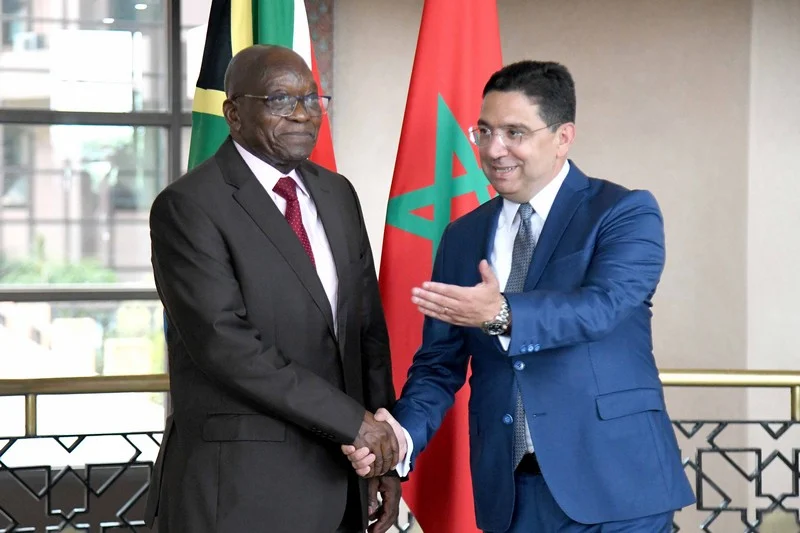
In a significant diplomatic development, South Africa’s opposition party uMkhonto weSizwe (MK Party), led by former President Jacob Zuma, publicly endorsed Morocco’s autonomy plan for the Sahara, signaling a shift in the political discourse surrounding the long-standing territorial dispute in Africa.
Speaking from Rabat on Wednesday, Zuma and MK Party officials declared their full support for Morocco’s proposed solution to the Sahara conflict, a plan that would grant the region autonomy while preserving the Kingdom’s territorial integrity and fostering regional stability.
The party urged the international community to adopt and support what it described as a “pragmatic and realistic” framework for peace.
A Blow to the Pretoria-Algiers Axis
The MK Party’s position marks a clear departure from the ideological stance of the ruling African National Congress (ANC), which has long maintained a pro-Polisario policy in alignment with Algeria, Morocco’s regional rival.
The development suggests growing political pluralism in South Africa’s foreign policy, with internal factions beginning to question the utility and relevance of entrenched positions inherited from the liberation era.
Analysts argue that this is not a mere partisan maneuver. According to Abdelfattah El Belamchi, professor of international relations at Cadi Ayyad University in Marrakech, the MK Party’s endorsement reflects a strategic reassessment of South Africa’s interests. “Zuma’s support for the Moroccan plan is grounded in a recognition of shifting geopolitical dynamics in Africa and the need for economic pragmatism,” he said.
El Belamchi emphasized Morocco’s rising economic and diplomatic influence on the continent, pointing to major infrastructure investments, regional integration efforts, and projects like the Nigeria-Morocco gas pipeline and the Atlantic initiative. “Pretoria cannot afford to ignore the benefits of constructive engagement with Rabat,” he added.
Breaking the Historical Mold
Morocco’s diplomatic outreach, characterized by quiet pragmatism and the revival of historical ties, including support for Nelson Mandela’s anti-apartheid movement, appears to be yielding dividends. Zuma’s party, the third-largest political force in South Africa’s parliament, invoked this legacy to argue for a reset in relations and a departure from what critics call ideological rigidity in Pretoria’s foreign policy.
Political scientist Jaouad El Kacimi also praised Morocco’s strategic approach. “Rather than confront the ANC directly, Rabat engaged other political actors, offering an alternative vision rooted in shared interests and historical solidarity,” he said.
El Kacimi argued that the MK Party’s stance could fracture South Africa’s traditional consensus on the Sahara issue. “It could transform what has been a foreign policy constant into a subject of domestic political debate, and possibly a bargaining chip in future coalition negotiations,” he noted.
Toward a New Pan-African Vision?
Beyond South Africa, observers say the MK Party’s position could spark a broader rethink across the continent. By reframing the Sahara dispute as a barrier to African integration and economic cooperation, the party joins a growing chorus of voices advocating for pragmatic solutions over ideological entrenchment.
“This could be the beginning of an alternative African narrative,” said El Kacimi, “one that favors peaceful conflict resolution and regional development over the perpetuation of separatist struggles that have historically hindered the continent.”
Indeed, the party’s stance may pose a challenge to the traditional Pretoria, Algiers alliance, long seen as a bulwark of the Polisario’s diplomatic efforts.
With Zuma’s MK Party now on record in favor of Morocco’s autonomy plan, South Africa’s internal political dynamics could reshape its role in this decades-old conflict, and perhaps even accelerate the push for a lasting solution.




add your comment
Terms of publication : Not to offend the writer, people, sacred things, or attack religions or the divine self, and refrain from racist incitement and insults.