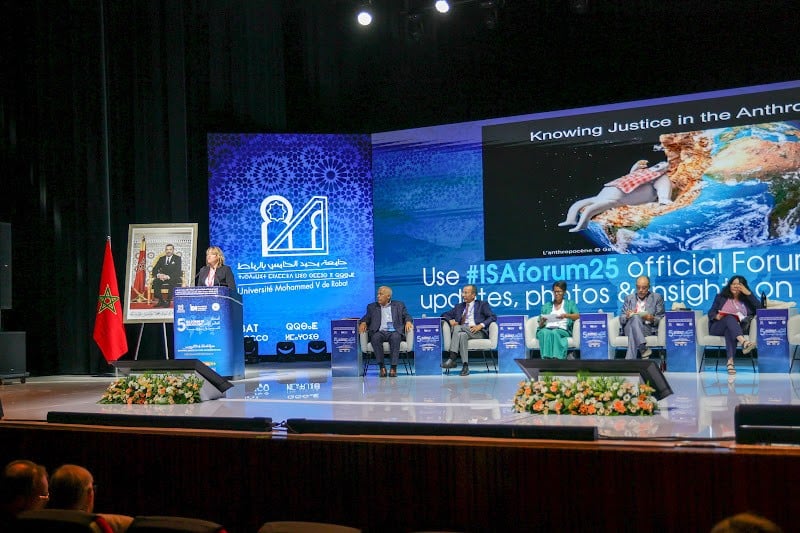
More than 100 nations are represented in Rabat this week as leading sociologists gather for the Fifth World Forum of Sociology, marking the first time the prestigious academic event is held in Africa and the Middle East and North Africa (MENA) region.
The forum, themed “Knowing Justice in the Anthropocene”, opened at the Mohammed V Theater and continues across several academic institutions in the capital, including the Faculty of Educational Sciences, the Faculty of Legal, Economic and Social Sciences, the Mohammedia School of Engineering, and the National Institute of Statistics and Applied Economics.
Jointly organized by the International Sociological Association (ISA), Mohammed V University, and the Moroccan Sociology Association, the event delves into the increasingly urgent question of justice in the age of the Anthropocene, the proposed new geological epoch marked by irreversible human impact on the planet.
Speaking to Hespress AR, Abdelfattah Zine, national coordinator of the Moroccan Sociology Association, emphasized the symbolic significance of Morocco as host. “Our country is a land of dialogue,” he said, while noting that sociology remains misunderstood by some sectors in Morocco. “This forum, with its unprecedented level of international participation, reflects the global academic recognition of Moroccan sociology.”
Zine stressed that sociology in Morocco has a long, deliberate history and has matured significantly, especially during the country’s democratic transitions. “We are not advocates of ‘knowledge for power,’ but of the ‘power of knowledge,’” he said, reaffirming the association’s commitment to academic freedom and the autonomy of researchers.
The theme of this year’s forum, Zine explained, raises fundamental questions: “What kind of human are we talking about? What form of justice in a world rife with conflict and lacking coherent alternatives?” He noted that this marks the first global forum where the Anthropocene is tackled at such scale and diversity of perspective.
Zine also pointed out Morocco’s existing experience with Anthropocene-related challenges, citing its hosting of the UN Climate Change Conference, the Global Forum on Migration and Development, and the Global Compact for Safe, Orderly and Regular Migration.
Highlighting the academic and institutional benefits of the forum, Zine described the event as a “scientific marketplace,” offering Moroccan students the opportunity to meet renowned sociologists whose work they had only read. He called for greater academic exchange, encouraging Moroccan universities to form international partnerships and tap into the expertise of Moroccan scholars abroad.
The forum’s opening ceremony concluded with a powerful moment of solidarity. In an address met with applause, the president of the ISA expressed support for sociologists in Palestine, denouncing the “ongoing genocide in Gaza” and the “deteriorating conditions in the West Bank.”
Held over five days, the forum aims to foster critical discussion on the social dimensions of climate change, inequality, and justice in a rapidly transforming world. For Moroccan sociology, it represents a milestone in visibility, exchange, and recognition on the international stage.



add your comment
Terms of publication : Not to offend the writer, people, sacred things, or attack religions or the divine self, and refrain from racist incitement and insults.