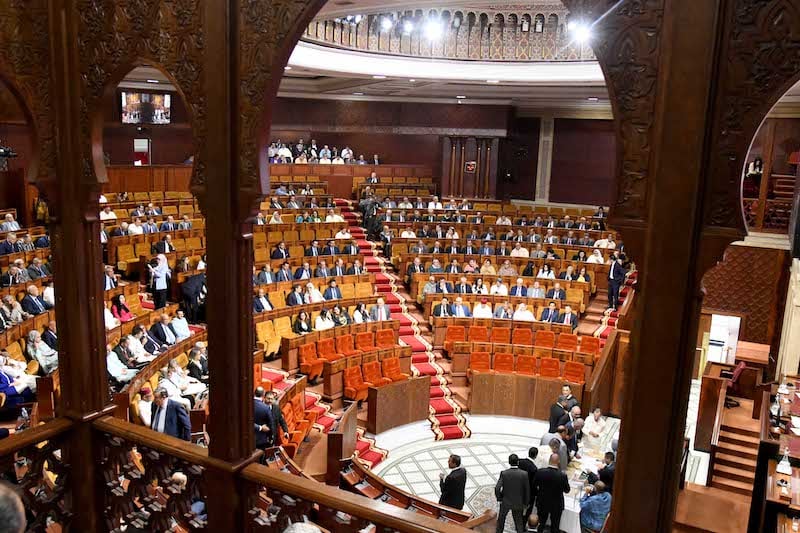
Morocco’s draft bill No. 03.23, which seeks to amend the Code of Criminal Procedure (Law No. 22.01), is set to be voted on by the House of Representatives in a plenary session on Tuesday, following its recent approval by the Committee on Justice, Legislation and Human Rights.
The legislation—one of the most debated legal texts of the current parliamentary term—is poised to head to the House of Councillors, where stakeholders expect further refinement amid the chamber’s diverse representation of local officials, unions, and political factions.
Legal experts and observers have raised hopes that the second chamber will address what they see as serious shortcomings in the current draft.
The bill has already drawn more than 1,000 proposed amendments from both majority and opposition lawmakers, many of which were rejected by the government and the Ministry of Justice. Central to the proposed reform is the introduction of legal frameworks aligning criminal justice policy with Morocco’s broader judicial developments, including the independence of the Public Prosecutor’s Office.
For the first time, criminal justice policy is defined in the bill in terms consistent with international norms, characterizing it as a set of public measures and rules aimed at crime prevention and control.
Shuaib Lamsahel, lawyer and head of the Moroccan Center for Legal Awareness, told Hespress AR that the bill aspires to modernize Morocco’s criminal justice system and better safeguard human rights.
He emphasized its potential to improve fair trial guarantees—particularly through strengthening defense rights, enhancing the role of lawyers during preliminary investigations, and allowing full and unrestricted access to case files from early stages.
Lamsahel also underscored the need for clearer rules on arrests, stronger protection for victims and witnesses, especially in corruption and violence cases, and efforts to reduce pretrial detention periods.
Other priorities highlighted by Lamsahel include the digitization of legal procedures, the regulation of remote trials, and broader use of technology such as online complaint submission to streamline justice and improve transparency. The proposed law also seeks to reduce delays by setting strict deadlines for investigations and trials, he added.
Crucially, the legislation aims to address new and evolving forms of crime, including cybercrime and complex financial offenses, with more effective procedural tools. Lamsahel also called for curbing some prosecutorial powers to ensure a more balanced relationship between the judiciary and the defense.
However, the lawyer warned that the political climate surrounding the bill’s review in the lower house focused disproportionately on parliamentary immunity provisions—raising concerns about the potential legal shielding of political elites. This, he noted, could risk legitimizing political corruption under the guise of legal protection.
For Mokhtar Amra, a criminal law professor at the Faculty of Legal and Economic Sciences in Salé, the draft reform touches on a critical aspect of justice: ensuring fairness from the earliest stages of investigation.
He praised provisions that mandate audio and video recordings of all detention and interrogation stages as a much-needed step toward transparency, especially in cases where suspects may try to manipulate investigators.
While recognizing that pretrial detention should be used cautiously, Amra argued it cannot be eliminated altogether, given widespread poverty and illiteracy that contribute to legal system violations.
Amra emphasized the psychological importance of pretrial detention for victims, particularly in the immediate aftermath of a crime. It helps assure victims that justice is being pursued, he said, while acknowledging the need for reconciliation and alternative sentencing once emotional tensions subside.
The professor also welcomed the bill’s provisions promoting the use of artificial intelligence and digital tools in tackling recurrent and high-stakes crimes such as money laundering and human trafficking.
For Amra, these measures signal a move toward a more responsive and modern criminal justice system, albeit one that must strike a balance between efficiency and the rights of all parties involved.








add your comment
Terms of publication : Not to offend the writer, people, sacred things, or attack religions or the divine self, and refrain from racist incitement and insults.