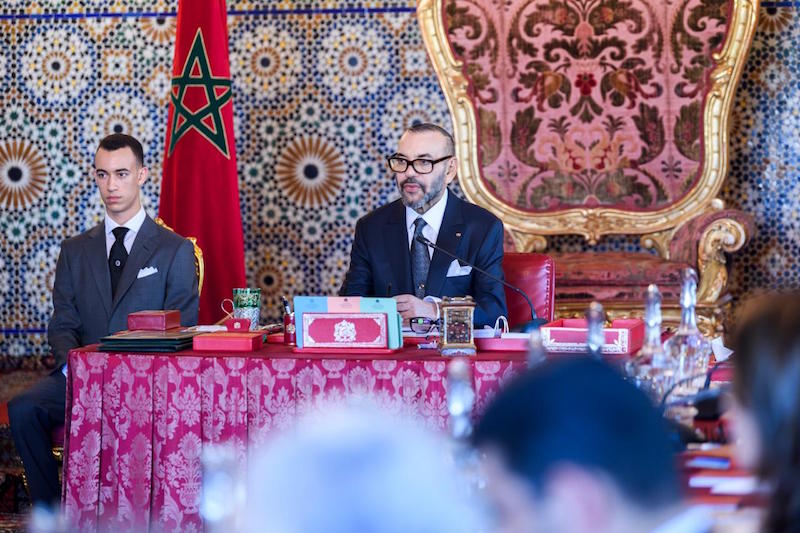
In a speech delivered on his behalf by Foreign Minister Nasser Bourita at the 34th Arab League Summit in Baghdad on Saturday, Morocco’s King Mohammed VI issued a forceful appeal for urgent action on multiple regional crises — most notably the escalating humanitarian catastrophe in Palestine — and called for structural reforms to strengthen Arab cooperation.
The King opened his remarks with a strong expression of solidarity with the Palestinian people, decrying the “tragic and intolerable” situation in Gaza and the West Bank. He proposed five urgent measures: an immediate halt to military operations, a return to truce negotiations, cessation of settler violence and home demolitions in the West Bank, unimpeded humanitarian aid access, and a comprehensive reconstruction plan under the Palestinian Authority with Arab and international support.
Reaffirming Morocco’s longstanding commitment to Jerusalem, King Mohammed VI emphasized his role as Chairman of the Al-Quds Committee and reiterated the Kingdom’s support for the UN agency for Palestinian refugees (UNRWA). He noted that the Bayt Mal Al-Quds Agency continues to implement development projects aimed at improving the living conditions of Palestinians in the holy city.
Reopening of Syrian Embassy and Commitment to Regional Sovereignty
In a significant diplomatic development, the King announced Morocco’s decision to reopen its embassy in Damascus, closed since 2012. This move reflects Morocco’s support for Syria’s sovereignty, territorial integrity, and the Syrian people’s right to peace and stability.
On Libya, the King reaffirmed Morocco’s continued mediation efforts to facilitate dialogue among rival factions, pledging that Rabat would remain a “constructive and impartial” partner in the peace process.
Warning Against Foreign Interference and Separatist Movements
King Mohammed VI warned of the dangers of foreign interference and the support of separatist movements in the region, calling for adherence to the principles of good neighborliness and respect for state sovereignty. “Separatist agendas have been discredited by history and have no place in today’s world,” he declared.
Call for Reform and Economic Integration
The King reiterated the need to reform the Arab League to make it more agile and responsive to modern challenges. On the economic front, he criticized the region’s sluggish growth — which stood at just 1.9% in 2024 — and the persistent lack of trade and investment integration.
He expressed particular concern about North Africa’s weak regional cohesion and voiced Morocco’s disappointment in the stalled Maghreb Union, especially its failure to ensure the free movement of people, goods, and capital.
To address these gaps, the monarch urged Arab nations to invest in renewable energy, artificial intelligence, and technology as engines for sustainable development.
Support for Conflict Resolution in Yemen, Sudan, and Lebanon
Turning to other flashpoints, King Mohammed VI voiced Morocco’s concern over the ongoing conflicts in Yemen, Sudan, and Lebanon, and reaffirmed the Kingdom’s support for all peaceful initiatives aimed at achieving stability and reconciliation in those countries.
A Vision for Collective Arab Progress
In closing, the King reaffirmed Morocco’s full commitment to advancing Arab unity, pledging to engage in any initiative that promotes common security, development, and prosperity across the Arab world. He underscored the Kingdom’s foreign policy principles: defending just Arab causes, supporting peace and dialogue, and building a more balanced and effective Arab cooperation model.



add your comment
Terms of publication : Not to offend the writer, people, sacred things, or attack religions or the divine self, and refrain from racist incitement and insults.