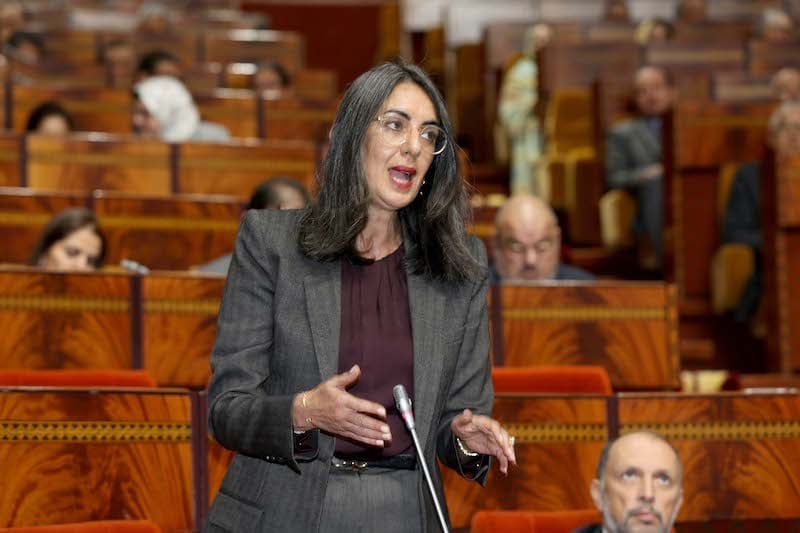
Morocco’s Minister of Economy and Finance, Nadia Fettah Alaoui, on Tuesday emphasized the government’s commitment to efficient dispute management and prevention, citing significant financial savings and ongoing reform efforts across various public sectors.
Speaking during a weekly parliamentary Q&A session, Fettah Alaoui disclosed that the Kingdom’s Judicial Agency handles around 20,000 new legal cases annually, with approximately 200,000 cases still in progress.
Each year, the agency receives nearly 7,000 court rulings, which are analyzed to extract financial and statistical data. In 2024 alone, this analysis resulted in savings of approximately 16.2 billion dirhams by minimizing the gap between claimed and adjudicated amounts.
Over the past five years, total savings have reached nearly 25.4 billion dirhams, she noted, also highlighting the successful defense of state interests in international arbitration cases, particularly before the International Centre for Settlement of Investment Disputes (ICSID).
However, she acknowledged persistent systemic challenges such as fragmented oversight, lack of coordination, and weak preventive mechanisms in public administration. These shortcomings hinder proactive and effective dispute management, especially given the expanding role and responsibilities of public institutions.
The minister recalled the National Symposium on State Dispute Management, which proposed five key recommendations and 43 operational measures. A detailed action plan is now being finalized, including timeline setting and the formation of oversight committees equipped with performance indicators.
State-Owned Enterprises and Strategic Investment Reform
On the subject of public institutions and enterprises, Fettah Alaoui stressed the government’s dedication to restructuring efforts under Framework Law 50.21, which lays out a roadmap for overhauling this critical sector.
Measures already implemented include the creation of a new institutional framework for reform, the establishment of the National Agency for Strategic Management of Public Enterprises, and legislative updates to facilitate mergers, liquidations, and mandate reviews for numerous public entities.
She noted that 57 state-owned enterprises generated approximately 240 billion dirhams in revenue in 2024, with profits reaching 13 billion dirhams. The agency has now produced the first-ever State Investment Strategy, a milestone in aligning public investments with national priorities.
As part of ongoing studies, the government is evaluating the financial sector portfolio, aiming to determine whether continued public ownership in certain areas aligns with policy objectives or if withdrawal is more appropriate.
Informal Sector Integration and Labor Inclusion
In response to questions about integrating the informal economy, Fettah Alaoui argued for open dialogue on the subject, stating: “We should no longer speak about the informal sector with embarrassment.”
She affirmed that various national sectoral strategies — covering tourism, agriculture, and commerce — include practical measures to transition informal enterprises into the formal economy. Initiatives also address workforce inclusion, especially for those without academic degrees, by recognizing skills over formal credentials.
Tax reforms, such as revisiting the auto-entrepreneur system and offering reduced contribution rates, are part of a broader incentive structure. Moreover, changes to the National Social Security Fund (CNSS) and health coverageschemes are expected to support formalization efforts.
Consumer Protection and Inflation Response
On inflation and price control, the minister highlighted the government’s proactive measures amid global economic instability. Since 2022, around 100 billion dirhams have been spent to subsidize basic goods, with inflation dropping from 13% in February 2023 due to targeted interventions.
Over the past few years, authorities have monitored 350,000 retail points, issuing over 15,000 violations. She emphasized that these inspections, along with programs to mitigate the effects of drought and stabilize electricity and water prices, have helped cushion citizens from global shocks.
Tax policy has also played a role, with VAT reductions on essential goods introduced to relieve cost burdens.







add your comment
Terms of publication : Not to offend the writer, people, sacred things, or attack religions or the divine self, and refrain from racist incitement and insults.