
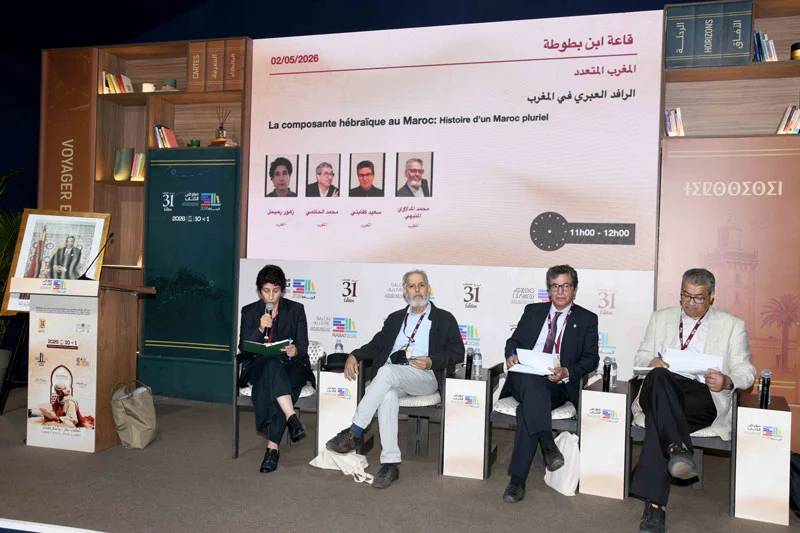
As the 30th edition of the International Book and Publishing Fair kicked off in Casablanca, a roundtable moderated by scholar Benaissa Yechou brought together three leading researchers in Amazigh studies to reflect on the sectoral rollout of the Amazigh language in Morocco—amid growing concerns about the pace and effectiveness of implementation since its recognition as an official language in the 2011 Constitution.
The panel, part of the “Plural Morocco” segment, explored the theme “Amazigh and the Challenges of Sectoral Implementation,” focusing on education and training. The speakers painted a sobering picture of stagnation, logistical obstacles, and policy contradictions hindering the integration of Amazigh into the national education system.
Lahcen Amqran, a university professor and Amazigh language expert, criticized what he described as the deteriorating status of Amazigh instruction in public schools. “A major issue we face is the lack of dedicated classrooms for Amazigh teachers—something that seems minor on the surface but is a real problem,” he said.
Amqran also noted the near-total absence of textbooks, both in the “One Million Schoolbags” initiative and in the broader education market. “We’re seeing fewer students benefitting from Amazigh classes now than before its constitutional recognition,” he lamented, adding that the long-promised generalization of Amazigh education has been postponed to 2030—a date he fears may be more rhetorical than realistic.
He expressed frustration that Amazigh teachers are often tasked with teaching Arabic or French despite having no training in these subjects, raising concerns about teaching quality and institutional coherence. The dismantling of regional and provincial Amazigh language units, he said, has further compounded the issue, along with a chronic shortage of inspectors and teacher training programs.
Educational policy researcher Said Akhitouch mapped out the three historical phases of Amazigh language inclusion in Moroccan education, arguing that the current reform initiative, Madrassat Al Riada (“School of Excellence”), has largely sidelined Amazigh.
“This reform doesn’t even propose a year-long teaching framework for Amazigh—only a support phase—leaving teachers with no structured content or lesson-building tools,” Akhitouch said.
He urged Moroccan universities to play a more central role in the rollout by increasing the number of qualified graduates and overhauling curriculum standards. “It’s absurd that students can earn a degree in Amazigh language without mastering Tifinagh script,” he said, highlighting structural contradictions in teacher training and quality control.
While the Ministry of Education has reportedly increased the number of Amazigh instructors to 600, Akhitouch criticized the return to training generalist bilingual teachers rather than specialists—underscoring the policy confusion and lack of clarity in the ministry’s model.
Rachid Oubghaj, another scholar in Amazigh studies, stressed the need to restore early ministerial frameworks that were based on clear criteria and accurate data. “Amazigh teachers need to be properly integrated into school schedules and teaching frameworks,” he said, adding that classrooms dedicated to Amazigh instruction are essential for quality learning.
Commenting on the Madrassat Al Riada project, Oubghaj questioned the credibility of a reform initiative that completely omits Amazigh from its reference framework. He also called for a nationwide audit of experienced Amazigh educators and strict adherence to existing regulatory memos to ensure that the generalization target is supported by qualified personnel and a structured strategy.
Despite constitutional recognition and the 2019 organic law on its implementation, the integration of Amazigh into Morocco’s education system remains riddled with logistical challenges, bureaucratic inertia, and inconsistent policies. Experts warn that without urgent structural reforms, robust teacher training, and clear institutional commitment, the 2030 deadline for full integration may remain elusive.


add your comment
Terms of publication : Not to offend the writer, people, sacred things, or attack religions or the divine self, and refrain from racist incitement and insults.