
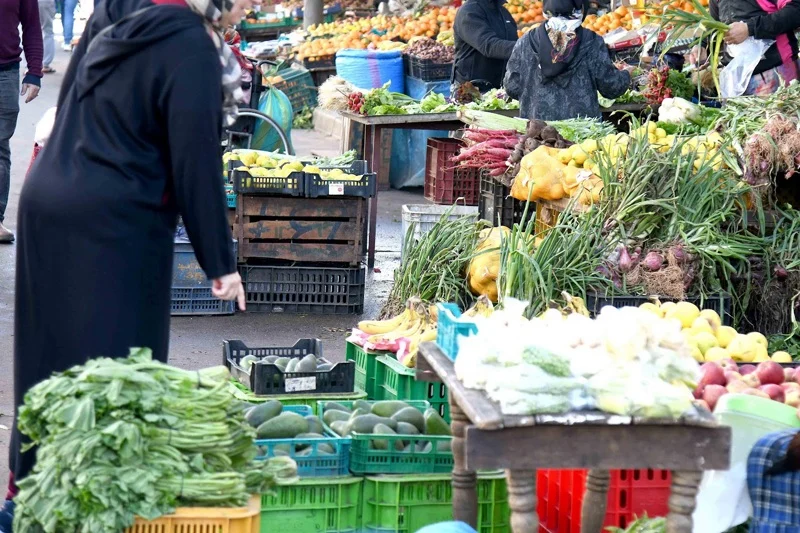
Wholesale market professionals across Morocco have reported a noticeable and relative decrease in the prices of various agricultural products in the latter half of Ramadan. After reaching record highs at the beginning of the month due to surging demand, prices have now stabilized.
Among the products experiencing price drops are tomatoes, potatoes, and onions, which benefited from a more balanced demand compared to the first days of Ramadan, when consumer purchasing typically peaks.
According to figures from the wholesale market in Inzegane, the average price of potatoes is now 3.31 MAD per kilogram, while tomatoes are priced at 3.83 MAD per kilogram. High-quality onions are selling for 6.75 MAD per kilogram, whereas lower-quality onions are at 2.65 MAD.
Carrots currently cost 2.25 MAD per kilogram, while green peas (jellbana) are being sold at 7.75 MAD per kilogram.
Fruit prices have also seen relative declines. Oranges are now selling at 3 MAD per kilogram, locally grown bananas at 8.75 MAD, and imported bananas at 16.50 MAD per kilogram. Red berries are being sold at 11 MAD per kilogram, locally produced apples at 9 MAD, and avocados at 21 MAD per kilogram.
Hussein Cherif, a member of the Tomato Traders’ Union at the Inzegane wholesale market, confirmed that wholesale prices have seen significant reductions and are expected to remain stable until the end of Ramadan.
He noted that the price of a crate of tomatoes has dropped from 210 MAD at the beginning of Ramadan to between 80 and 150 MAD currently. He also highlighted that recent rainfall has positively impacted agricultural production, which may further stabilize or reduce prices in the near future.
Similarly, Hicham Meknassi, a professional at the Meknes wholesale market, reported that the market is returning to equilibrium after the sharp price hikes seen in the early days of Ramadan. Some vegetables, such as green peppers and eggplants, have seen price drops of up to 3 MAD per kilogram.
However, Meknassi cautioned that not all agricultural products will follow this trend, as those dependent on rainfall and increased labor costs may remain expensive.
Despite these reductions at the wholesale level, many consumers have yet to see a significant drop in prices at retail markets. Meknassi explained that the complexity of distribution chains plays a major role in this issue.
He pointed out that multiple intermediaries, each adding their own profit margin, contribute to final retail prices being significantly higher than wholesale rates.
This has led to renewed calls for structural reforms, particularly the implementation of an effective “agricultural aggregation” system, which would help streamline distribution and ensure price drops at the consumer level.








add your comment
Terms of publication : Not to offend the writer, people, sacred things, or attack religions or the divine self, and refrain from racist incitement and insults.