Morocco has recently come under a wave of coordinated media attacks from entities known for supporting separatist movements in the Moroccan Sahara and opposing Rabat’s growing influence in regional and international affairs.
Chief among these is the Palestinian issue, where Morocco has consistently affirmed, at the highest levels, its support for the Palestinian people’s right to establish an independent state—despite ongoing political maneuvering aimed at undermining this stance both domestically and abroad.
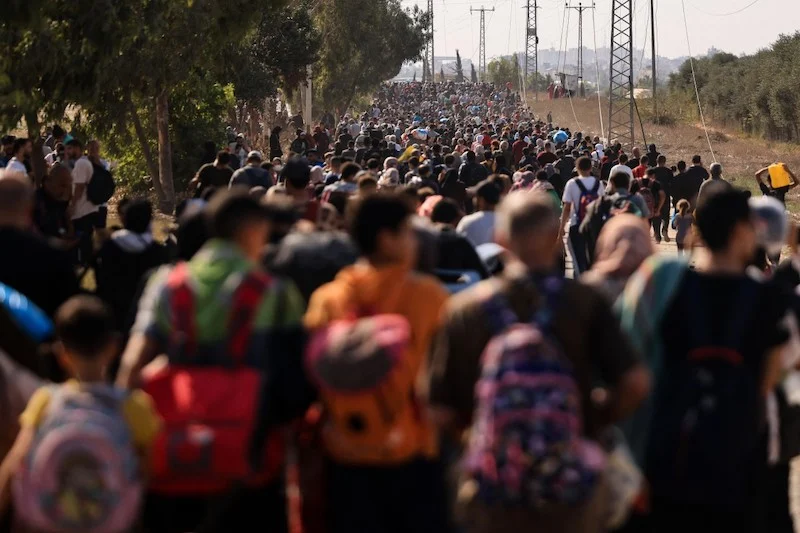
A recent example of this media targeting comes from Iran’s state-run news agency IRNA, which alleged that Morocco was complicit in a U.S. plan—reportedly conceived during the Trump administration—to forcibly relocate Palestinians from Gaza to other countries, including Morocco, Egypt, Jordan, and certain areas in the Horn of Africa.
The report went further, claiming that Morocco had shown less resistance to this purported plan than other Arab nations.
In an attempt to discredit Morocco’s sovereignty, the Iranian outlet linked Rabat’s position to what it called “colonial ambitions” in the Sahara, portraying Morocco’s territorial integrity as a betrayal of Arab and Islamic identity.
Political analyst Saïd Berkanan dismissed these accusations as baseless and indicative of Iran’s diminishing regional influence. He described the claims as “the last echoes of a fading power struggle,” particularly after the weakening of the Tehran-Algiers-Damascus axis, which once sought to undermine Morocco’s territorial integrity by backing and training the Polisario Front.
Speaking to Hespress AR, Berkanan noted that the Iranian news agency was simply recycling old, unfounded allegations that Morocco was part of an international plan to relocate Gazans. He argued that such claims serve as a convenient tool for media outlets aiming to discredit Morocco’s sovereignty and distract from Rabat’s consistent rejection of forced displacement policies.
Berkanan further pointed out that Morocco has clearly distanced itself from the Gaza relocation debate, which is currently unfolding between Israel, the U.S., Egypt, and Jordan. Morocco remains aligned with the broader stance of the Arab League, making it illogical to suggest that Rabat would take a divergent position.
“This is an effort to downplay Morocco’s role in the Palestinian cause,” he concluded, emphasizing that Rabat remains committed to a peace process that prioritizes negotiations and excludes extremists from both sides.
Bourak Chadi Abdessalam, an international expert in crisis management and conflict analysis, sees the Iranian media offensive as part of a broader strategy of psychological warfare.
“The deliberate spread of falsehoods targeting Morocco’s stance on Middle Eastern issues, particularly the Palestinian-Israeli conflict, is a longstanding feature of Iranian foreign policy,” he told Hespress AR.
Abdessalam argued that Iran’s misinformation campaign is designed to undermine Moroccan national unity and its unwavering support for the Palestinian cause. He highlighted that Morocco’s recent diplomatic efforts—including its mediation to unfreeze Palestinian Authority funds withheld by Israel—have unsettled regional actors, particularly Iran, which seeks to exploit Palestinian suffering for political leverage.
Recycling the false claim that Morocco is prepared to receive displaced Palestinians is, according to Abdessalam, a desperate ploy by Iranian intelligence to create geopolitical confusion and divert attention from Tehran’s regional proxies, including the Polisario Front and the Algerian regime.
“Iran sees Morocco as a major obstacle to its ambitions in North and West Africa,” he added, stressing that Tehran relies on Algeria’s expansionist policies to further its destabilizing agenda in the region.
Ultimately, Morocco’s approach to regional security—focusing on peace, stability, and development—directly conflicts with Iran’s disruptive strategies, which involve supporting separatist and militant movements. Abdessalam dismissed any notion of a rapprochement between Rabat and Tehran, given Iran’s continued backing of entities that threaten Morocco’s territorial integrity.
As Morocco strengthens its role as a stabilizing force in North Africa and the Middle East, it is likely to remain a target of misinformation campaigns. However, its diplomatic strategy, based on sovereignty, peace, and non-interference, positions it as a key player in countering regional instability.





add your comment
Terms of publication : Not to offend the writer, people, sacred things, or attack religions or the divine self, and refrain from racist incitement and insults.