
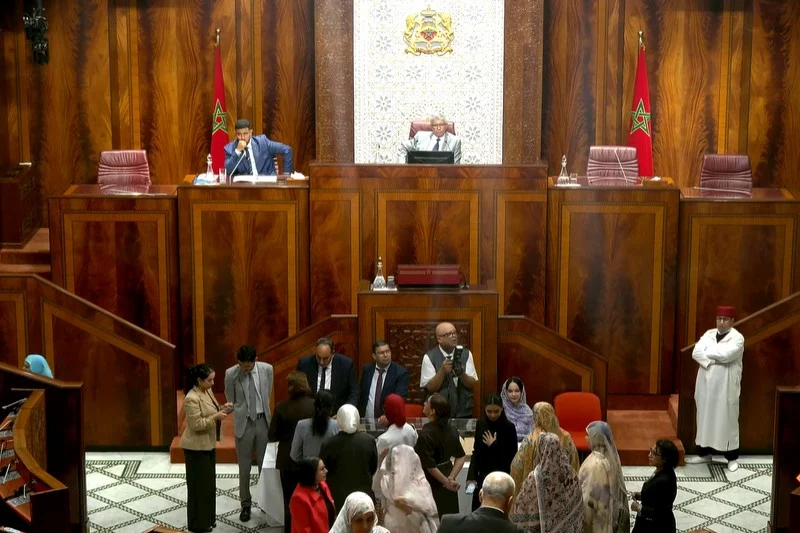
Opposition groups strongly criticized the government’s approach, accusing it of trying to rush the bill through parliament without sufficient dialogue.
Youssef Aydi, head of the Socialist Group – Federal Opposition, argued that the bill “does not truly reflect the essence of the right to strike as outlined in international standards.” He pointed out that its definition of striking only applies to employees covered by labor and public service laws, ignoring Morocco’s large informal labor market.
He also highlighted structural flaws in the bill, including “redundant articles and overlapping penalty provisions,” and called for a comprehensive revision to ensure clarity and compliance with the constitution and international treaties.
Fatima Zakag, a councillor from the Democratic Confederation of Labor, described the bill as a “restrictive law” that limits the right to strike. She accused the government of “favoring capital over workers’ rights” and argued that, given Morocco’s economic struggles, addressing unemployment and rising costs should take priority over limiting social rights.
Similarly, Khalid Souti from the National Union of Labor in Morocco accused the government of “disrespecting the legislative process” by introducing last-minute amendments to avoid deeper discussions in parliamentary committees.
On the other hand, the National Rally of Independents (RNI) defended the bill, calling it a “turning point in Morocco’s institutional and political landscape.” RNI councillor Mohamed El Bakouri praised the government for its “unprecedented political courage” in tackling an issue that had been stalled for decades.
He argued that the bill “enhances governance in exercising the right to strike while protecting workers’ acquired rights and ensuring a stable investment climate.” According to him, “regulating strikes will build trust, attract investments, and create new job opportunities.”
Similarly, Hassan Lahcennaoui from the Authenticity and Modernity Party (PAM) stated that the bill “achieved broad consensus among stakeholders” and “ends a 60-year legislative void.” He emphasized that it “strikes a balance between workers’ rights and national economic interests.”
Hanae Ben Khair, a councillor from the General Union of Moroccan Workers, asserted that the bill being debated today is “significantly different from the original 2016 version.” She expressed confidence that Morocco’s Constitutional Court will ensure the law does not infringe on the constitutional right to strike.
She also called on the government to uphold trade union freedoms, warning against “continued violations of workers’ rights in both the public and private sectors.”
As debates continue, the key question remains: Will this law successfully balance workers’ rights with economic stability, or will it lead to further tensions between labor unions and employers?






add your comment
Terms of publication : Not to offend the writer, people, sacred things, or attack religions or the divine self, and refrain from racist incitement and insults.