
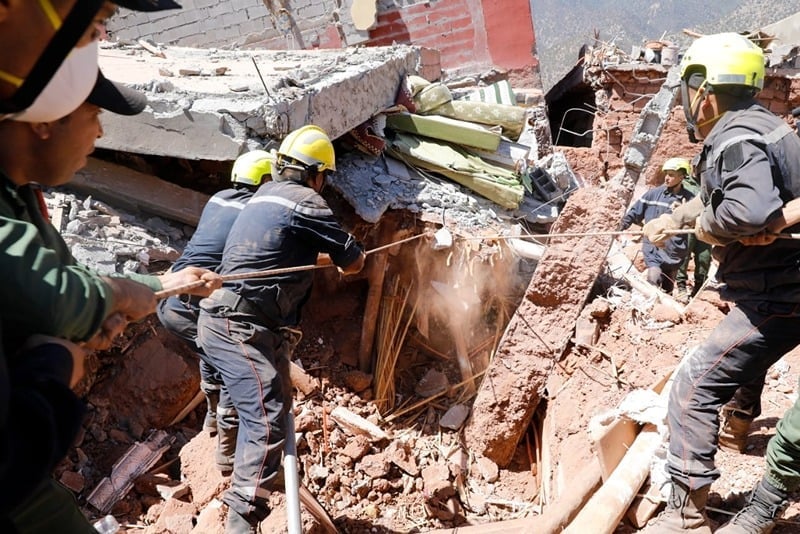
The “Unified Arab Economic Report” published by the Arab Monetary Fund (AMF) reveals the staggering repercussions of the Al Haouz earthquake on Moroccan industry.
The earthquake, considered to be the most powerful of the century in Morocco, disrupted the local economy, particularly in sectors directly linked to tourism, such as handicrafts and traditional trades, thus weakening national industrial competitiveness.
According to this report for the year 2024, the earthquake severely damaged historic and emblematic sites, particularly in Marrakech, a city where tourism is a major economic pillar. “The tourism industry is essential in Marrakech, where many residents depend on traditional crafts for their livelihoods”, the report states.
Craft production has been particularly hard hit, with falling tourist demand affecting sectors such as jewelry, pottery, textiles, carpets and copperware. These activities, with their high cultural value, are struggling to recover from the crisis.
In response to this disaster, the Arab Fund for Economic and Social Development, along with several other donors, granted emergency aid of 3 million Kuwaiti dinars (around 100 million Moroccan dirhams) in 2023 to support relief efforts.
The report highlights a deterioration in Morocco’s position in the Industrial Performance Competitiveness Index, from 64th to 66th place worldwide. In the Arab world, Morocco ranks 7th, behind the United Arab Emirates, Saudi Arabia and other Gulf economies, but ahead of countries such as Egypt and Algeria.
This index assesses the structure of production, the technologies used and the ability of economies to produce and export manufactured goods competitively.
In 2023, the added value of manufacturing industries in the Arab countries reached $393.3 billion, down 7.7% on 2022, the same source points out, noting that Morocco is among the best-performing economies in the region, with manufacturing industries contributing an estimated 11.6% to its GDP. The highest contributions were recorded in Syria, Bahrain and Jordan.
Also according to the FMA report, Morocco dominates Arab silver production, accounting for around 96% of the total, with output of 202.3 tonnes in 2023. In the gold sector, the country is also a key player, alongside Sudan, Egypt and Saudi Arabia. However, the Arab contribution to global production remains modest: 5.7% for gold and 2.2% for silver.
Despite its potential, the Arab manufacturing sector is struggling to fully realize its investment and employment opportunities. The report highlights shortcomings in terms of long-term vision, infrastructure and appropriate policies.
In response to these challenges, Morocco joined the Arab Industrial Integration Initiative in 2024, aimed at strengthening regional cooperation in strategic sectors. This partnership, initiated in 2022 by the United Arab Emirates, Egypt, Jordan and Bahrain, aims to stimulate growth in five priority areas: fertilizers, pharmaceuticals, textiles, metals and petrochemicals.
The “Unified Arab Economic Report” highlights the challenges and opportunities facing Morocco and the Arab region. Although the earthquake caused significant disruption, cooperation initiatives and long-term strategies offer encouraging prospects for strengthening the resilience and competitiveness of Moroccan industry, the report stresses.






add your comment
Terms of publication : Not to offend the writer, people, sacred things, or attack religions or the divine self, and refrain from racist incitement and insults.