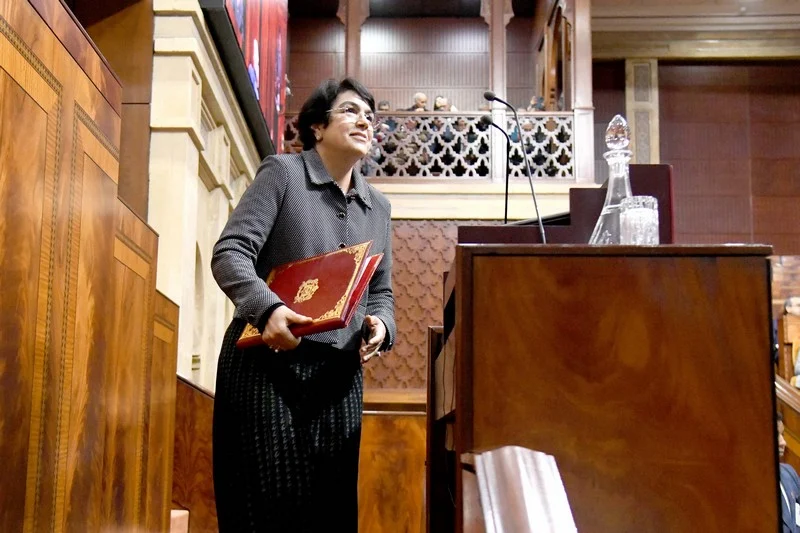
President of the Court of Auditors,Zineb El Adaoui called today for enhanced intersectoral cooperation, more efficient water use, and a stronger focus on non-conventional resources. during a speech before Parliament to present the Court’s 2023-2024 report.
El Adaoui emphasized the need to “sensitize businesses, households, and citizens to the critical importance of rationalizing water consumption,” urging for widespread communication on the issue.
El Adaoui also stressed the necessity of introducing “deterrent measures” against irresponsible water use, drawing from global best practices. She highlighted the role of renewable energy in optimizing water resources, particularly through “desalination technologies.”
In addition, she advocated for greater scientific research in the water sector, calling for closer collaboration with universities and research labs to address pressing environmental challenges related to water and soil.
Regarding irrigation, El Adaoui noted that while efforts to modernize irrigation systems have been significant, they have not stopped the growing demand for irrigation water.
“Despite considerable efforts to modernize collective irrigation networks and expand localized irrigation, we have not been able to curb the rising demand for irrigation water,” she said. By the end of 2023, only 50% of irrigated land was covered by localized systems, largely due to delays in equipping farms for this transition.
El Adaoui also lamented the underutilization of treated wastewater in agriculture, pointing out that around 37 million cubic meters of wastewater were available in 2023 but not fully exploited. This issue, she explained, is partly due to “the absence of clear standards defining the quality of treated wastewater for agricultural use.”
She also noted that “effective water management requires continued efforts to reduce distribution losses,” aiming to increase the national network efficiency from 77% to 80% by 2030.
Since the 1960s, Morocco has implemented proactive water policies, such as dam construction, to improve sustainability and meet environmental and economic challenges. El Adaoui reminded Parliament of the 2020-2027 National Drinking Water and Irrigation Supply Program, with a budget of 143 billion dirhams, which aims to secure water supplies for both drinking and agriculture.
El Adaoui concluded by stressing the importance of focusing dam projects in regions with high rainfall and accelerating the interconnection of hydraulic basins, describing it as a “novel solution to tackle water scarcity and reduce territorial inequalities” in water distribution.






add your comment
Terms of publication : Not to offend the writer, people, sacred things, or attack religions or the divine self, and refrain from racist incitement and insults.