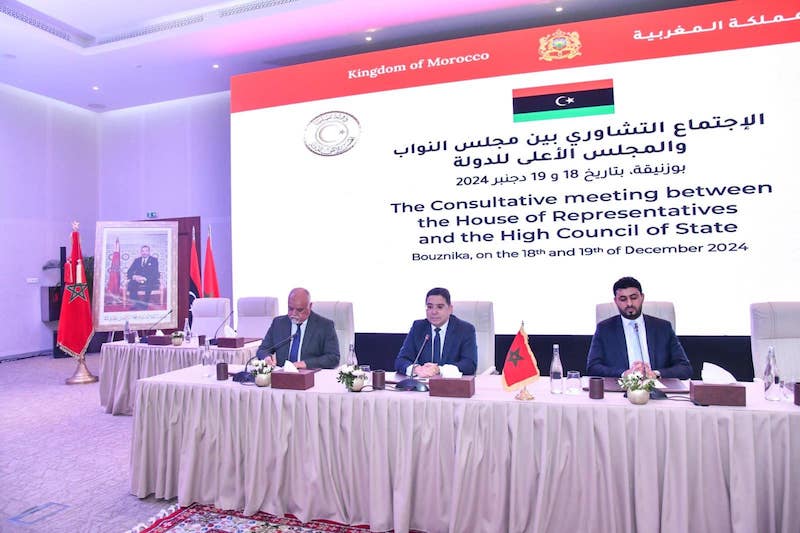
The delegations of the Libyan House of Representatives and the High Council of State in Libya discussed today in Bouznika the formation of joint committees between the two councils to address several political and security issues, according to a draft agreement expected to emerge from this meeting.
The talks, held in Bouznika, near the Moroccan capital Rabat, are a continuation of efforts to resolve the longstanding political divide between the two rival legislative bodies: the House of Representatives based in Benghazi in the east, and the High Council of State based in Tripoli in the west. These talks come amid a stalled political process that has seen years of institutional division, warfare, and unstable peace.
Moroccan Foreign Minister Nasser Bourita, speaking at the opening of the consultations, urged participants to work together to preserve Libya’s unity and prepare for “credible elections.”
He stressed that despite the numerous international and regional conferences on Libya, it is the inter-Libyan dialogue that holds the most credibility and ownership, and is essential for moving forward.
The draft agreement under discussion proposes several crucial reforms. It includes the formation of a joint working committee for local governance and transparency support, tasked with setting standards and mechanisms to ensure the fair distribution of development programs and budgets across localities. This initiative aims to achieve a balance between central allocations for strategic projects and local development, while also introducing measures to support transparency, decentralization, and the fight against corruption.
On the security front, the draft agreement also calls for the formation of a joint working committee focused on the security situation.
This committee will engage with the 5+5 Joint Military Commission to review its work, charters, and the challenges it faces. It will also coordinate with the commission to develop a plan to restore state control over borders, crossings, and ports—critical areas for Libya’s stability and sovereignty.
The draft includes the creation of a joint committee to oversee sovereign positions in Libya. This body will establish criteria for candidacy for these positions, create a joint mechanism for submitting candidacy requests, and set an election process that ensures consensus as stipulated in the 2015 Libyan Political Agreement (the Skhirat Agreement).
The agreement outlines the formation of another joint committee to monitor the issue of smuggled funds and money laundering, proposing new legislation and following up on its implementation.
The draft agreement, which is expected to undergo further amendments, also includes provisions for the President of the House of Representatives to communicate with the Central Bank of Libya, on an exceptional basis, to allocate the necessary funds for the implementation of the national population census project and the reorganization of the national identity number system.
If a consensus is reached, it is expected that Khaled al-Mishri, President of the High Council of State, and Aguila Saleh, Speaker of the House of Representatives, will travel to Morocco tomorrow to sign the agreement.

add your comment
Terms of publication : Not to offend the writer, people, sacred things, or attack religions or the divine self, and refrain from racist incitement and insults.