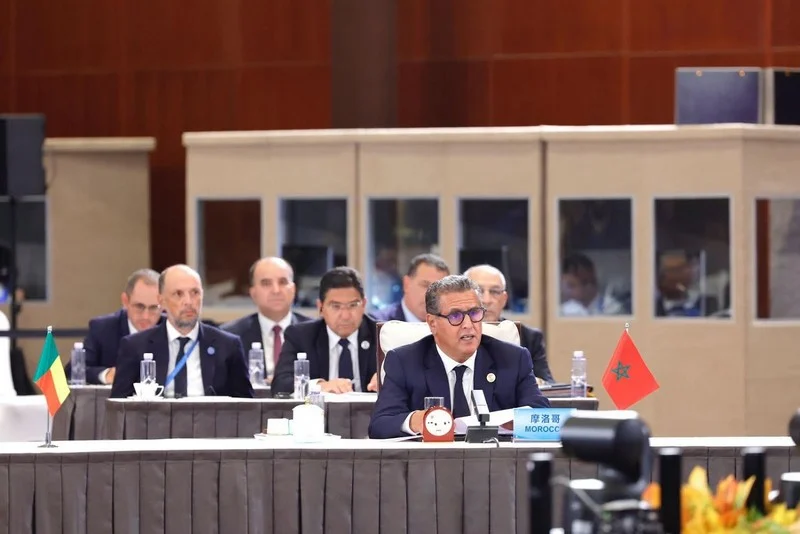
Morocco’s leadership in Africa’s development was highlighted at the Forum on China-Africa Cooperation (FOCAC) Summit in Beijing from September 4 to 6.
The Kingdom reaffirmed its dedication to working with China and Africa, advocating for pragmatic, solidarity-based cooperation within a win-win partnership.
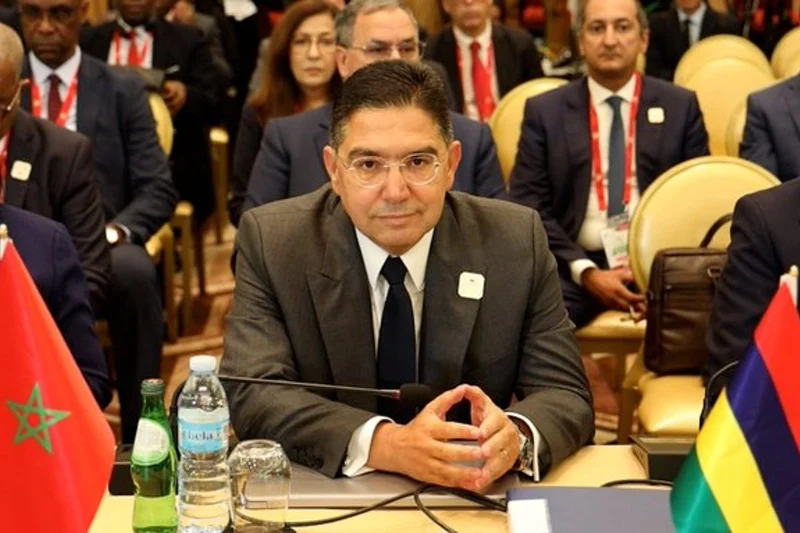
Morocco’s active participation in the summit’s preparations underscored its commitment to Africa, showcasing its achievements while countering Algerian efforts to disrupt the event.
Moroccan diplomacy successfully ensured that the Summit’s documents, such as the Beijing Declaration and the 2025-2027 Action Plan, clearly state that only African UN member states are part of FOCAC, debunking Algerian claims about the Polisario Front’s involvement.
It additionally underscored Morocco’s support for African nations in fighting terrorism, as evidenced by the Beijing Action Plan’s recognition of the Rabat Office of the United Nations Counter-Terrorism Program and Training for Africa.
Morocco’s prominent role in Africa is firmly established not only through FOCAC but also at recent summits, such as the inaugural Korea-Africa Summit in Seoul and the Indonesia-Africa Forum. Morocco’s diplomatic achievements have effectively isolated the Polisario Front internationally.
Despite Algeria’s substantial investments and political pressure, the Polisario Front has failed to gain recognition or participation in these key African and global partnerships.
The Forum on China-Africa Cooperation represents a vital partnership between China and the African continent, based on principles of solidarity, cooperation, and respect for sovereignty and territorial integrity.
President Xi Jinping has pledged China’s collaboration with Africa on ten partnership actions over the next three years, supported by a 360 billion yuan budget, according to Chinese media.
These actions will encompass mutual learning among civilizations, trade prosperity, industrial chain cooperation, connectivity, development cooperation, health, agriculture and livelihoods, people-to-people and cultural exchanges, green development, and common security.
The Chinese president proposed elevating the description of China-Africa relations to an all-weather China-Africa community with a shared future for the new era.
He also called for upgrading bilateral relations between China and all African countries with diplomatic ties to the level of strategic relations.
Xi announced that China will unilaterally open its market wider and grant zero-tariff treatment to all least developed countries with diplomatic relations with China, including 33 in Africa.
This move aims to turn China’s large market into a significant opportunity for Africa. China will also expand market access for African agricultural products, enhance e-commerce cooperation, and launch a China-Africa Quality Enhancement Program.
The President stated that China is ready to establish framework agreements with African countries to ensure long-term stability in trade and investment.
China will also advance the Pilot Zone for In-depth China-Africa Economic and Trade Cooperation, support African SMEs with an empowerment program, and jointly build a China-Africa digital technology cooperation center with 20 digital demonstration projects to foster technological and industrial advancement.
Xi also revealed that his country will undertake 30 infrastructure projects in Africa and advance high-quality Belt and Road cooperation.
For development, the republic will release a joint statement with Africa on the Global Development Initiative and implement 1,000 “small and beautiful” livelihood projects.
In health, China plans to establish with Africa a hospital alliance and joint medical centers and launch 20 health programs.
For agriculture, the country will provide 1 billion yuan (about $140 million) in emergency food aid, send 500 agricultural experts, and establish a China-Africa agricultural science and technology alliance.
The Republic also aims to boost two-way investment between Chinese and African companies, create at least 1 million jobs in Africa, and enable Africa to retain added value.
For people-to-people exchanges, China will establish an engineering technology academy, build 10 Luban Workshops, and offer 60,000 training opportunities, focusing on women and youth.
In green development, the country will launch 30 clean energy projects, establish 30 joint laboratories, and collaborate on space exploration.
For security, China will build a partnership under the Global Security Initiative and provide 1 billion yuan in military assistance.
In recent years, China has heavily invested in Africa, deploying thousands of workers and engineers to construct major infrastructure projects.
In exchange, China has gained privileged access to Africa’s natural resources, such as copper, gold, and lithium.
Chinese state loans have funded crucial railways, ports, and roads, enhancing China’s influence on the continent.
As the world’s second-largest economy, China has become Africa’s largest trading partner. Bilateral trade reached $167.8 billion (151.8 billion euros) in the first half of 2024, underscoring the significance of this partnership.







add your comment
Terms of publication : Not to offend the writer, people, sacred things, or attack religions or the divine self, and refrain from racist incitement and insults.