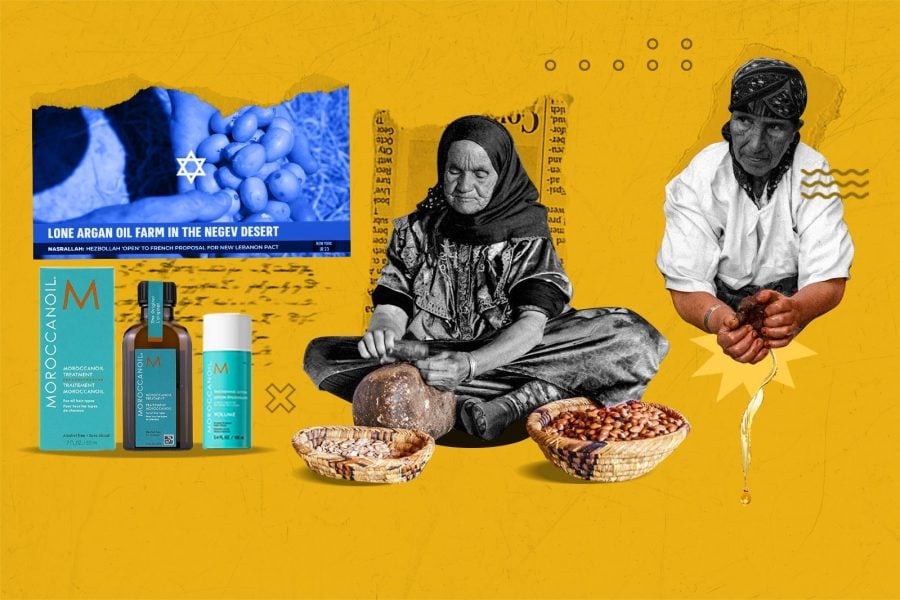
When Carmen Tal walked into a Tel Aviv hair salon in the early 2000s, her damaged, frizzy hair met its savior in golden-hued, lightly textured oil. She immediately knew it was a game changer.
Within weeks, Tal came back to ask for the oil’s name and ultimately turned it into a million-dollar business. That oil? Morocco’s Argan.
While MoroccanOil’s marketing materials don’t explicitly mention an Israeli source for its Argan oil, the ethical concerns surrounding the brand lie more with its use of the “Morocco” name than the Argan oil itself—a strategy that has shielded the product from boycotts directed at Israeli companies.
Consumers, including those in Morocco, were surprised to learn the brand’s origin due to its name, “MoroccanOil,” and the company never highlighted Morocco: Why it chose the name, the country’s role in its production process, nor it is the original source for its raw star ingredient, argan oil.
CNN visited the brand’s manufacturing plant in Israel, located in a nondescript warehouse “two hours north of Jerusalem,” where MoroccanOil manufactures 80% of its product, with an output of 150,000 bottles a day, sold in over 40 countries worldwide.
And the appropriation of Morocco’s Argan tree – a historic and solid national beacon of small, female-led slow social mobility hallmarks – extends beyond the brand name, to the cultivation of the tree in the Negev desert.

The Argan tree, scientifically known as the Sideroxylon Spinosum, requires a particularly harsh environment. It can survive extreme heat of over 50° celsius, withstanding drought and flourishing despite poor soil. In other words, southwestern Morocco makes for the perfect argan breeding ground.
But for the last 30 years ago, Israeli scientists and agriculture professionals gathered Argan seeds and experimented with growing them in the desert.
Today, estimates suggest that Israel has about 20,000 argan trees, each producing nearly 100 kg of fruit, which amounts to approximately two liters of oil.
And they wish to take it further: now aiming to make an argan tree “super strain.”
These “super trees” were propagated in Israel through inter-pollination to produce a hybrid strain resistant to soil diseases and producing more fruit, propelling Israel to a proper industrial scale with its Argan production. Scientific studies have yet to compare both Argan seeds and their oils.
“We planted 1,000 wild trees, got 20 or so very good ones for this area, narrowed them down to seven or eight and we’re cloning them,” explains pioneer American-Israeli scientist Elaine Solowey to The Times of Israel.

“Samples have been passed onto the Hebrew University’s Faculty of Agriculture for further development,” as the state looks towards offering the tree to Kibbutz in the arid south. She believes that the trees could grow as far north as the Galilee region of Israel.
Solowey, who worked on argan tree cultivation since the 80s, worked at the National School of Agriculture in Meknes, Morocco.
The Solowey profile piece with The Times Of Israel claims “the first batch of seeds came from the late King Hassan II himself.”
The uprooting of the argan tree in Morocco, if not carefully managed, could critically impact its role in economically empowering rural Amazigh women, who have preserved three through artisanal and ancestral traditions for centuries.
More importantly, in regions where locals have little to no economic opportunities outside of male-dominated agricultural activities, the Argan tree presented yet another offering to rural families, spearheaded by their women, who organized in cooperatives to grow, extract and commercialize Argan oil.
The local women knew of the oil’s countless cosmetic benefits, which had been passed down from mother to daughter for centuries. These benefits included their skin, gut, nails, and hair.

The “industry” remained small and local, female-led and artisanal, respecting the soil and agricultural harvesting seasons, while simultaneously providing income for rural women who wouldn’t have had such professional opportunities without the tree’s bearings and their sisters’ demand for the Moroccan beauty essential.
Since 2014, the argan tree has been included on UNESCO’s list of Intangible Cultural Heritage of Humanity, for its peculiar and demanding nature, as well as its ample benefits.

Meanwhile, in Israel, Carmen Tal has expanded her brand to include a range of different products, namely numerous complete hair care lines, body care products, and pharmaceutical hygiene products.
Celebrities rave about the “miracle product,” this year’s official Eurovision presenting partner. The company boasts USD 60.6 million in revenue and employs over 500 people.
The “Morocco” brand appropriation goes beyond argan oil for Founder Tal, who ventured into another business under the MoroccanOil Ltd: Brumes du Maroc.
In an interview with Harper’s Bazaar for the fragrance line launch, Tal spoke of the new products, saying they are inspired by “the Mediterranean,” without mentioning the country it’s named after.
–
Edited by Amira El Masaiti







What I would like to know is: What does this great success of argan in Morocco/Israel/the world mean for the average Amazigh woman who saved this tree for all of us??? Simply out of curosity!!!!!!